

How to Visualize Capitalism (Part 2)
Adding in money, finance and power

This piece is exclusive to paying subscribers. I hope you enjoy it!
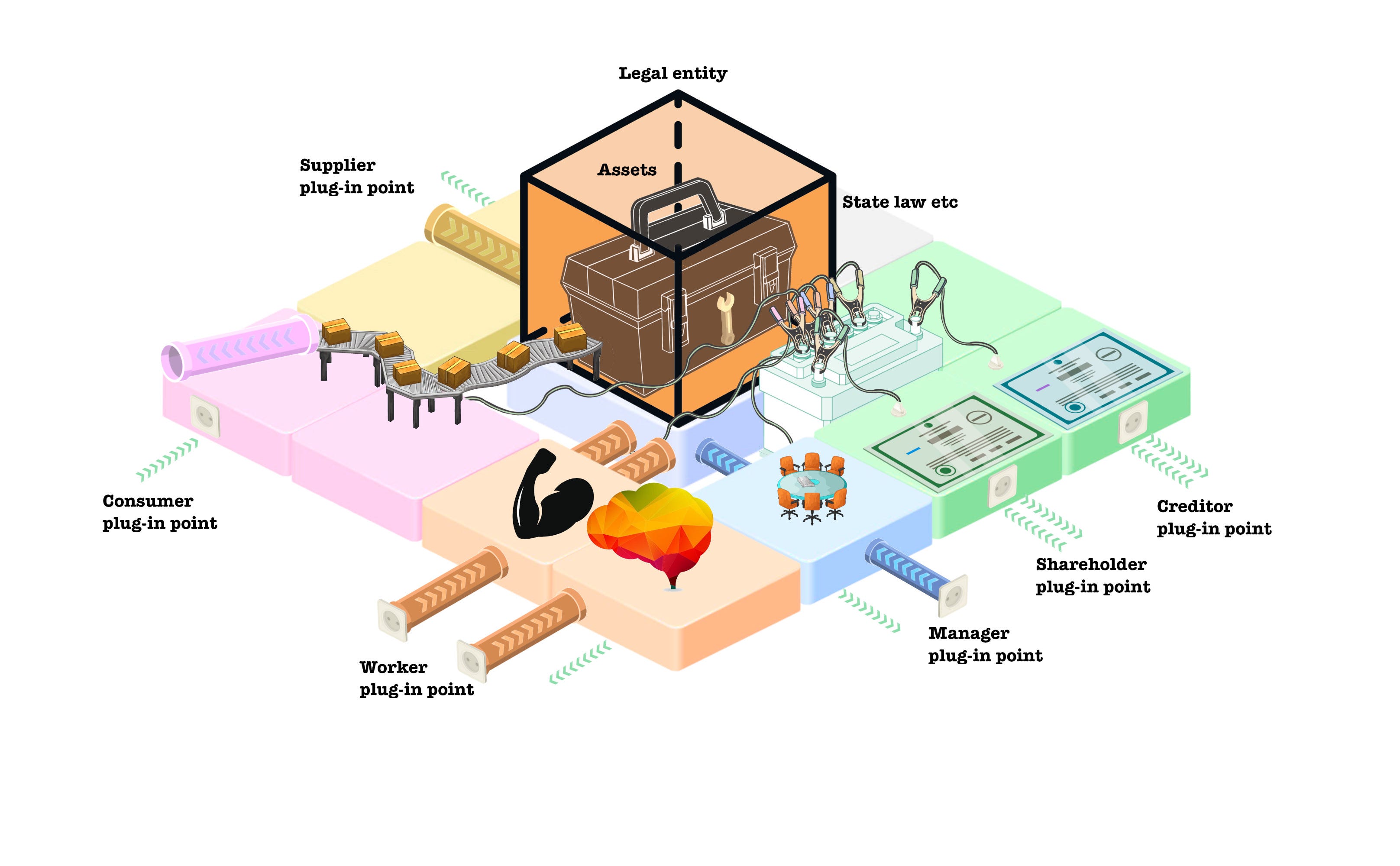
In Part 1 of How to Visualize Capitalism, I set out to map the relations of production in a capitalist system, the way the different pieces of our economic puzzle interact to create the full picture. To do this, I started by mapping the components of a single corporation and fitting them together as below (this image is a slicker version of my older Lego models of capitalism).
I then showed chains of these interlocking firms, before pulling them apart into their constituent components, and then re-organising those components into a single ‘macro-economic’ picture of capitalism as a whole. This is what would happen if you took every enterprise in the world, and merged them into a single ‘meta-enterprise’.
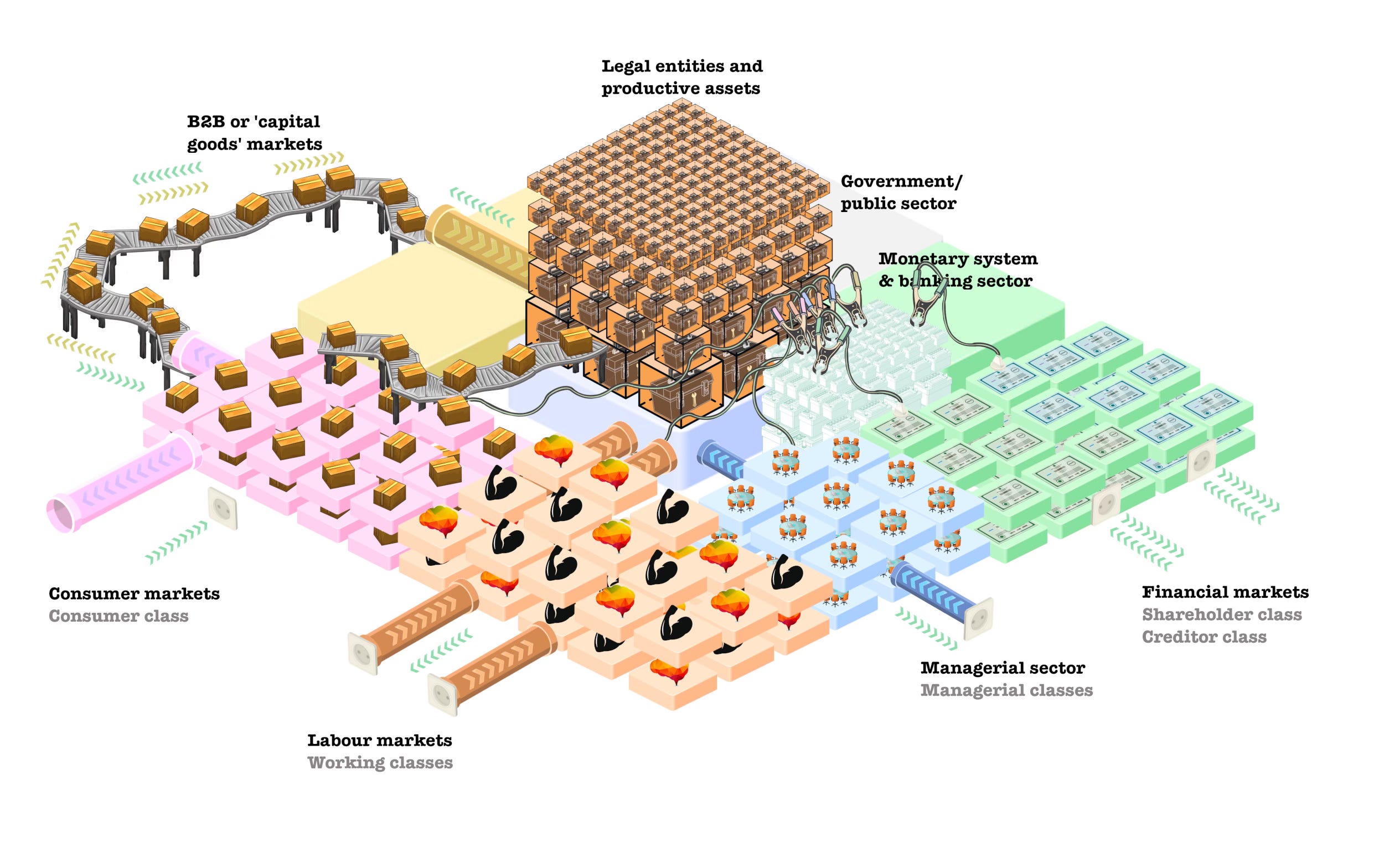
This macro-economic image shows how the different sectors and classes in our system interact, but still misses out various crucial things.
For example, I’ve glossed over the state, which in our image is tucked away in the back, acting as a foundation
I’ve also glossed over the ecological foundation, all the natural systems that lie below our society, forming the substrate upon which we survive.
I’ve also missed out all the hidden ‘non-market’ layers of human society - all the unpaid care, gift economy systems, informal reciprocity and reproduction that we depend upon, but which are largely taken for granted and ignored in a capitalist system (for more on that, check out my Econ Life 101 course, exclusive to paying subscribers).
For today, though, I’d like to focus in on another major missing piece of the picture, which is the monetary system. So let’s pick up from where we left off in Part 1, and add three final sections.
In Section 8, I’ll visualize money issuers versus money users
In Section 9, I’ll visualize the financial sector
In Section 10, I’ll combine all the visualizations into a big picture of capitalism within the monetary system
8: Banks, central banks and society
Before starting on this section, I’d like to note that I’ve written a lot about money and finance before on ASOMOCO, and it’s a more complex topic that requires some experience before you get comfortable with it. So, my primary purpose here is not to explain every aspect of money and finance in detail, but rather to introduce a new body of visualizations that can complement my pre-existing articles, which I will point to as we go along.
So, let’s start with the banking sector.
In Part 1, we started by picturing each firm, corporation and individual with their own bank account - represented as a battery - before creating the macro-economic image of capitalism above, in which all those bank accounts (‘batteries’) are placed into a single conglomeration as follows.
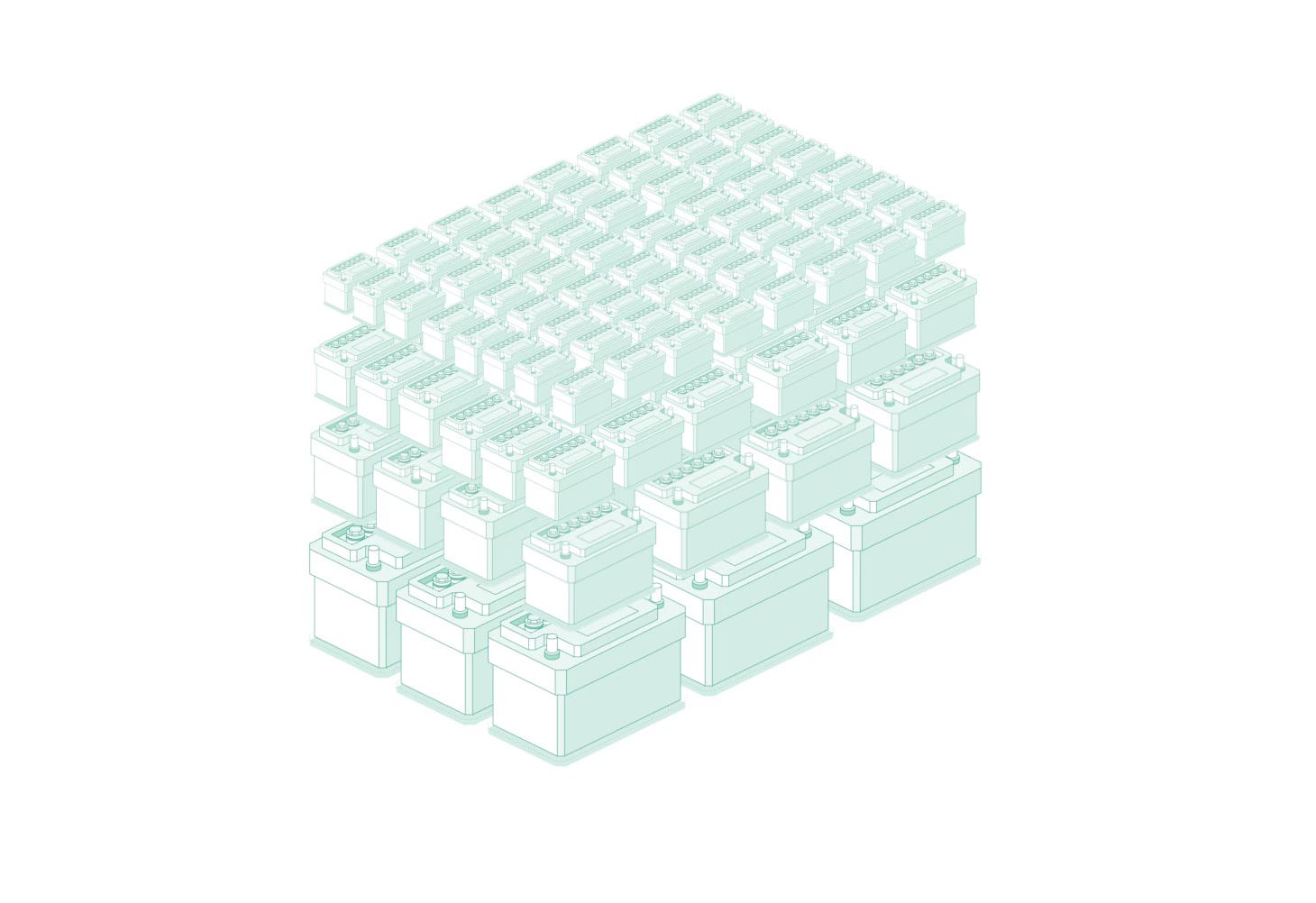
This conglomeration of bank accounts is hosted by the banking sector.
Every time you tap your contactless card on a payment terminal, for example, you are simply contacting your bank, asking them to edit an account that they host. Similarly, every time a firm makes a payment to a supplier, or pays an employee, they are contacting their bank, asking that bank to transfer money from the firm’s ‘battery’ into the ‘battery’ of another player, which will also be hosted in the banking sector. The entire digital monetary system takes place within the datacentres of the banking sector.
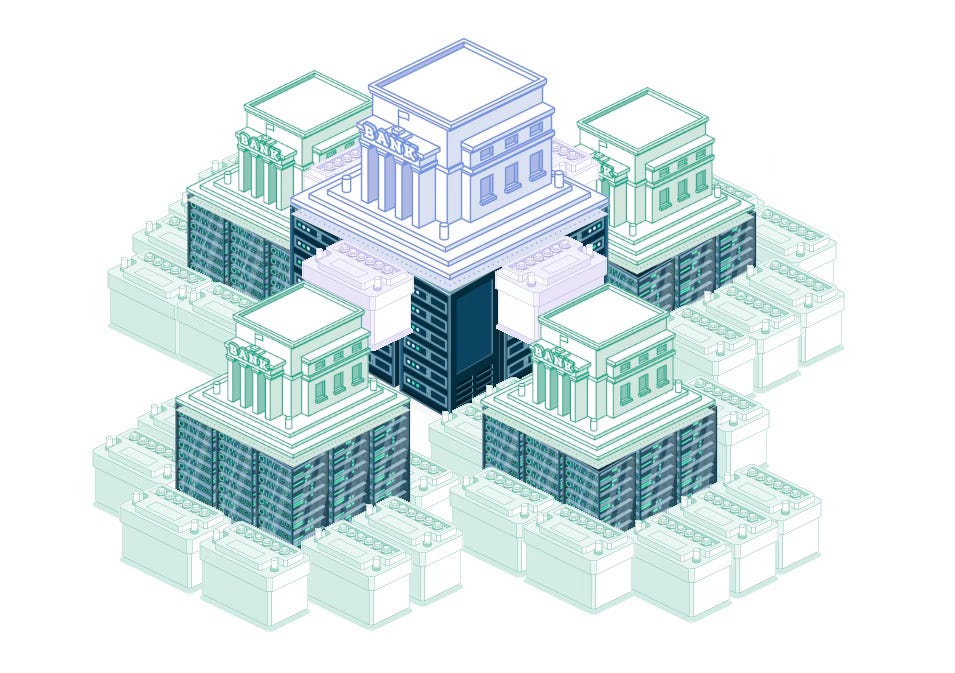
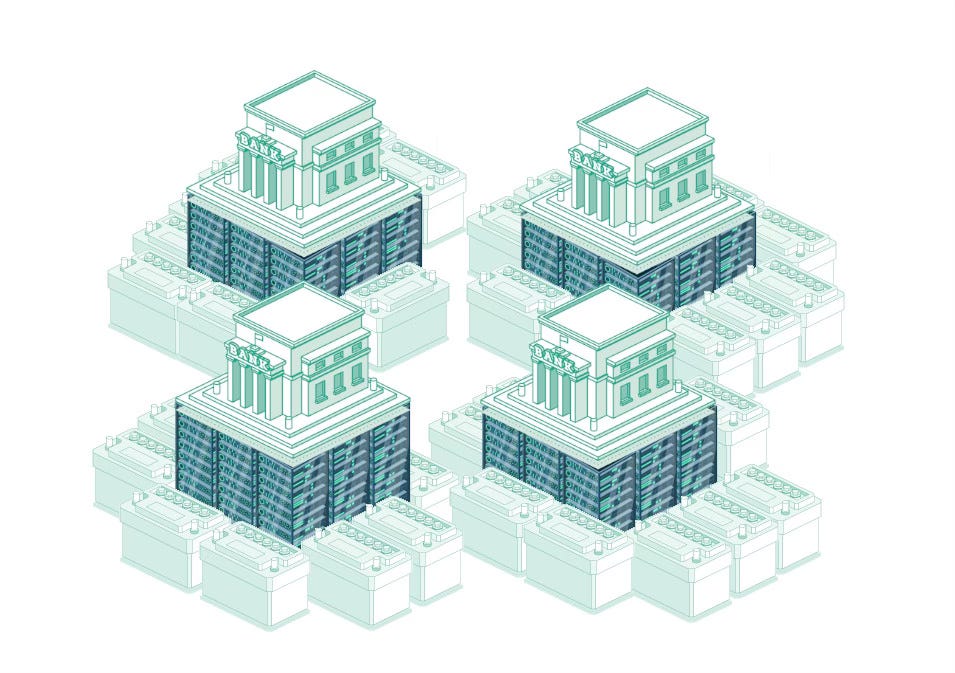
To visualise this, I’m going to take that conglomeration of bank accounts, and cluster them around the datacentres presided over by individual banks that host them. In the image below I show each bank hosting a handful of these accounts of equal size, but an actual bank can host millions of accounts of vastly different sizes. We can then imagine individuals and firms approaching these banks, asking them to set up accounts, or to edit them.
These commercial banks in turn all have special accounts at a central bank that they cluster around. I’m going to represent the central bank, and the accounts it presides over, in purple.
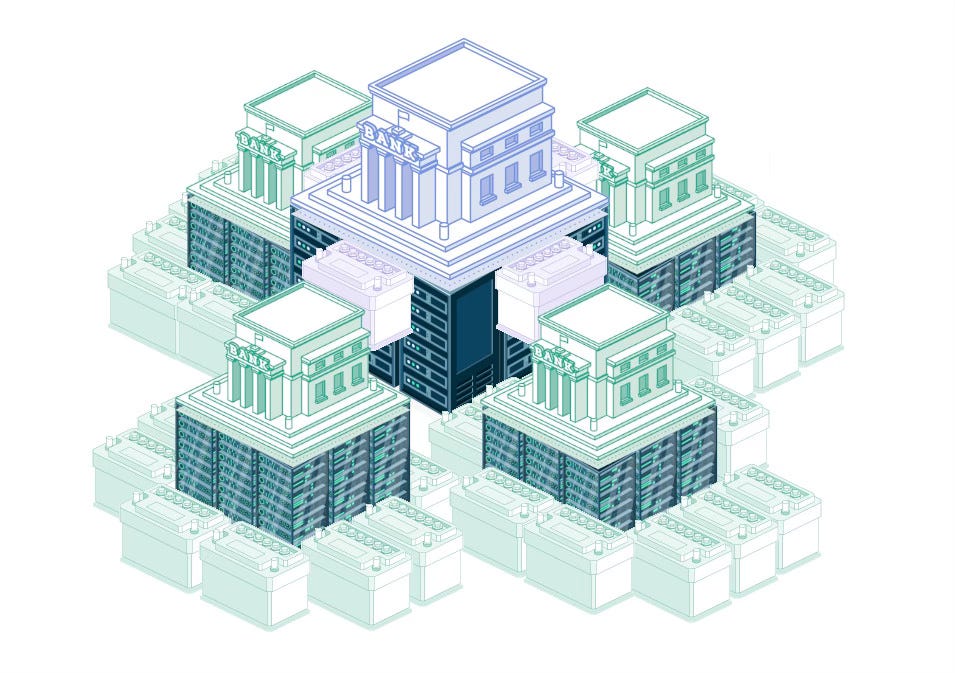
What I’m showing here are not only two layers of different types of accounts, but two layers of digital money, issued by two layers of money issuers. Let’s explore that before mapping it onto society more broadly