

The Craft of Capitalism
How gentrification sands away the rough beauty of Berlin

Paying subscribers can listen to the ASOMOCO Audio essay here!
For a four minute preview of the audio, click here
My friend Pod moved to Berlin in the late 1980s, before the fall of the Wall. In the years that followed, he explored its streets discovering pockets of counterculture in the post-reunification city. In the early nineties, Berlin was wide open with abandoned plots and disused warehouses. These were the perfect nesting grounds for new flocks of artists, musicians, and scraggly adventurers looking to build a creative life amidst the rubble.
One such nest was the old Haus der Technik in the Mitte district. It was the former showrooms of the German appliance giant AEG, originally connected into an adjacent shopping arcade. During the Nazi era it was used by the SS, but in the post-war period found itself within East Berlin, where it became a department store. Over the years it hosted radio manufacturers, colleges, a cinema and the army, but fell into disrepair amidst heavy use. So, in 1980 the battered building was partly demolished, in preparation for a full demolition scheduled for 1990.
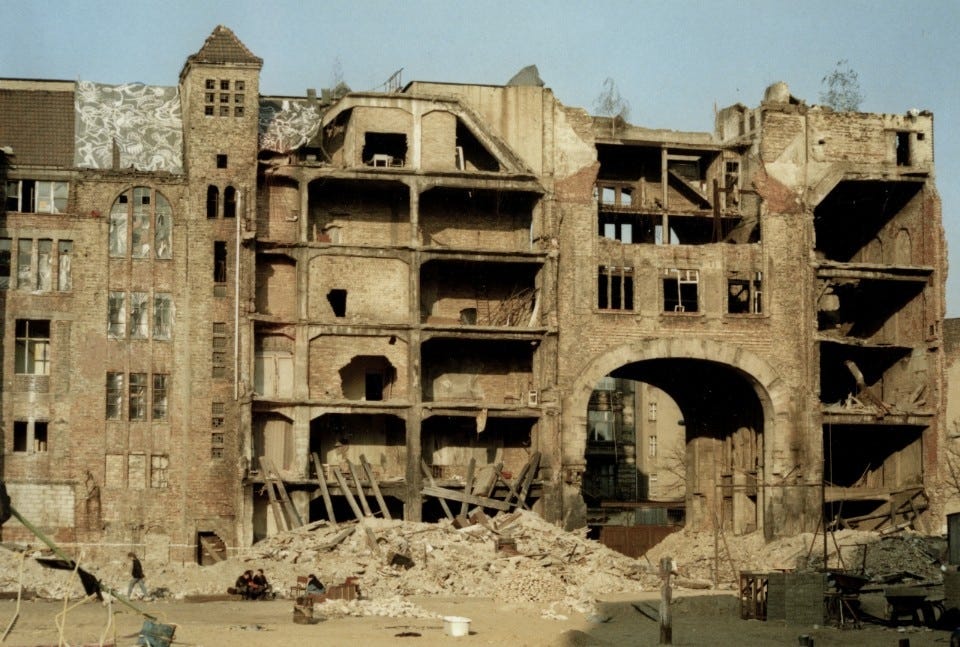
The subcultures of post-Wall Berlin, though, staged an intervention before the final demolition could take place. In February 1990 a group of artists occupied it to save it. They argued that the building was a historical monument. They won, and over the next few years transformed the lifeless shell into a vibrant arts centre full of studios and spaces for concerts. They called it ‘Tacheles’, a Yiddish-derived German word that loosely translates into ‘speaking plainly’ (or ‘no beating around the bush’).
Young people like Pod arrived, and collectively they helped to transform the wrecked site into a playground of sculpture, electronic music, and experimental architecture. It became an iconic symbol of anarchic open culture, weirdness and free expression. It was initiatives like this that established Berlin’s ‘poor but sexy’ reputation.
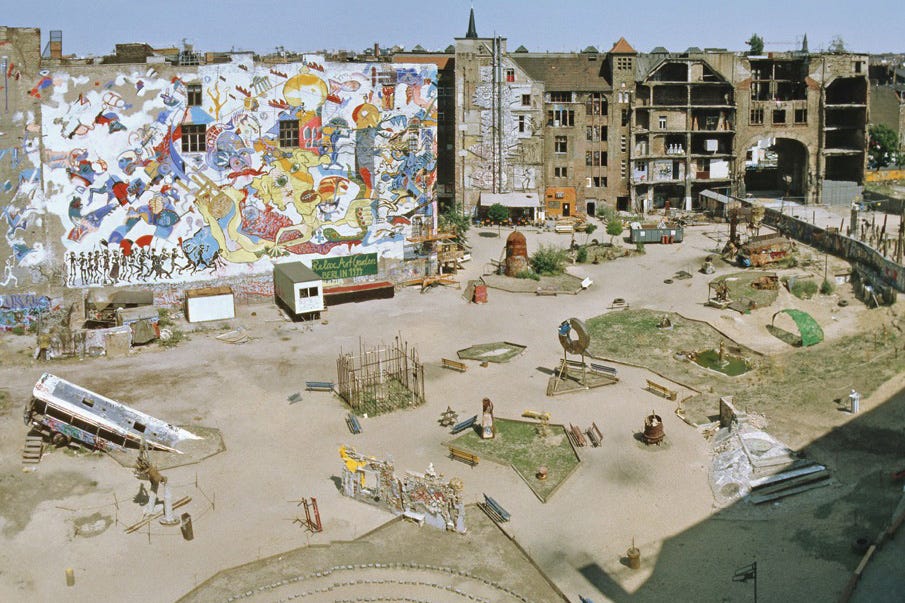
In many ways, the spirit of nineties Berlin thrived in the vacuum formed between a retreating state and a reluctant capitalist class. The state wasn’t prepared to maintain its properties, but capitalists weren’t ready to commercialise them either until the situation became more profitable. This was a moment in which real estate stood unclaimed by the powerful, giving space for small and youthful collectives to do relatively ‘non-economic’ stuff.
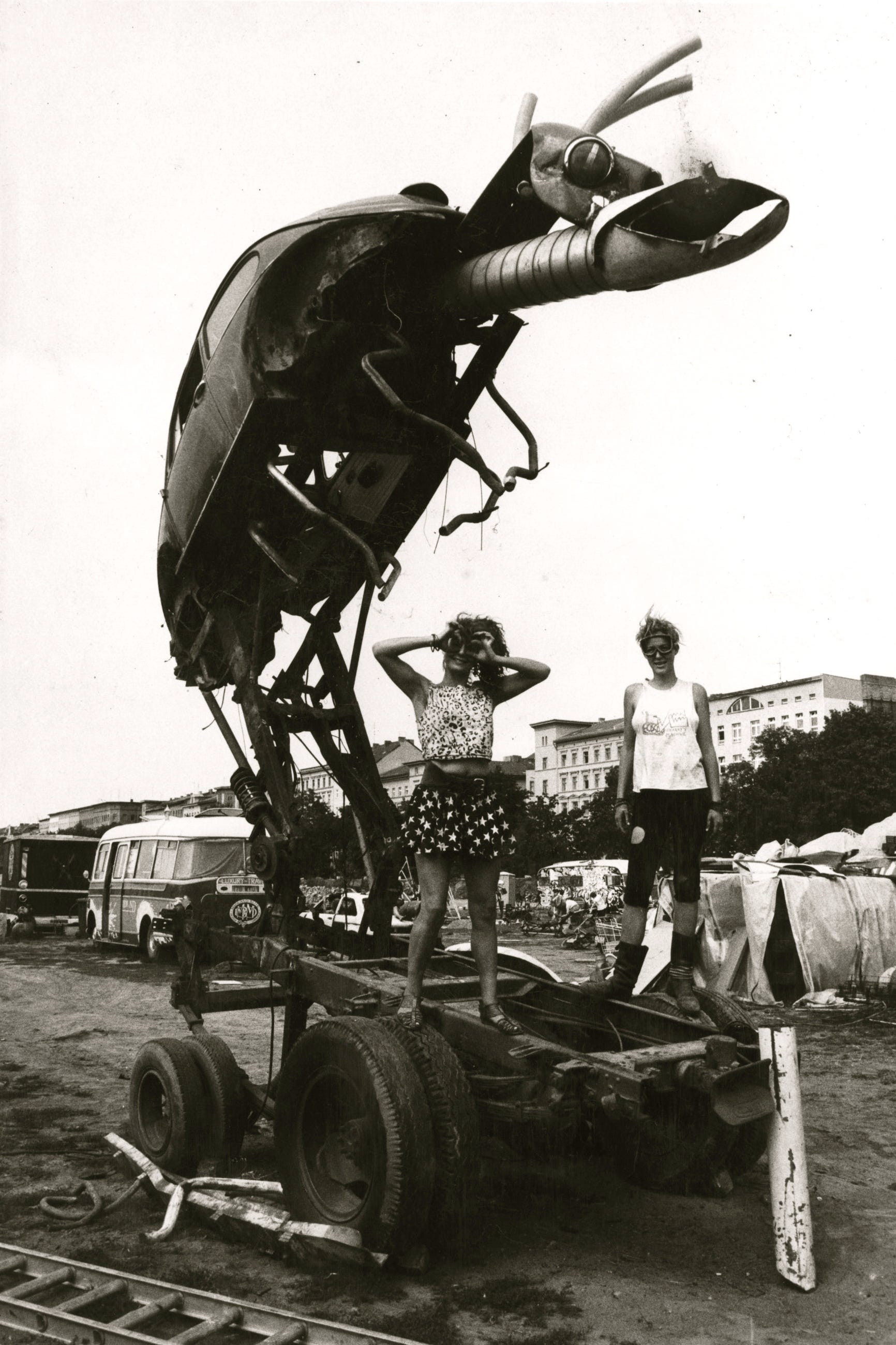
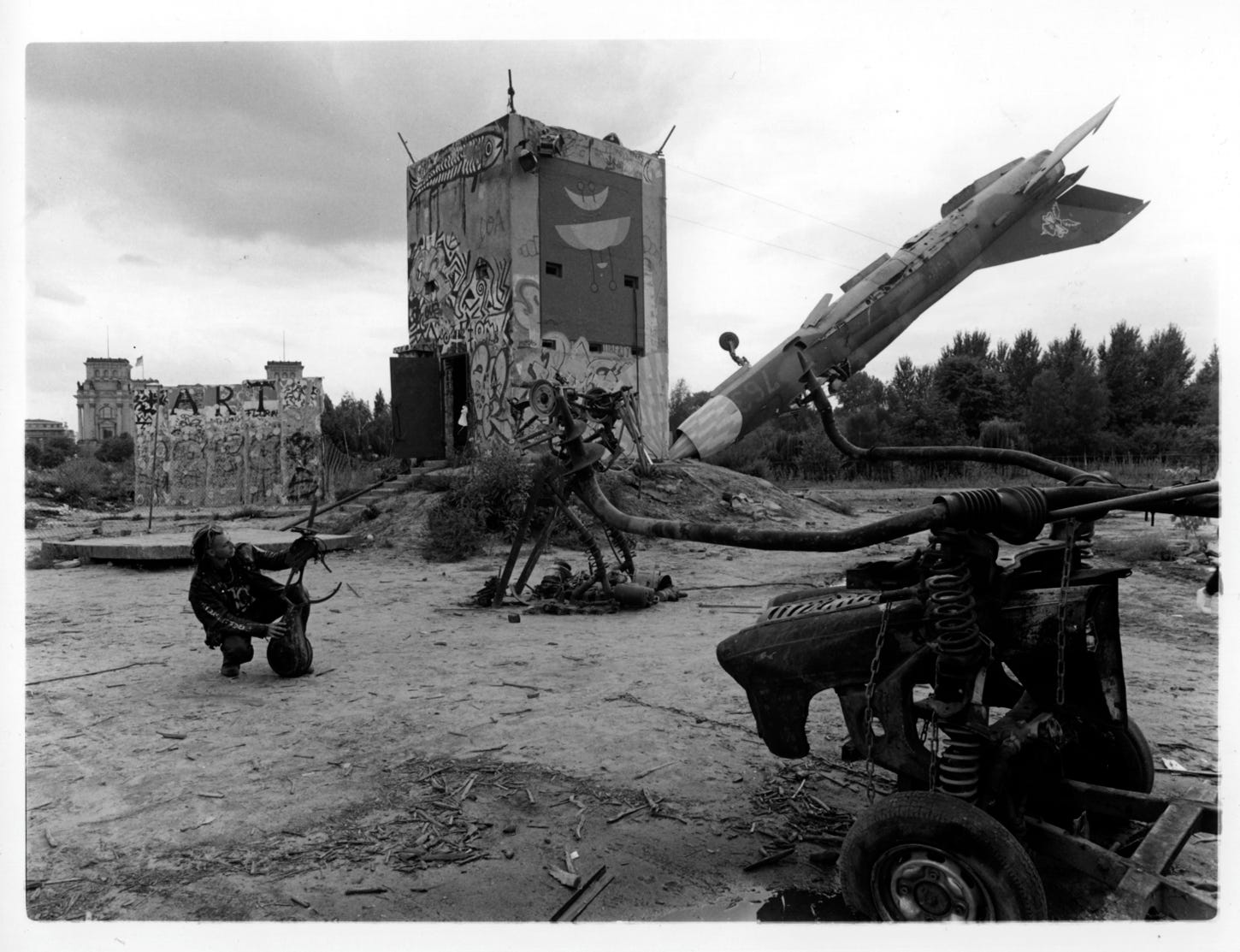
It was, in a sense, a tribal time, in which clans of DJs, metalworkers, hackers and craftspeople could create little outposts of subsistence in the city jungle, under the constant shadow of the private property rights that could be wielded by the rich at any point to push them out.
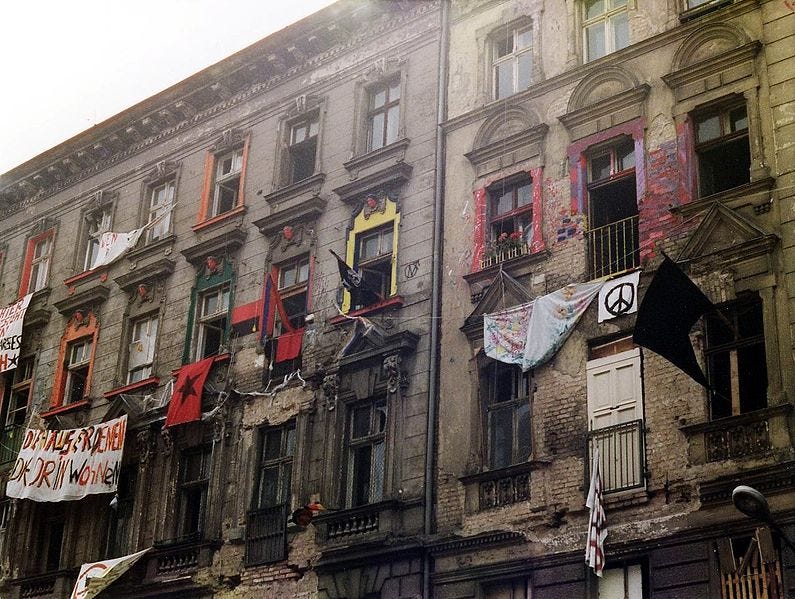
In 2011, though, the hammer fell on the inhabitants of Tacheles. The bank that had come to own the property sent in the bailiffs to evict the artists, and by 2012 it was again a lifeless shell, ready for redevelopment.
It wasn’t the only victim. The whole of Mitte was going through this process. The profit-calculations of property speculators were, by the 2010s, starting to transform the old industrial working-class neighbourhood into a space for bouji galleries, laptop-and-latte cafés, offices and high-end chain stores. Capitalism was spreading.
What do I mean, though, when I say that?
***
Within mainstream economics and politics, ‘capitalism’ is often spoken of as if it were simply the presence of markets, but markets long precede capitalism. Markets are social spaces where people engage in tit-for-tat reciprocal exchange - I’ll do X if you do Y - but this mode of behaviour was traditionally mixed with many other modes. When you encounter a vibrant street market in the Peruvian Andes, full of local villagers selling roots and herbs, it does not scream ‘CAPITALISM!’ at you, whereas a mall full of mass-produced corporate products really does.
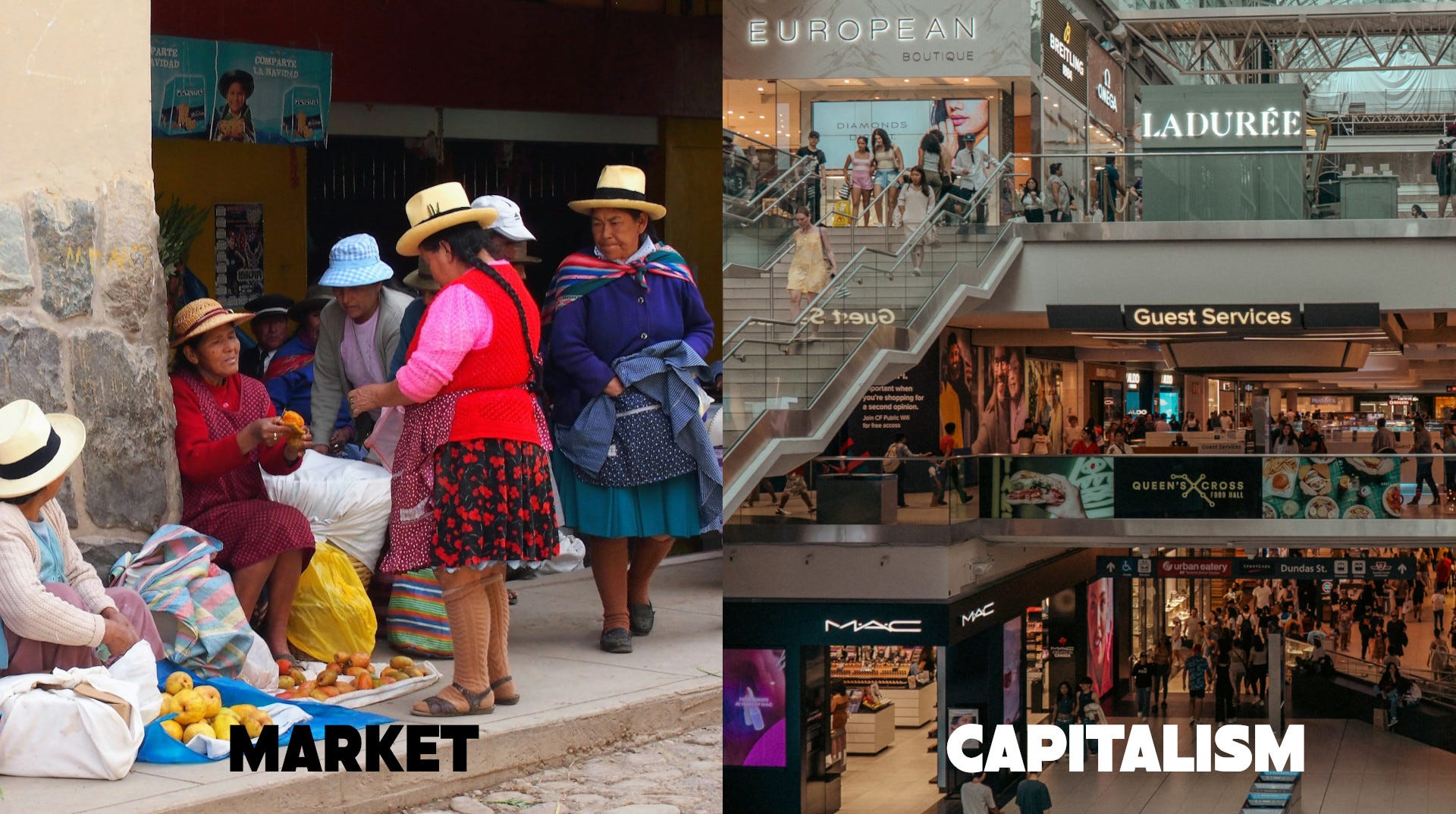
The reason for this is that old traditional markets are rife with all sorts of ‘non-commercial’ logics, with people hanging out or lingering in each other’s stalls to catch up on gossip, and young people flirting, and old men playing chess on the side ranting about politics. These are holistic, integrated spaces, where the ‘economic’, ‘social’, ‘cultural’, and ‘political’ realm are all entangled, rather than siloed off from each other.
Moreover, the type of community who uses an old-school market is also woven together with forms of informal reciprocity. This is a term we use in anthropology to talk about webs of obligations that play out over time. Rather than ‘I’ll do X now if you do Y now’, informal reciprocity is more like “I’ll sort of do something a bit like X in a year’s time if you maybe kinda do Y in a couple weeks”. Informal reciprocity is a style of exchange, but it’s implicit rather than explicit, unmeasured rather than measured, and unenforced and deferred rather than immediate. This means it feels very different to ‘cold’ formal exchange. It’s the kind of thing we associate with community.
Finally, the oldest markets historically formed around the edges of society, rather than forming the centre. For example, feudal society had market towns, but the central defining logic of the overall economy was based on agricultural land. Similarly, ancient tribal societies could certainly engage in trade, but that was often peripheral to their clan systems, kinship structures and traditional pastoralism or horticulture.
The nomadic Kalbelia people in Rajasthan, for example, would gather each year for a multi-day dance festival in which marriages were sparked and news shared. Little commercial operations, such as food stalls, would spring up around the periphery of that event. That peripheral market, though, feels very different to a modern corporate festival, in which the point of the dancing is to sell entrance tickets and concessions. Capitalism always contains a tendency towards an inversion, in which the market ceases to serve other social activity, and, instead, the other social activity is re-purposed to serve the market. This is what people mean when they say something feels ‘commercialized’.
During the ‘tribal’ period of 1990s Berlin, then, the underground punk venue would certainly sell things - the broke-ass attendees could buy a beer - but that wasn’t the central purpose. The central purpose was punk, and the market was secondary. This is what made that punk feel authentic.
To picture this in nineties Berlin, imagine a fridge in a squat, stocked with beers and a little donation box on the side. You can open the fridge and take a beer, and pay later if you want. There’s no explicit ‘if X then Y’ condition. It’s just run on trust, and a sense of community reciprocity and responsibility over time. There’s no attempt at accumulation and no surge pricing to extract the maximum possible profit in any given situation. The ethos is one in which the provider of beer is simply attempting to break even, in order to keep some kind of balance in the social web.
Capitalism, by contrast, is a state of being in which breaking even is seen, ultimately, as a failure. It is a system in which everything above the break-even point - profit - is elevated in an attempt to accumulate power in the social web. It often does take place within the market, but the ultimate end goal would not be to maintain a web of egalitarian reciprocity. No, it would be to transform the Peruvian street market into a space dominated by oligarchs who have capitalized on their existing advantage to secure more. That’s what a mall is.
A society starts to feel very ‘capitalistic’ when its resources begin to concentrate into these large nodes of power, and when a class of people who own this concentration of assets start to become gatekeepers to the survival of others. Those others must prostrate themselves asking for jobs - the right to operate the owned assets - so that they can get money to buy the things outputted by those very same assets.
People continue to maintain community, but the social web starts to feel like it contains a constant underlying struggle. They find themselves under pressure to compete, and to do this will increasingly strip non-commercial ethics out of the old market. This hollows it out and leaves it with a ‘pure’ market logic siloed away from other logics, which increasingly get cast as inefficient pollutants. As this is amplified, pure market logic becomes the central driving force in a society, and the end justification for all other activity.
So, that’s what I mean when I say ‘capitalism was spreading’ in Mitte. The old Berlin punk bar would only make money to continue in its mission to elevate the punk, but a capitalist chain bar for tourists would only serve up an image of punk to continue in its mission to elevate the profit. This is why the latter feels inauthentic.
***
I originally met Pod in Mitte in 2016. It was my first time visiting the city - I was living in London at the time - and had been told about a ‘stammtisch’, a weekly gathering of old-school hackers who would congregate at a bar called Café Buchhandlung in Oranienstrasse.
Coming from London, the whole of Berlin seemed far grittier and less gentrified than the British capital. People like Pod, though, who’d lived here through the ‘Post-Wende’ period when the Wall fell, were far more attuned to the changes that had already taken place. I, for example, had never experienced Tacheles, which had been shut down only a few years earlier.
Pod was spinning vinyls there as the regulars to the stammtisch gathered. Some, like Lo, worked on anti-surveillance tools, such as mix-net browsers, while others like Adam worked on community versions of the Internet, such as Freifunk, to fight back against Big Tech. They’d smoke and drink and debate as the bartender Topsy would serve the gathered activists, who’d all pay in cash for beer that - by London standards - seemed incredibly cheap.
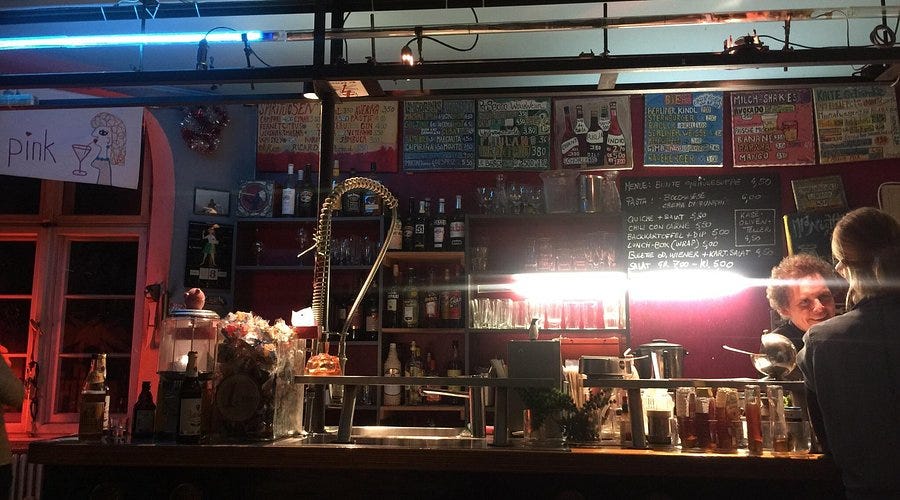
At that time, I still didn’t have my Berlin eyes properly calibrated, and didn’t fully realise that Buchhandlung, with its speak-easy spirit, stood as a hold-out in one of the fastest gentrifying parts of the city. Mitte was increasingly sanitised, its wide streets becoming like veins for privatised neoliberalism. Its composition was changing. The area was beginning to feel sterile and commercial.
‘Sterile’ is a word that accompanies the spread of modern corporate capitalism, precisely because of that process in which the rough edges of older, more informal markets are sanded away. In the midst of an accelerating capitalist economy, people operating according to its logic feel compelled to remove friction or ‘inefficiency’, but in doing so begin to scour away all the texture that gives a neighbourhood its soul. Inefficient snags are the very thing around which community collects, which is why efficiency can create malls but not community.
What we call gentrification is often just that commercialisation creeping into an area while dressed up in t he counter-cultural colours of those snags. Gentrification appropriates the aesthetics of punk, anarchism, village life or immigrant culture, and uses it as a marketing tool while stripping away the substance of that culture. This is a version of the aforementioned hollowing-out process. It’s like cutting away the roots of a bonsai, while preserving the branches in resin. The organic basis of the culture dies, while the appearance remains.
The end result of a gentrification is an area that feels like a museum of itself. Your eyes catch glimpses of things that still look edgy, exotic or alternative, and yet your body does not feel it, because all those little cues that would be present in an authentic and alive space are missing. The honesty box by the beer fridge is gone. In its place is a Square terminal for cashless payments, plugging into the banking sector via Visa and Mastercard.
When I arrived at Café Buchandlung in 2016, though, anarchic hacker culture still held a flame in Mitte. Everyone at the stammtisch used Signal rather than Whatsapp, even as Big Tech tried to cloak itself in the aesthetics of hackerdom to gentrify the rebellious spirit of that culture and hire away its activists. Perhaps the most sneaky Trojan Horse working its way in, though, was the crypto world. Crypto bros were starting to turn up at the drinks, looking like hackers but thinking like capitalists. They were in the process of doing that classic inversion, the one in which profit-seeking is moved from the periphery of a culture into its centre.
Over the last decade then, Berlin’s hacker scene has been disrupted by the crypto tzars, who have slowly warped its break-even ethics as they’ve become horrendously wealthy from selling tokens during the crypto boom times. Still, the embattled hacker spirit lives on. While the tzars all pivot to AI, hackers like Lo continue to dedicate themselves to projects that don’t attract the venture capital community.
Now, in 2026, the stammtisch is gone, but Pod feels like he needs to do something about the disappearing memory of old Berlin, so he’s launched a series of subculture tours of Mitte. Last week he took Lo, I and a few other people on one. His tours are designed to introduce us to the ghosts of spaces that did not survive the gentrification. He wants to keep them alive in our memory.
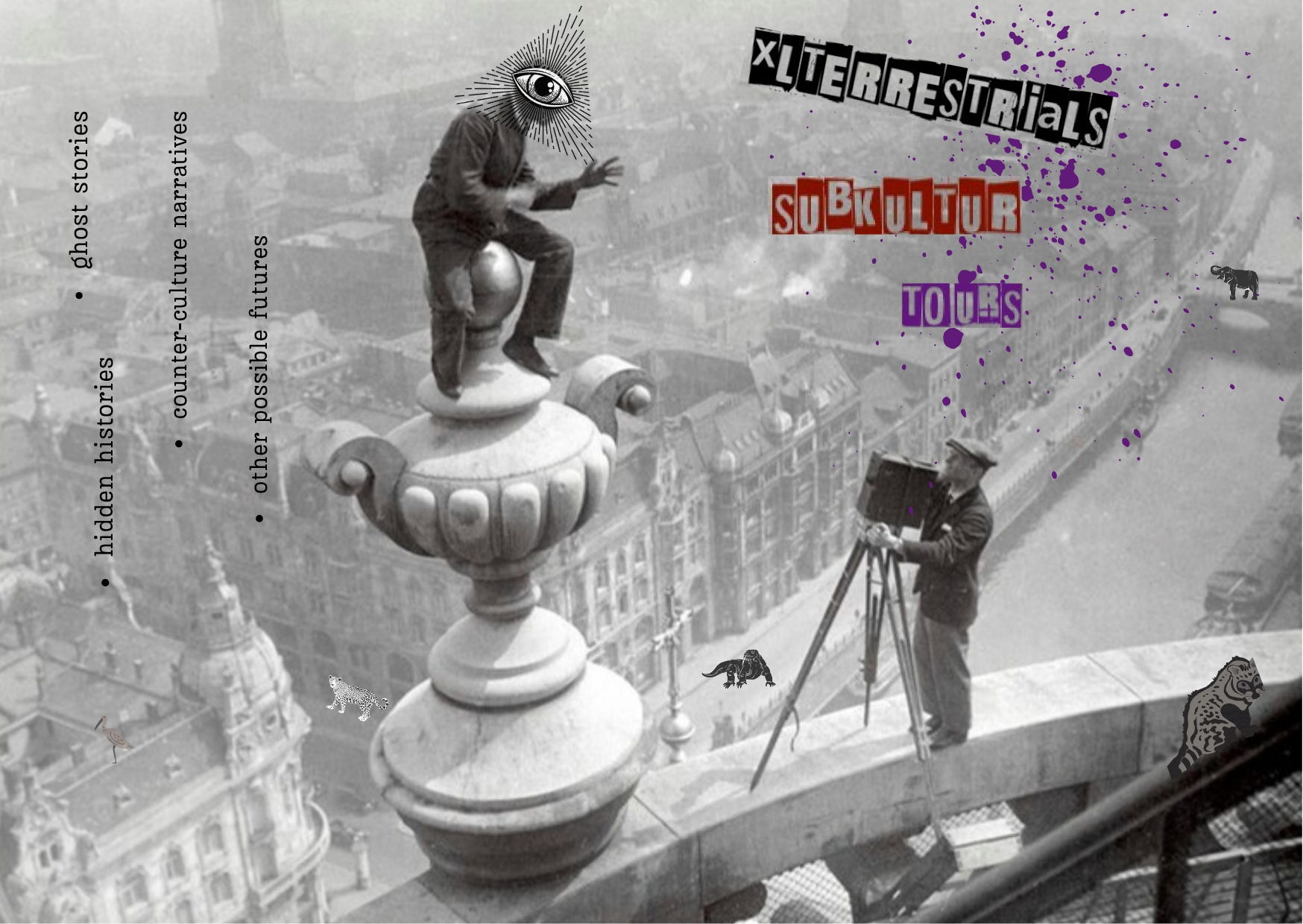
The tour has several stops, and at each he recounts stories about a forgotten past, such as an old hack-lab in the basement of what is now a bland office building, where - without heating - people used to huddle smoking in winter, tinkering away on sculptures or circuitbending synthesisers.
At each stop he paints pictures of a past that indeed does now feel ghostly and out of place in this increasingly rich area. Wealthy people with designer jackets and handbags that cost more than my rent hurry past us on the pavement, giving us disapproving glances as their bodies register the scruffy cues in our clothes.
The penultimate stop in the tour, though, brings a particularly deep feeling of sadness.
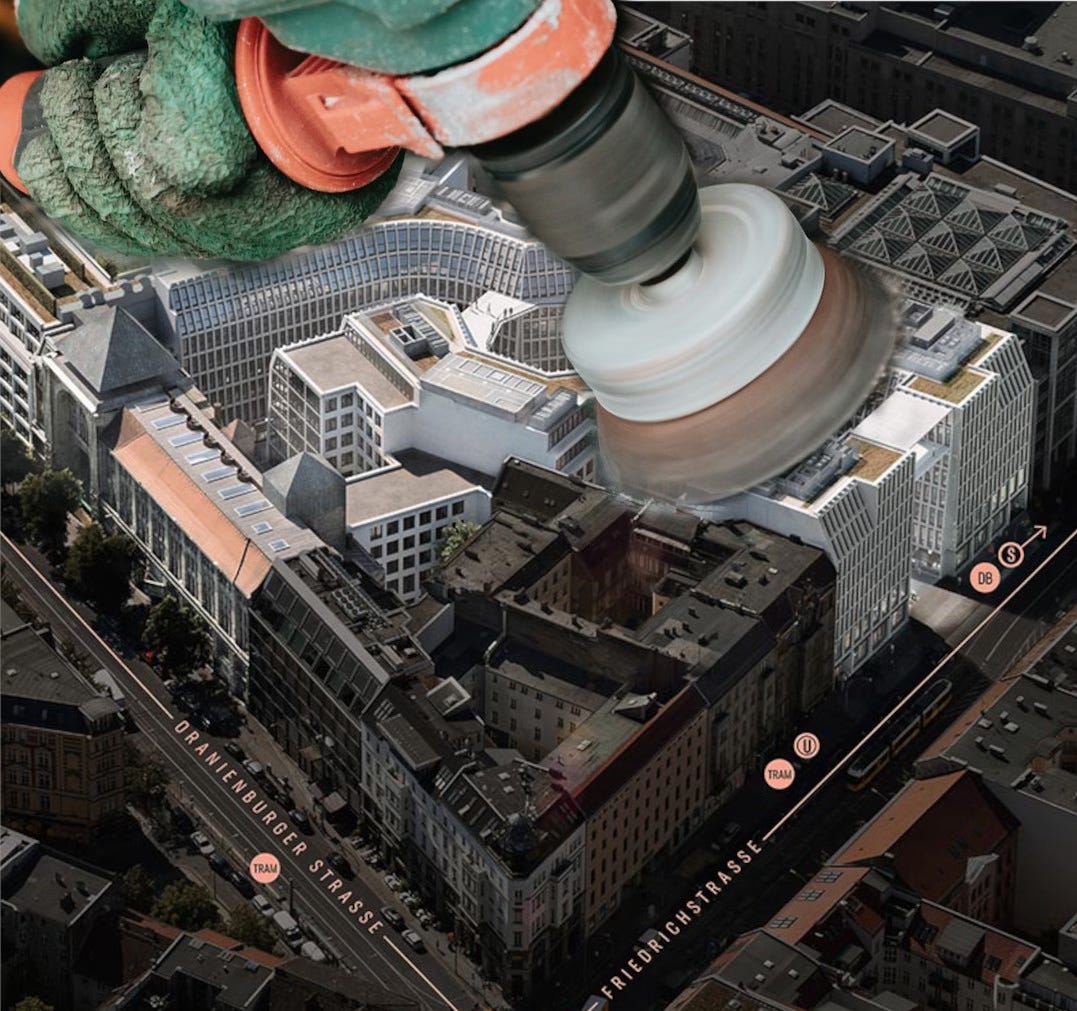
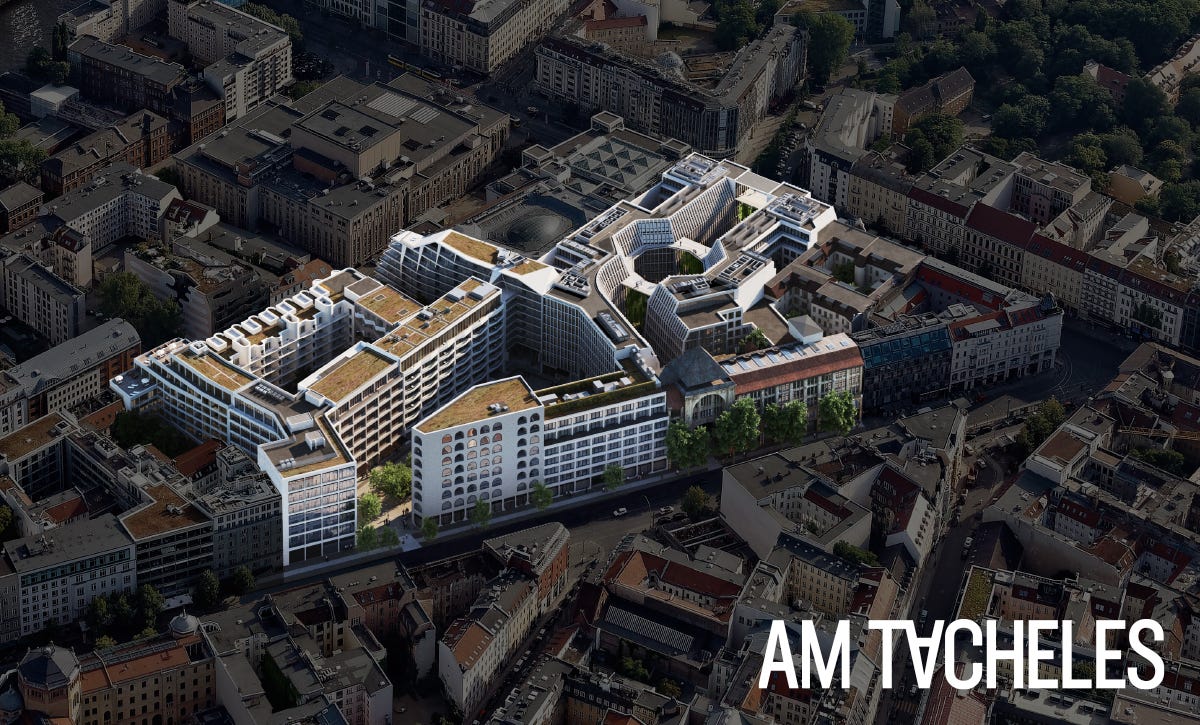
They call it Am Tacheles.
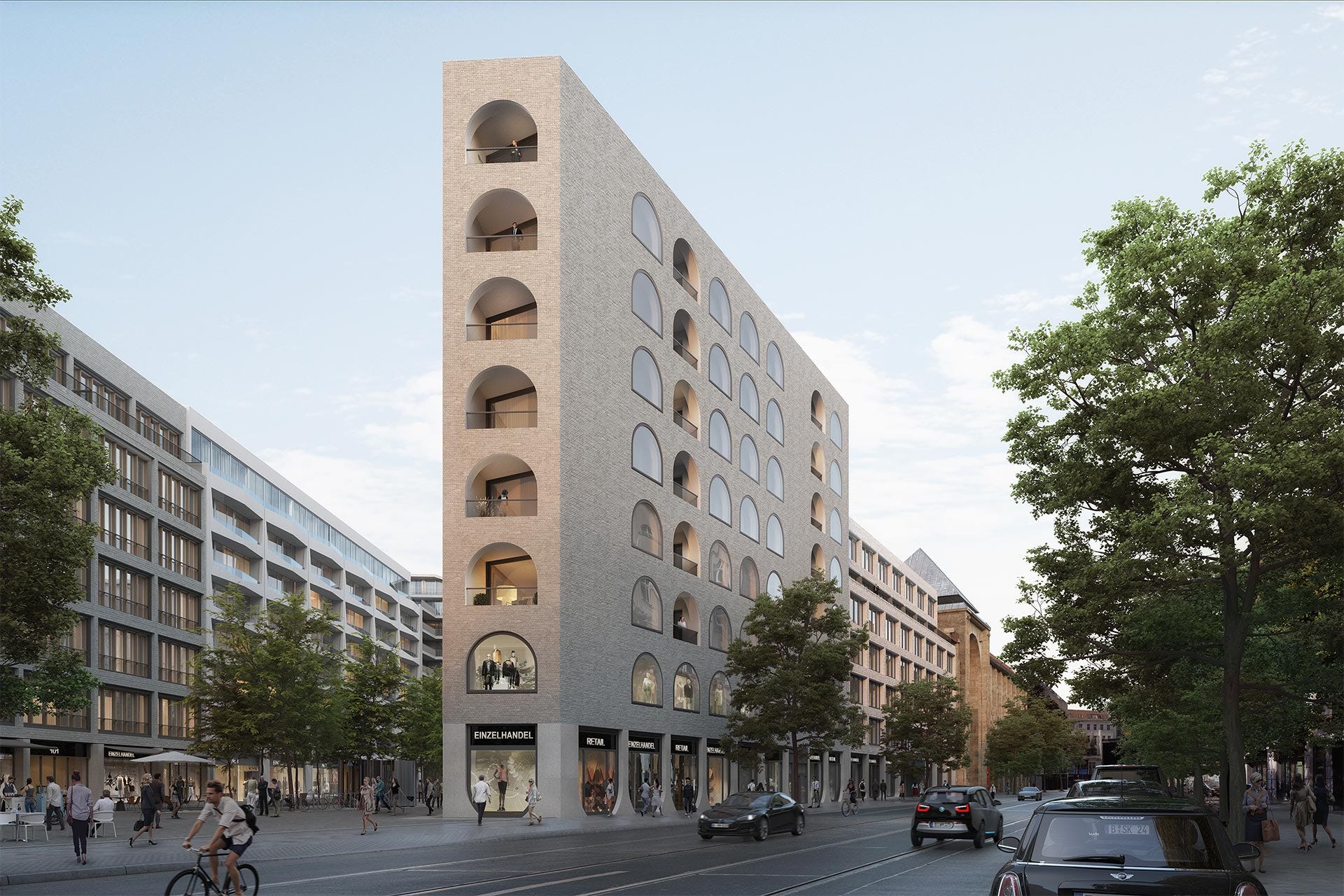
‘Am’ is a contextual word in German. It could translate to ‘At Tacheles’, or ‘in the vicinity of Tacheles’, but could also just be ‘On Tacheles’. To me, the latter is most appropriate, because they’ve built this, literally, and metaphorically, on top of the old evicted Tacheles arts centre, burying it.
Pod tells us how the developers originally had a big information board with images of the old space. They wanted to associate themselves with the edgy coolness of the former site, but this display got smaller and smaller as the new plots were rented out to restaurants and clothing salons.
We venture in, seeing all those generic fonts that accompany all gentrification around the world, and those empty marketing slogans pasted in transfer on the windows. It has that classic hollowed out feeling. Consumer experience without joy. Space without community. Aesthetics without substance.
I can feel the spreadsheets they must have used to model the cash-flows as we walk through to the new square in the midst of the development. There are chairs there, all chained together to prevent them being moved around. On a bench is a sign that says no smoking and drinking.
Lo’s hacker mind finds a loophole, and with a grin he says ‘well, just make sure you put down your drink before you take a smoke’.
Being able to drink and smoke on a public bench is a hallmark of Berlin culture. That’s what originally made this city feel so unique to me when I first arrived, and also why I decided to move here in 2020. When living in London, I always felt like there was a landlord or authority figure waiting in the wings to tell me to stop sitting on a bench smoking. They’d send some poorly-paid security guard to do their dirty work. They’d move you on, and shut down informal culture.
Berlin was never like this. It felt like the security guards were only in the distant background, and that people were allowed to co-create culture from the bottom-up, rather than having it served to them from the top-down. You could grab a cheap beer at a späti - a corner store - and crack it open on a side-walk where some neighbourhood DJ had just set up a sound system to create a temporary dance floor.
So, a sign saying no smoking and drinking on a bench is the anti-thesis of Berlin. It reeks of social control and power, and of weaponised private property wielded by the rich. Here we have benches that appear to be public, and yet they’re etched with instructions on how you’re allowed to behave on them. They might as well have a big sign saying no co-creation of culture allowed here.
We perch in this dead-zone while Pod tells us about the time when this was the Tacheles ‘beach’, alive with smoky-drinky people welding their big weird sculptures.
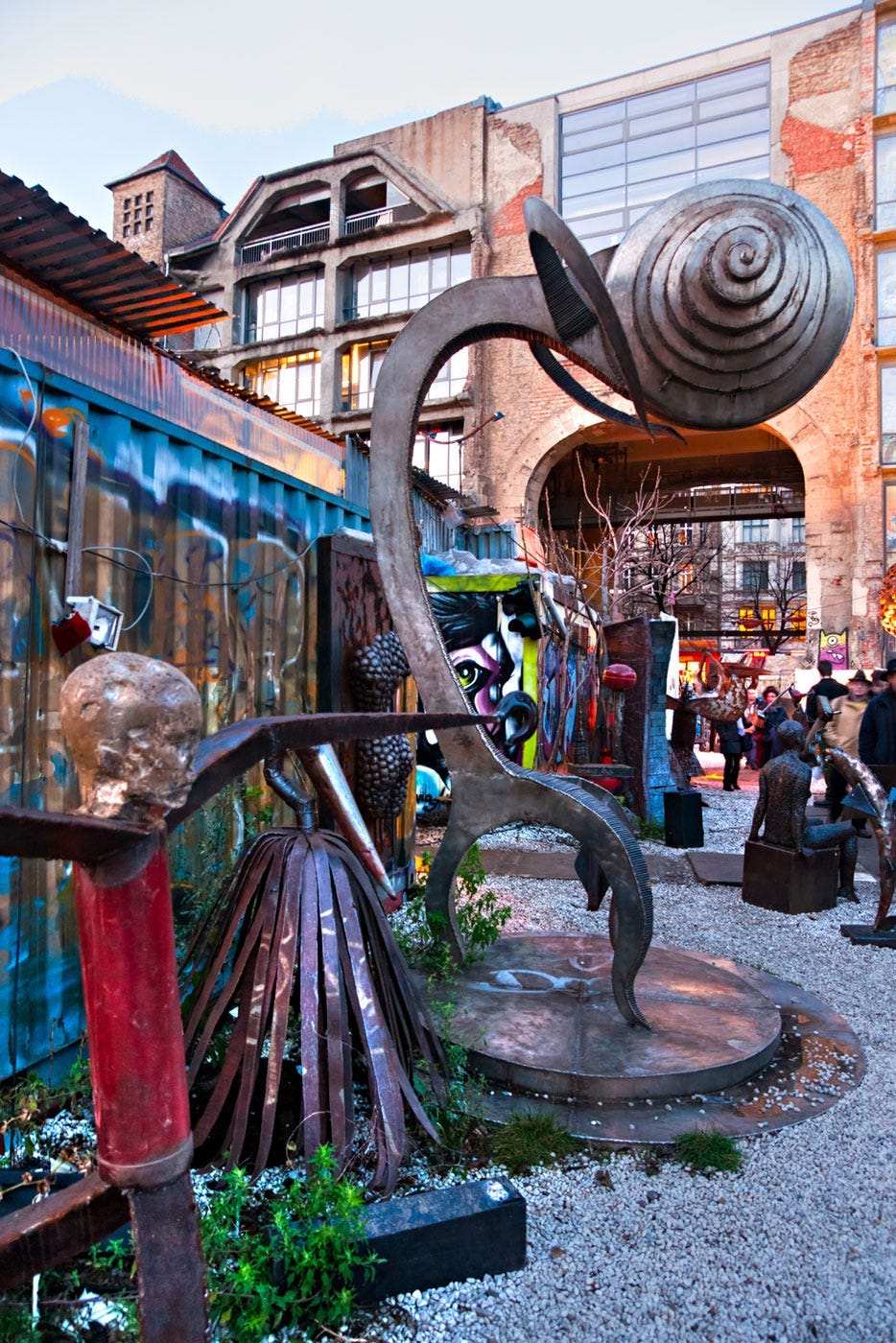
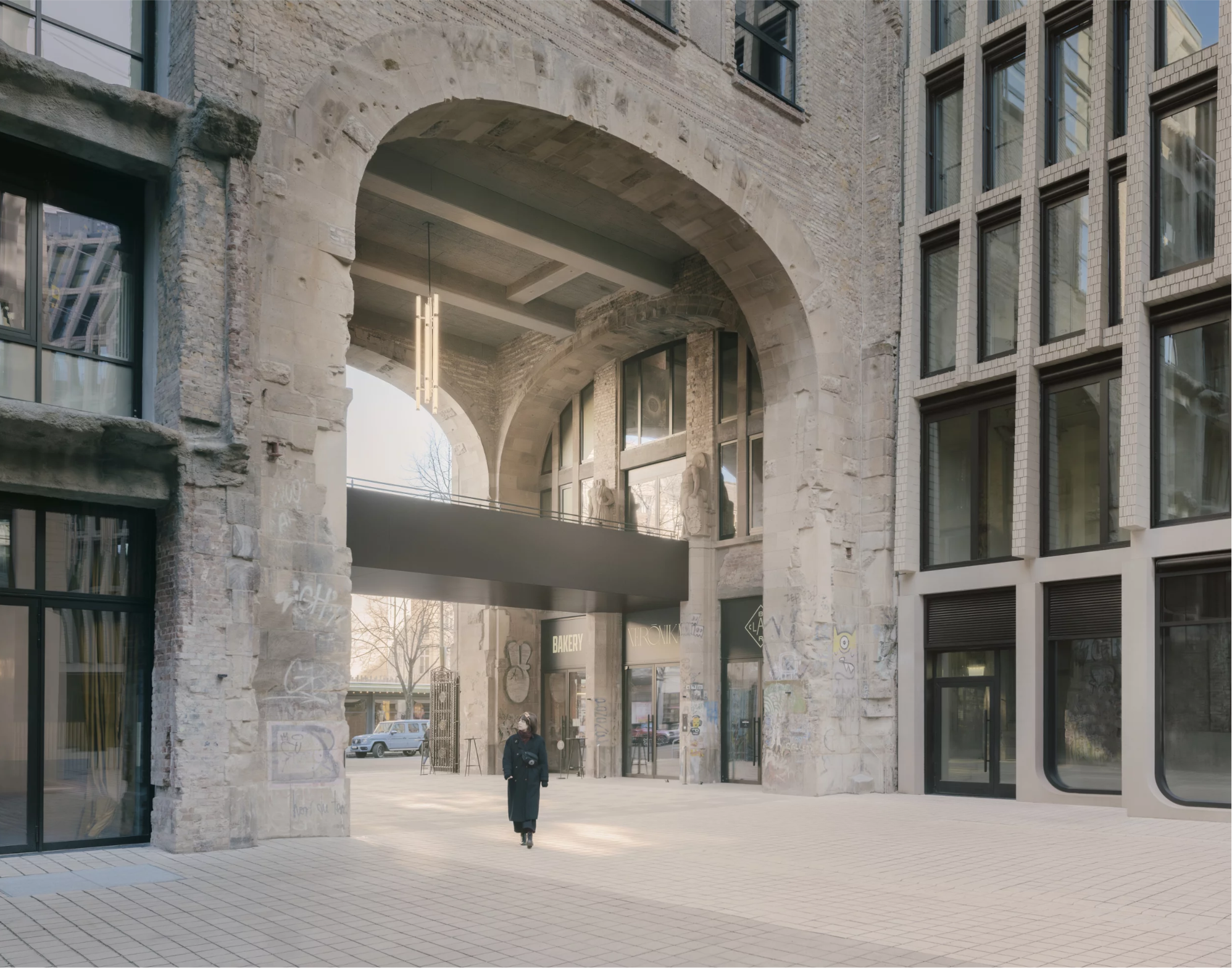
As we walk through the redeveloped complex, we see that they’ve kept the old arch and a section of the back wall as a kind of museum. Now, though, its surrounded by the gleaming glass and newly laid concrete that marks it out as a financial asset, rather than a community centre.
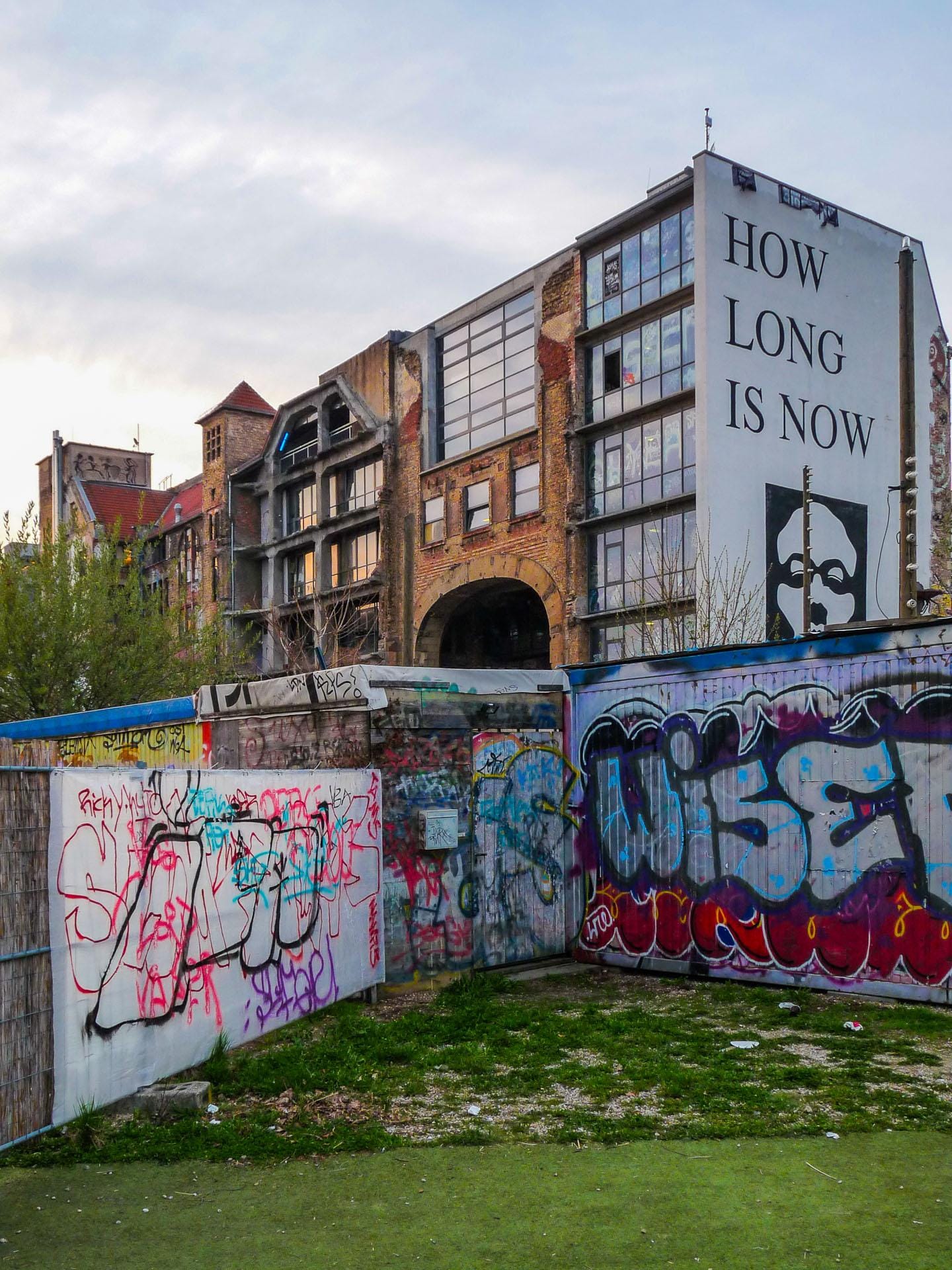
Pod tells us about how this development also obliterated Tacheles’ most iconic piece of street art, a huge mural that said How long is now? He shows us an old picture of it.
We exit the complex onto Oranienburgerstrasse, and look at the new frontage. It now houses a photography gallery called Fotografiska. It has that upmarket Scandinavian look, with one of those expensive book stores inside it.
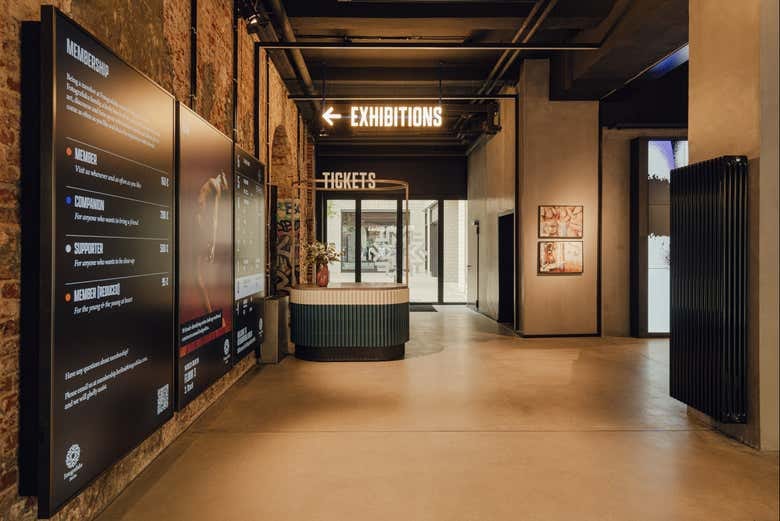
Pod recounts how this gallery last year hosted the launch of a new book about Tacheles from one of its original founders - the musician Rafael Insunza - but how, when push came to shove, the gallery bosses tucked that book away in the corner, and rather piled the book store high with the work of Shepard Fairey, the American street artist whose highly aesthetic and palatable prints are far easier to sell. Fairey is (in)famously good at commercialising his work, and that’s what galleries like this enjoy.
They’re currently advertising a big exhibition, a retrospective of Anton Corbijn, the Dutch music photographer. Outside the entrance stands a billboard with one of his iconic photos of the young Einstürzende Neubauten, the German industrial-experimental krautrock band, heavily influential in the 80s and 90s. It’s a band that exemplifies the old anarchic spirit of the building. It now, however, find itself rendered in resin like the dead and preserved branches of that bonsai, here to sell tickets.
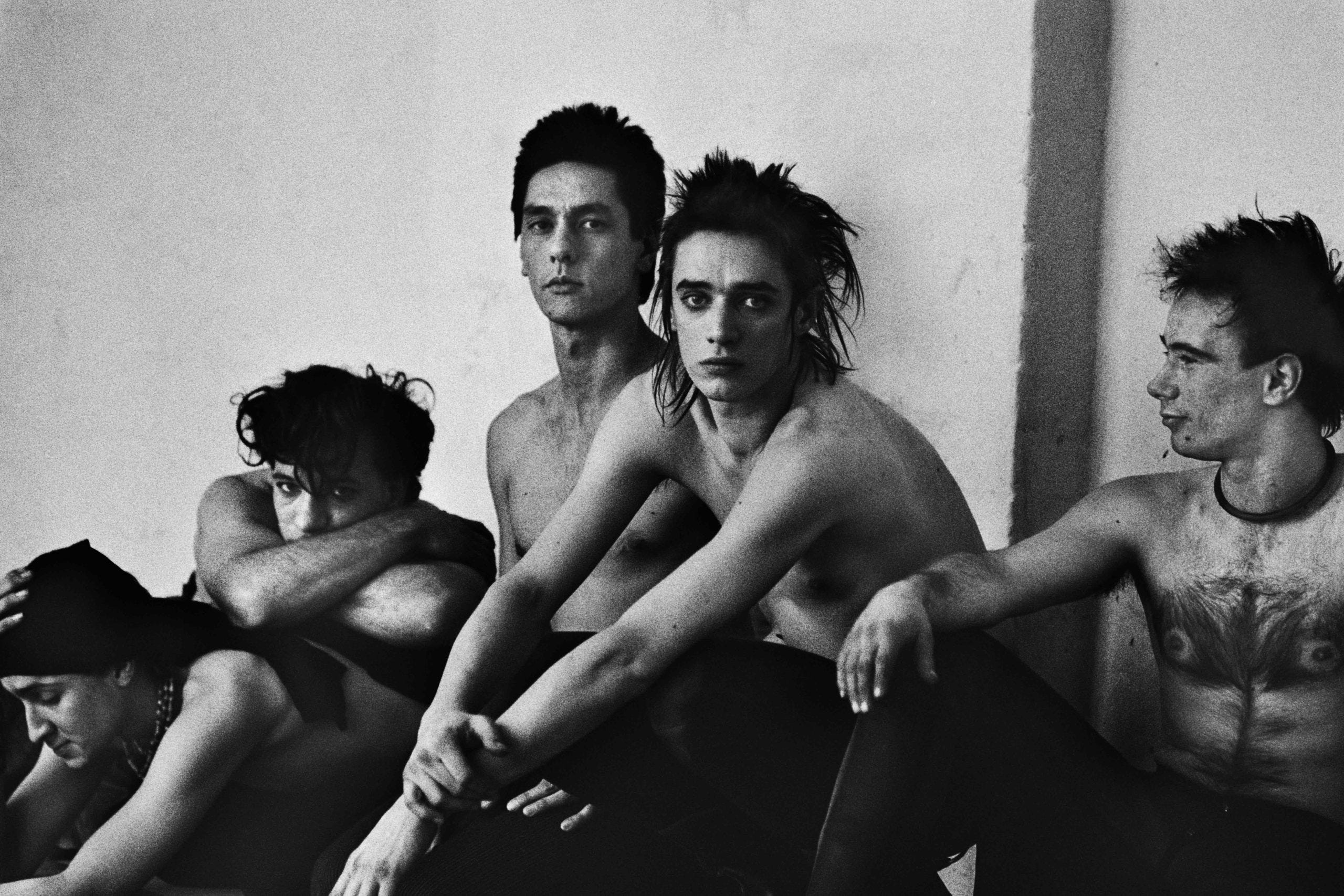
I muse to the Pod and Lo that this is punkwashing. Capitalism does this. It takes a spirit and neutralises it by making it play second fiddle to commercialism.
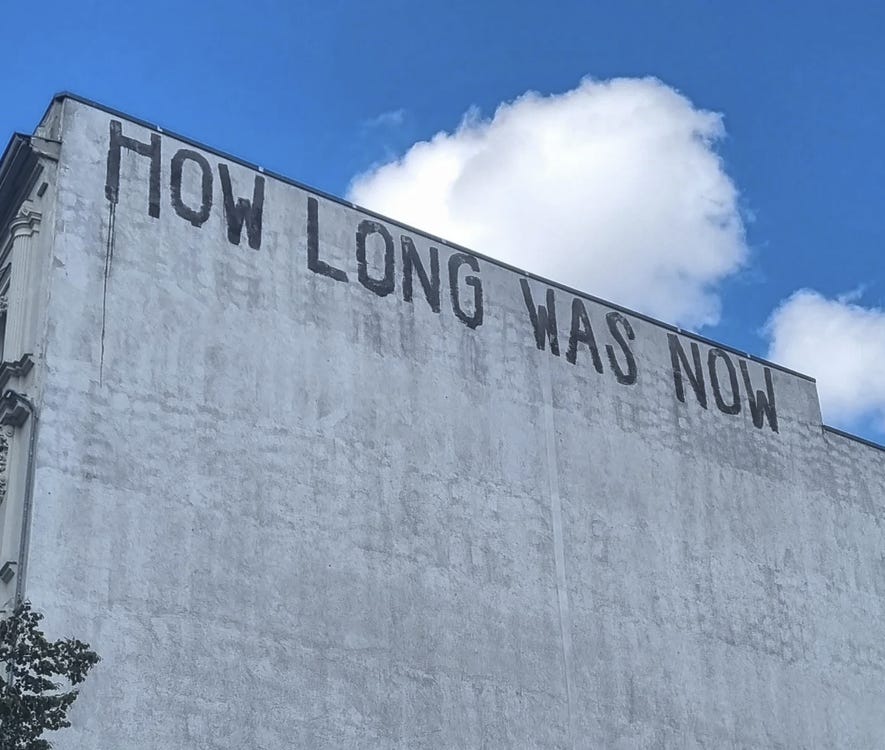
As we leave, Pod points across the street to where there’s now a coded memorial to the former Tacheles, etched in big graffiti letters high on an adjacent building.
It says How long was now.
***
Walking to our final stop, I wonder to myself why I use that phrase, ‘capitalism does this’. Why do I speak about a system doing something, rather than focusing in on the actual people who do this gentrification, the actual property developers, financiers, architects and so on?
I think more about this as we arrive at our final destination. It’s Café Buchhandlung, where Topsy still serves. He welcomes us with a big smile, and points us to the fridge where we can grab beers. Pod uses one of the bar tables to spread out a whole series of photos of Berlin, each chronicling the changes that have taken place. I pick one up. It’s a photo he’s taken of a new coffee chain that’s spreading like a virus through the city.
I try to imagine the founders of this chain. Who they are. What their identity is. What they imagine they are doing.
When I say ‘capitalism does this’, I mean something like this: we are immersed in a system that has default tendencies, and which rewards certain patterns of behaviour and punishes others.
I imagine a carpenter working with a piece of wood that has a certain grain. The skill of a carpenter is how to work with the grain of the wood to bring out its possible shapes. Likewise, being a capitalist is a specialist art-form in which a person attempts to work with the grain of the systemic processes that surround us. The skill of a capitalist is measured by how well they bring out the shapes allowed within those systemic constraints, and how they can subtly steer or manipulate market and political forces to create an installation that can yield them a constant stream of profit. That’s their art form, and if other people’s culture must be gentrified in order to pursue it, then that’s what their art-form demands.
For people like me and Pod and Lo, the developments spearheaded by these people - whether they be a bland office complex or a coffee chain - feel like a kind of abomination. We feel violated as they ride roughshod over organic community and as they replace informal, peer-to-peer culture with top-down, capital-intensive development. For many of us romantic types, these ‘redevelopments’ seem lifeless, reducing human existence to transactions. We cannot imagine how the developers can feel proud of this.
That’s a judgemental reaction I always have, but judgement doesn’t always help us to understand what is happening. So, I try to put myself into the position of the property developer, or the financier behind the coffee chain. I try to imagine the meetings they have around the boardroom, the cash-flow projections, the vision. I try to imagine the specific, and powerful, sub-culture they form part of, and which give them a sense of meaning in their lives.
In the end, everyone in this world wants inclusion into some form of community. For anarchist hackers, that community might congregate at Buchhandlung with its open door fridge, but - if the twists and turns of life have left you into the position of being a capitalist, you also have a community, formed by other capitalists. You seek their approval and validation, and want them to grant you status. You feel comfortable around them, and measure yourself by what they say rather than what outsiders to your community say. Much like a group of sculptors might have admired each other’s creations in the grungy yard of the old Tacheles, the financiers driving past Am Tacheles in their climate-controlled Audis might text the major shareholder of the complex and say ‘congratulations on your new sculpture. It is a masterpiece’.
I call Am Tacheles sterile, but - through the eyes of a capitalist crafter - that’s the point. It’s that sterility that yields the profit. It’s means they’ve optimised to minimise costs while maximizing throughput. That is their art-form, and they feel a warm glow at succeeding at that, even as the rest of society feels a gradual deadening of the environment around them.
Being a capitalist is a skill, and like any skill, the more you do it the better you get, and the greater the scale you can operate at. People like Trump, for example, now see the entire world as nothing but a giant redevelopment project. He, and Murdoch and Musk form their identity and community by manipulating capital, which is why they hang out together, and feel seen around each other. They casually talk about steering the labour power of tens of thousands of people to gouge a hundred kilometre trench through a mountain range to lay an oil pipeline, much like a carpenter might talk about chiselling a groove in a log. They talk about hacking off 30% of a workforce like a sculptor might think about abandoning a brass piece that’s gone a bit awry.
In the end, though, there are limits to my metaphor, for the capitalists do not represent the muscle of the sculptor or the carpenter. No, the body of the planetary sculptor is made up of billions of ordinary individuals who make up the majority of our social web. This vast collective - of which most of us are part - are the arms, hands, chisel and sandpaper that sculpts our world by turning up to work. But, we are constrained and steered in that by the capital of oligarchs.
Yes, the capitalist art-form is not to be the actual sculptor, but rather to control the sculptor. It is to buy up labour power on one side, and set it against the buying power of the consumer on the other side, to create installation pieces - call them firms, corporations, developments, funds, whatever - that yields a constant stream of profit to their shareholders.
Doing that successfully gets you inducted into the tiny Guild of Capitalists. Over time, its gallery of works spread across society, taking over new areas and frontiers.
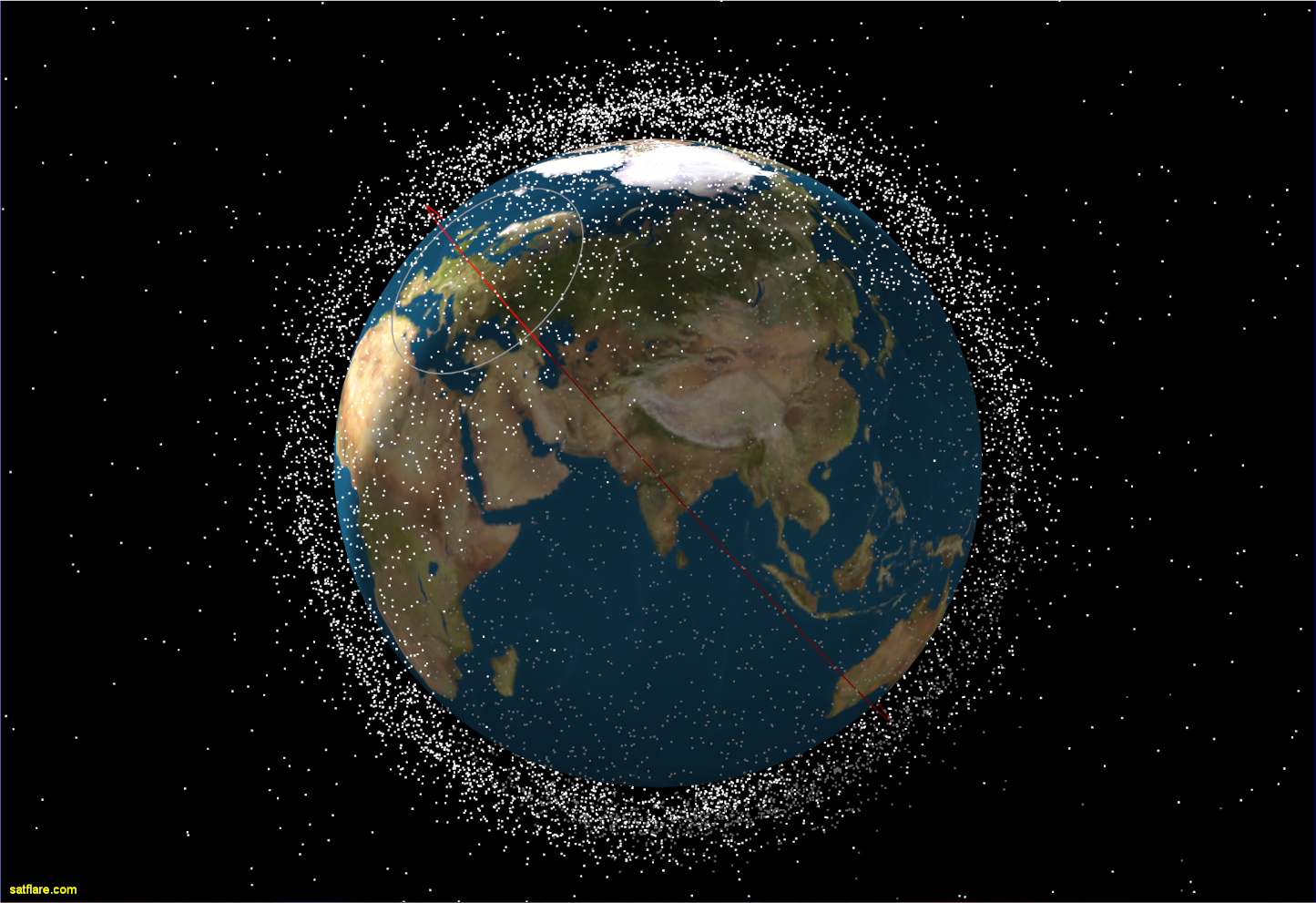
Some, like Musk, now raise billions in financing in an attempt to get us - the sculptor - to etch vast new installation pieces in space. Our skies are now filled with satellites gentrifying the night sky, pushing out the stars, but none of us feel like we as a species decided to do that. That’s because we didn’t decide. Rather, ‘The Market’ decided.
The sense of sadness that many of us feel at the gentrification, commercialisation and commodification of everything, does not only come from that feeling of having to live within this gallery owned by that guild. It also comes from having to work for them.
Of course, many people still believe in being able to create a life outside of this system, and modern Berlin still hosts many inspiring initiatives like that. 90 Mil, for example, is a space with a spirit reminiscent of the old Tacheles. It is set in a condemned building, waiting for redevelopment.
There are too, countless small businesses who do try to keep open some space for logics beyond pure commercialism, even as they fight for survival in the market.
For the majority of people, though, capitalism often feels like an inescapable show. No wonder then, that many feel like the only way to have any agency in this world is to go with its grain and seek a position in the guild, to turn away from community and ecology and peer-to-peer culture, and to use those rather as the raw materials for commercialisation. You’re told that to survive in this world, you must take your inner Tacheles, tame it, and push it back out as Am Tacheles.
For anyone visiting Berlin, you can find info about Pod’s subculture tours of Mitte here. His Substack is rich with Berlin underground history, so check it out
This was beautifully written and it gripped me from the start. The closing graffiti, "How long was now," reminded me of an idea Mark Fisher often wrote about, which I think captures what the whole essay is building toward. This is hauntology in Fisher's sense. It's not nostalgia for the old Berlin, but grief for a future that was once promised and was quietly taken away. Pod's tour then becomes a slow walk through that lost future.
I have two thoughts from that perspective. First, the chain bar serving "an image of punk" feels to me less like simple cooption and more like what Fisher called precorporation. The rebellious style was already packaged to be sold long before the crypto crowd arrived dressed like hackers. Capitalist realism doesn't simply take real desire and sell it later. It shapes desire in advance so that the marketable version comes first.
Second is the sadness you end with. Capitalism as "an inescapable show" is what Fisher called reflexive impotence- the feeling that there's no alternative (to quote Fisher "It’s easier to imagine the end of the world than the end of capitalism."). It rests on a sense of defeat that the system creates and then feeds on. Fisher argued that this feeling should be understood politically rather than treated as a private emotional problem...so I would hesitate to let the tour remain only a memorial. The ghosts aren't just something to mourn, they're also proof that the Techeles of the 90s shows that people once created together outside the logic of profit. It was never impossible, just pushed aside. The tour then becomes an act of hauntology, remembering a future that was lost. Fisher would say the next step would be to turn that memory into a political demand.
But we are not constrained to collaborate with this nervous system... that must be repeated thousand times, we just have to "dream" and act differently...