


Would you prefer to listen to this as an immersive audio essay? Paying subscribers can access that here

High finance is often, literally, high.
Fifteen years ago, when working in the financial sector, I’d stand on the street looking up at these skyscraper behemoths. Then I’d push through their rotating glass doors, check in, pass through the security gates, enter the elevators, and press the button. I’d watch the floor indicator lights ticking up into the double digits.
Then the lift would stop, ding, and the door would open into an investment bank division, or an open-plan fund management office, or a real estate finance company. I’d walk past desks with traders and analysts, and enter meeting rooms. Once in there, I might be greeted with a view like this…
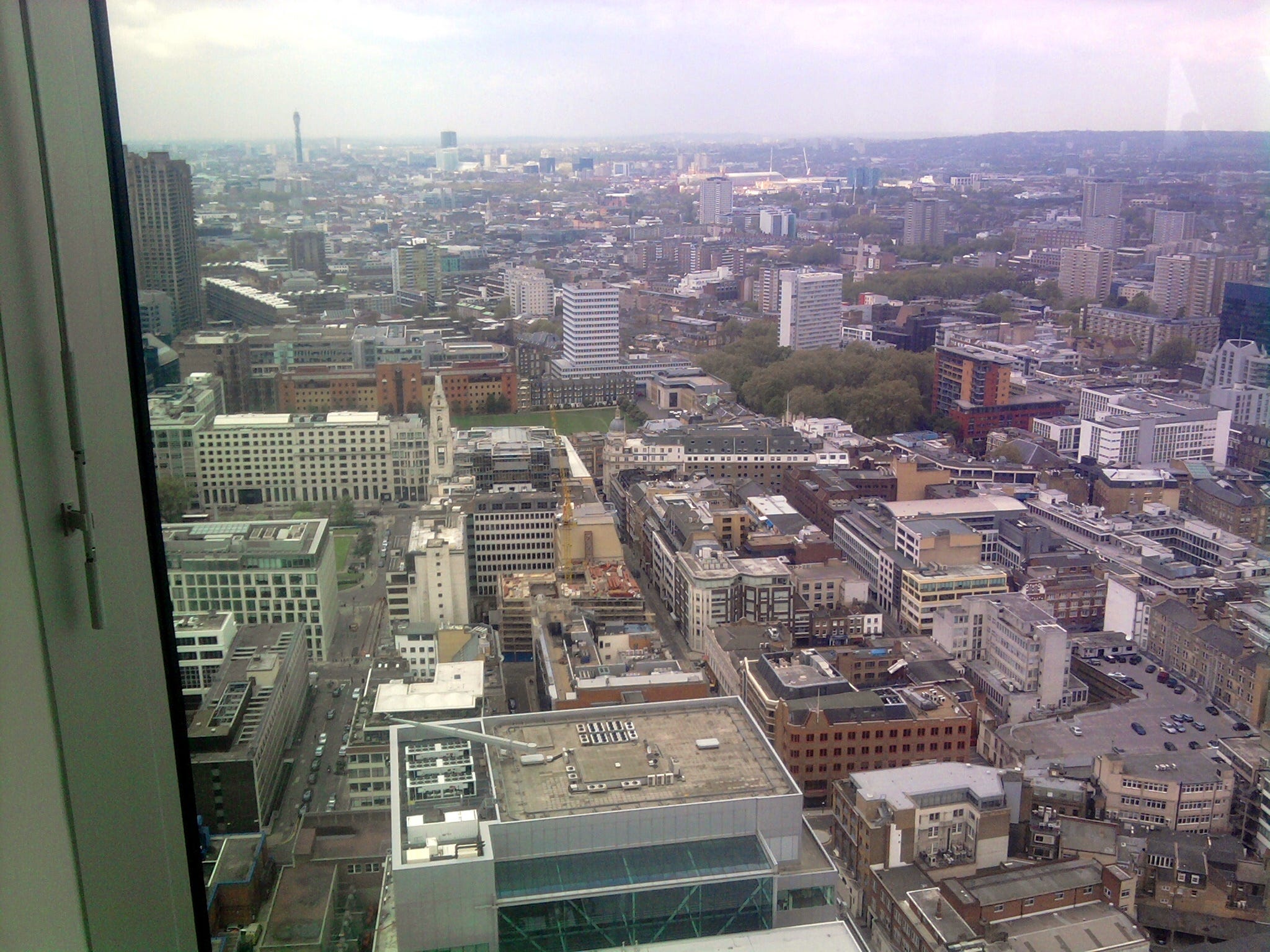
Or like this…
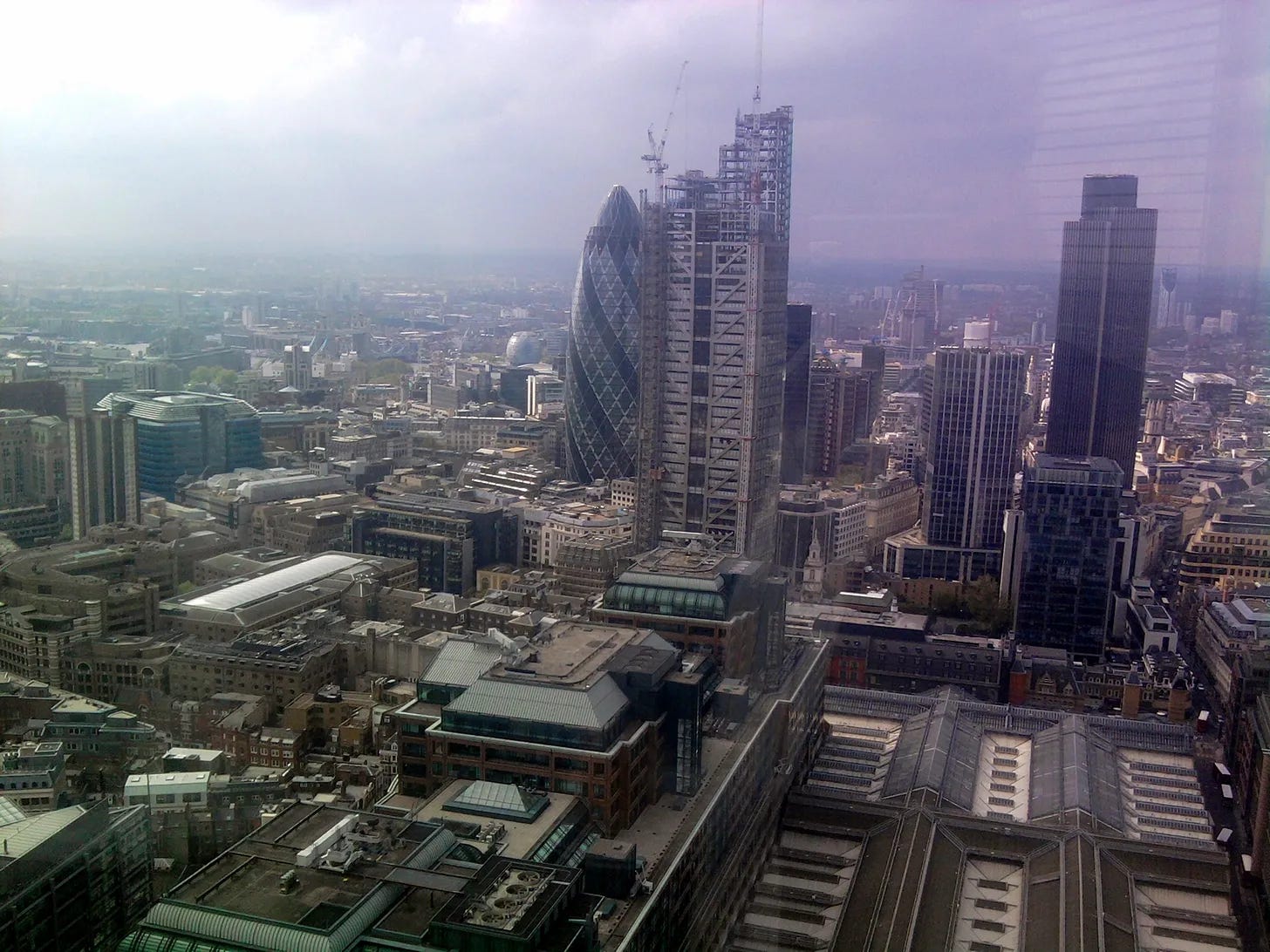
My first skyscraper adventure took place on the 35th floor of the former Lehman Brothers offices in Canary Wharf, mere weeks before they collapsed. Later I’d visit 18th floors and 39th floors, and many more above, below and between.
The higher you go in a skyscraper, the more you look out onto the world with a bird’s-eye view. As the ground floor grows more distant, you too grow increasingly ungrounded. People on the streets below begin to look like scurrying ants. They become a distant, faceless collective.
The opposite view to the bird’s-eye is the worm’s eye. The most down to earth positions in our society are literally down in the earth. Picture miners working underground, or farm workers, far from the city, with their hands in the soil. To labourers like this, the distant towers of finance are just abstract symbols of city-based power.
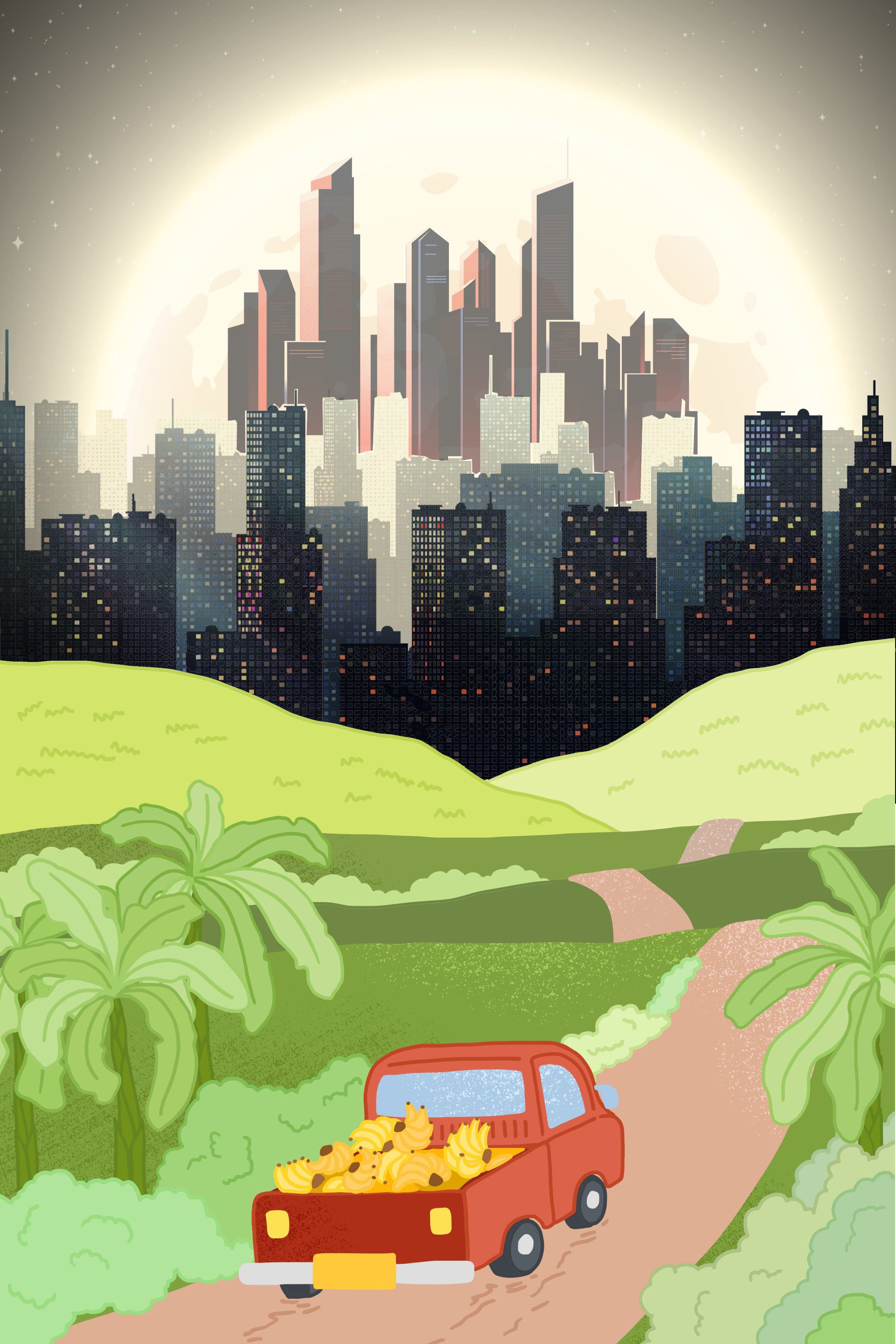
Economic statisticians sometimes split the activities of people in our economy into broad ‘sectors’ - primary sector workers are involved in extracting raw materials, secondary sector workers get involved in processing those materials and manufacturing stuff, while tertiary sector workers provide services around that extraction and manufacturing base.
If you project your mind back in time to, for example, 20,000 years ago, the primary, secondary and tertiary sectors were integrated. A person might dig up clay - a primary activity - mould it into a figurine and bake it - a secondary skill - and then use it to perform religious rites for a community - a tertiary service. As our economies have scaled up, though, these once unified spheres have been stretched out, ripped apart, and delegated across time and space to separate classes of people who often no longer have any knowledge or experience of the big, integrated picture.
At a global scale, the world’s poorest countries are often those who are stuck ‘digging the clay’ in the primary sector. The Democratic Republic of Congo, for example, relies on its people extracting cobalt, which will be passed on to the mid-tier manufacturing nations - the ones who ‘bake’ it - but the high priests of capitalism who chant the rites will cluster in those big centres of finance, tech and statecraft.
This global picture, however, hides more localised pictures. Even in rich countries, you’ll find primary sector rural areas, and as you move towards the outskirts of their urban sprawls, you’ll find those secondary manufacturing zones that process stuff from the raw material peripheries. If you go on into the centre of a city, you’ll find yourself surrounded by tertiary retail store-fronts, with people trying to sell the manufactured stuff, or to cut hair with scissors forged from metals, or to mix processed flour, refined sugar and churned butter to make a croissant.
At a global scale, the tertiary sector might be seen as relatively high status, but at this local scale it’s rife with its own class dynamics. Let’s think about a baker kneading dough in a deli under a skyscraper. They’re operating somewhere between the secondary and tertiary spheres, but they do so at a small scale, at ground level, with localised impact. They wake up early, prepare the bread, sell it to people walking past, and then start the cycle again the next day. Their world is one of small-scale short cycles with immediate impact.

The opposite to that is the world of large-scale long cycles with deferred impacts. That’s the kind of thing that might happen in the skyscraper above the deli. People entering those offices with their croissants, are - nine times out of ten - going to be entering the realm of professional services, the world of overseers, managers, strategy, communications, accounting, and - eventually - finance.

Unlike the baker, who makes no assumption that his activities will have a distant impact beyond the here and now, the elites high up in offices picture their impacts stretching out into the distance, and into the future. The baker gains his sense of achievement from impacting the lives of small numbers of people directly right now, but a core characteristic of an elite mindset is that the person imagines that their single actions will affect large numbers of people indirectly and diffusely over time.

The people in skyscrapers might have close human connections with other elites, phoning them up and meeting them for lunch, but the business they discuss eventually always concerns distant people over spans of months or years. They sign documents that affect the future livelihoods of strangers they’ll never meet. They reduce countless ground level activities to numbers on spreadsheets. They write research reports that present entire countries as sets of statistics. Everything scales up and de-personalises.
So, when the elevator dings, and the doors open out into the offices of an investment banking securitization division, you’re not going to find people in there who care about getting dirty building a single house for a family. No, their role is to write and trade contracts that will indirectly induce tens of thousands of ground-level workers to build thousands of houses over the course of a decade.
Pyramidal Amplification
When an ancient pharaoh issued orders to tens of thousands of workers to build a pyramid, he was directing their energy down a particular path, but also stopping them from using their bodies and minds to do something else, like building schools for their children, for example. He later might claim to have ‘built’ the pyramid like this, but really he activated and steered others who did the actual building.
Similarly, financiers create contracts that activate particular pathways that steer human energy away from some things and towards others, and they do so from the tip of our economic pyramid. That positioning means individual people within the financial sector get to earn at vast multiples of the actual work they do.
Primary sector labourers can slog away with their bodies for an entire day and yet still struggle to survive, while a single click on the mouse by a hedge fund manager can yield tens of millions of dollars in profit. It’s not because he’s doing a lot of work, or being highly productive. No, it’s because there are billions of others below him, amplifying his returns.
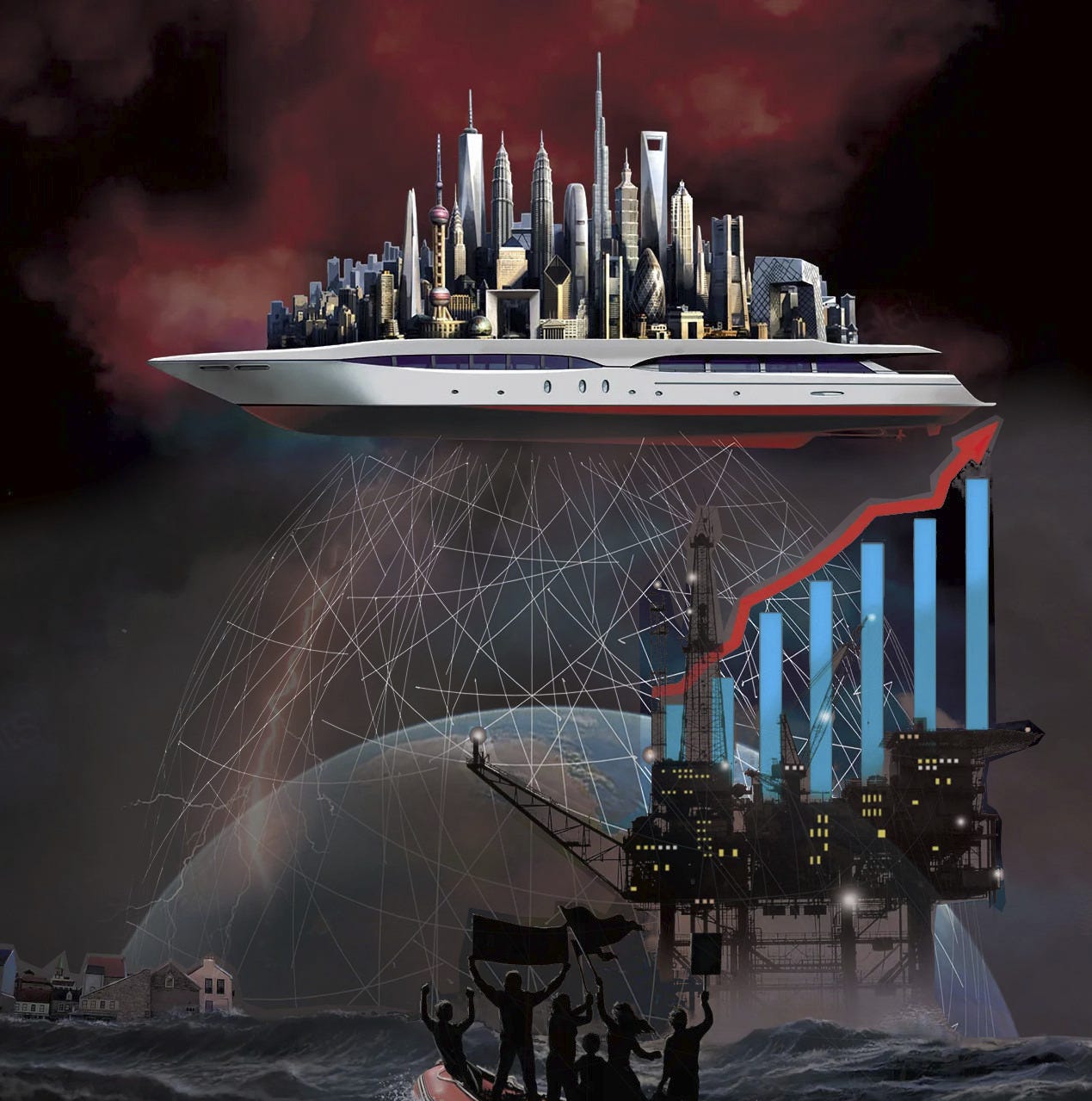
This Pyramidal Amplification can be understood by thinking about a ship. A captain might exert a small amount of energy turning the steering wheel to make a 100,000 tonne ocean liner change direction, but in reality the structure only moves because hundreds of thousands of others extracted the metals for the hull, built the thing, and now staff the engine rooms. His present day actions only have impact because of millions of other actions that extend across both time and space.
The power of the captain does not reside in himself. It resides in the fact that he’s sitting on the apex of a singular productive unit, with his own labour being massively amplified by those below him.
He does, however, get to claim an outsized cut of the glory, because his positionality means his individual actions have higher consequence within the structure than the individual action of a single person stoking the engines, even though the captain’s actions would mean sweet fuck all if those engines weren’t there.
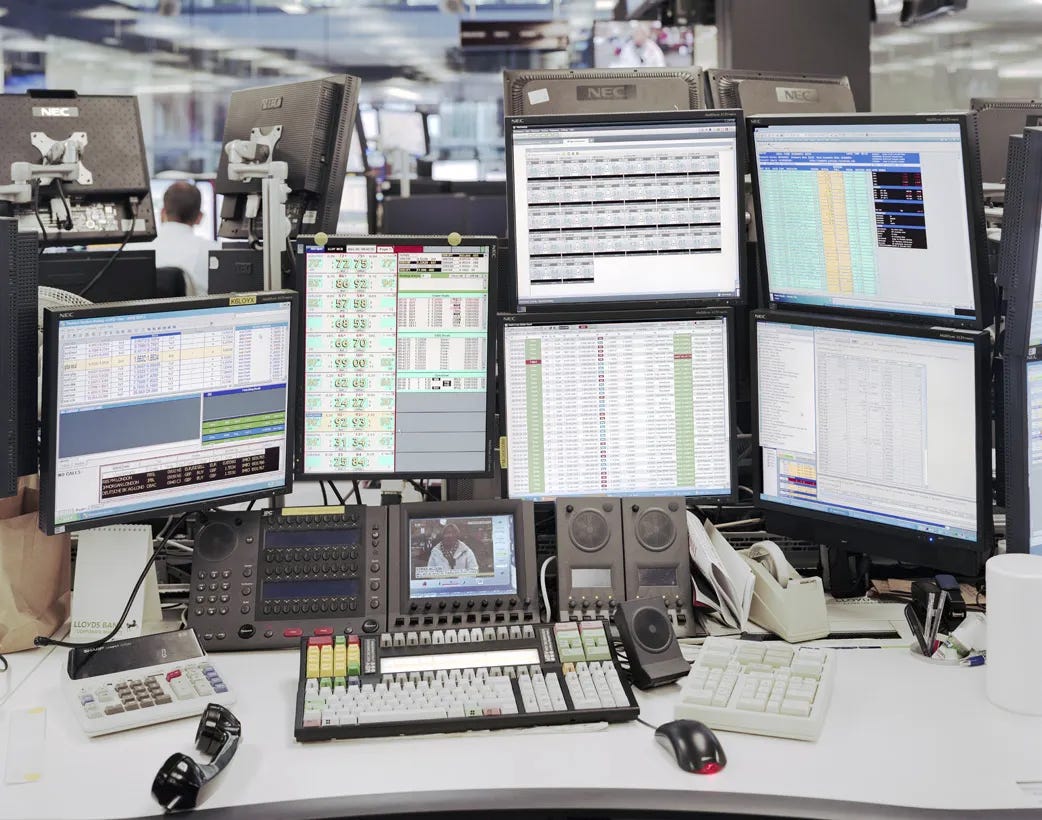
This is something I became acutely aware of in the financial sector. High finance is an apex-level industry, which means it operates at enormous scale, but the human beings within it are just normal people who find themselves in an abnormal position in the high reaches of the global economy. There’s only so many people needed to staff the top of the pyramid, but their systemic positionality means their pay is horrendously distorted. The bonus of $5 million given to a Goldman Sachs trader might seem vast from their puny human perspective, but from a corporate perspective it’s tiny.
That’s why hedge funds will pay single managers $100 million just to join their firm, and it’s the same reason why Big Tech companies will now pay AI engineers the same. It’s because their little human actions contribute to apex infrastructures that yoke in billions of others underneath them.
This positionality distorts more than just pay. It bends those people’s sense of normality. Let me illustrate this with an anecdote.
The Charity Ball
When I was working in the finance sector, a colleague of mine hosted a charity ball to raise money for a sports team. He asked some of us to help out, and I was given the job of selling raffle tickets to the assembled elite in the luxury dining hall.
After dinner, a Sotheby’s auctioneer got up to auction off various donated prizes. He started with smaller items, enabling the more junior bankers to prove their philanthropic status by bidding a few thousand pounds, but at some point he moved on to the bigger ones. One of them was a day in an exclusive private booth at a fancy horse race. The auctioneer started the bidding for that one at £16,000 ($21,000), but he’d miscalculated. He was met with awkward silence. Nobody wanted it at that price.
It’s worth mentioning here that the sports team wasn’t some underprivileged group. It was… wait for it… the British national ski team, a community of athletes drawn almost exclusively from the upper classes. The assembled fund managers and private equity bosses were weighing up whether they really wanted to hand over 16k to such a group.
The silence seemed to stretch towards eternity. The auctioneer looked around, unsure of what to do. Finally, in a corner of the room, a man reluctantly raised his hand and spent £16,000 to ease the tension.
I’d met this man earlier when I sold him a raffle ticket. He was quiet and polite, but he was also a manager at an infamous commodity hedge fund called Armajaro, one that made over £10 million in a single trade to corner the cocoa market (an exploit that earned the founder the nickname ‘Chocfinger’, after the Bond villain Goldfinger). For these guys, throwing away £16,000 was like tossing a single banknote, but what struck me was that he was going to do this because he was experiencing some ordinary emotion - that feeling of group embarrassment that leaves everyone silent - and he felt like maybe he should take the lead in breaking the awkwardness.
But, given his position in the pyramidal structure, the scale of his response was, to an ordinary person, absolutely insane. Here was our hedge fund trader, spending more than six times the average annual income of a cocoa worker in Cote d’Ivoire to buy something that he didn’t want, or need, to help an elite auctioneer save some face.
The Hierarchy vs. The Underarchy
It’s not surprising that people’s blood pressure goes up when they hear media outlets reporting on high finance with numbers that seem so deeply alien to us. Consider a phrase like ‘trillions move through the FX market daily’, or ‘high-frequency trading operates at nanosecond speed’, or ‘the value of the global derivatives market is ten times the size of world GDP’, and so on. High finance feels at once omniscient - like it permeates everything - and yet simultaneously feels abstract and meaningless.
But, as I sketch out in The Ten Layers of Finance, even the most ‘high’ of high finance is always connected back to the low earth. If I walk out of the city, lie in the grass and look down, I’ll see mites crawling through soil particles, and if I could sink deeper into that soil I’d see microbes, fungi, spores, and little drops of water falling in from the sky, pulled by gravity. This is the underarchy, the foundation which births the plants, which give life to countless creatures.
All our economies throughout history are predicated upon the simple reality that we must eat plants, or eat animals that eat plants, if we wish to survive and care for children, and it’s only upon this foundation of ecology, care and sunlight that we can be kickstarted into directing our own energy towards more abstract things.
So, people, raised by other people, raise barley from the soil, which others later input into a new production loop to raise vodka, which eventually might be inputted into the body of a stressed out derivatives broker, sitting in a rooftop bar in London, trying to raise his spirits. He’s on the high rungs of a hierarchy built upon the earthy reality of mud and human labour, but - unfortunately - people who scrape the sky like this are the most distanced from the grubby foundations of their existence.
Here, swilling my cocktail while looking out over the city, I might become confused. I might imagine that the techno-futural world could sever itself from its foundations. I might fantasise about transcending natural cycles, uploading my consciousness into the cloud and living forever.
That though, is just a grandiose delusion inhabiting a fallible human body, stuck too far up the pyramid to have any grip on reality any more.
I love these explainers, because it often "unlocks" other similar things I've seen to understand them in a new way.
For instance, I'm a nurse in the US and there is a similar hierarchy. As in finance, at some point the compensation and hierarchy becomes severed from the value or service it is trying to provide. I think about this all the time - if a doctor, for example, gives an order to draw blood or administer a medication but I am the one physically DOING it, why is the doctor paid so much more? And why does the CEO - who arguably actually does nothing? - make 1,000x that doctor? And the insurance exec 10x more than him? And why is the housekeeper, who is ABSOLUTELY ESSENTIAL for me to practice safely, paid 90% less?
It might be argued that it's for expertise, and yes - this is probably where it started, rewarding the longer years of study and effort - but this is no longer usually the case. Almost all medicine is algorithmic. A computer spits out a pathway or a plan based on given inputs. Those inputs come almost exclusively from nurses, techs, and medics. The nurse already knows what the doctor is going to order, and in fact changes or emphasizes different parts of her documentation to match what they know the doctor is looking for.
My theory is that Doctors (and CEOs) were actually paid this premium to accept responsibility for the outcomes under their care. They wouldn't always get it right, but the relationship was "small" enough that a patient could hear or accept that a doctor had attempted all they could, even if the outcome was poor. It would break it up into small enough units for meaningful accountability and meaningful process improvement. I think it was intended to be the same for CEOs and top finance guys - someone to blame if things go wrong, someone responsible for the training and actions of those working directly under them.
Now though, in healthcare as in finance, it all feels scrambled. Those higher up the chain have so much power that they are beyond accountability and can deflect the downside of their positions (responsibility) onto workers below them or "systems/protocols" above them. I often joke with my nursing students that we have to know every bit as much as the doctors do, and that we exist to be a moral crumple zone - to have our tiny mistakes or omissions in documentation magnified by huge teams of well paid lawyers so the doctor or CEO can avoid responsibility.
I don't know how to fix it, but yeah - it's a mess. Sorry I don't have more solutions to contribute, just more ways that this infects our interdependence and gets in the way of people doing the right thing.
I went to one of these gala events for the first time a few weeks ago....it was very uncomfortable and I couldn't understand how everyone there didn't see it!! Thanks for the article