


Dear readers, in this piece I offer a metaphoric framework for thinking about the mindset and actions of US president Donald Trump, but it can be applied to other world leaders too. I don’t see it as perfect, but I invite you to extend upon, or nuance, the metaphor in the comments. I hope you enjoy!
The audio version for paying subscribers can be found here!

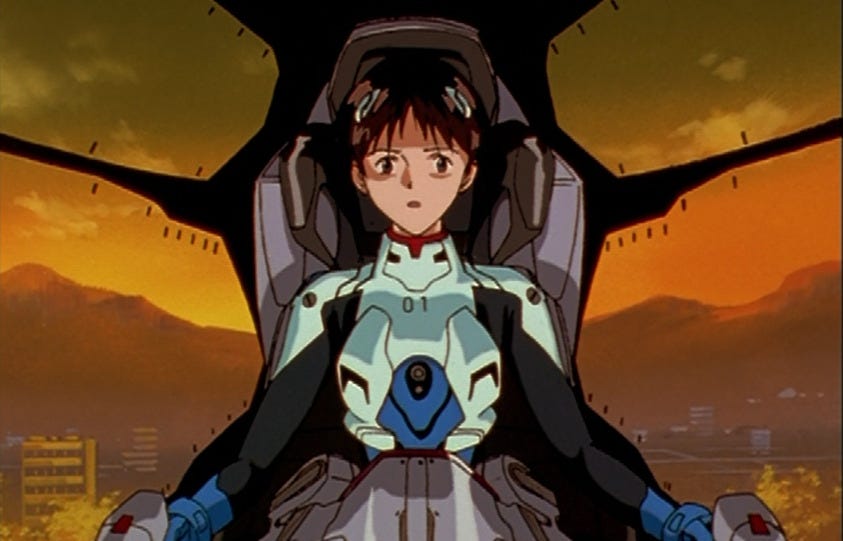
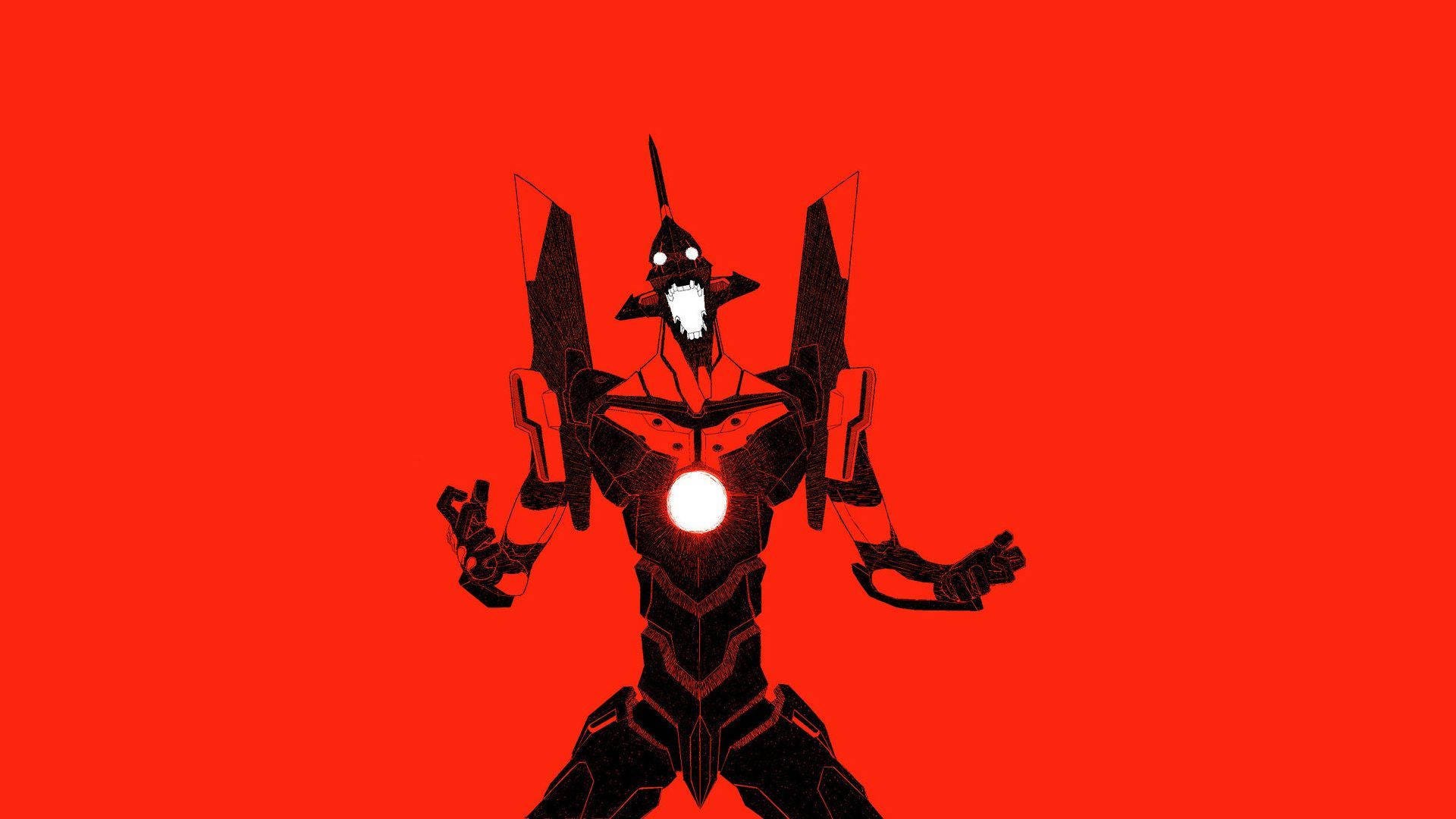
In 1995 a moody anime series called Neon Genesis Evangelion was released, and it quickly became a cult classic. It revolved around an alienated boy - Shinji Ikari - who is recruited to pilot a huge robot warrior called Eva Unit 1. The fighting machine has been designed by his cold and estranged father for the Japanese government, in order to battle a mysterious race of monsters called the Angels.
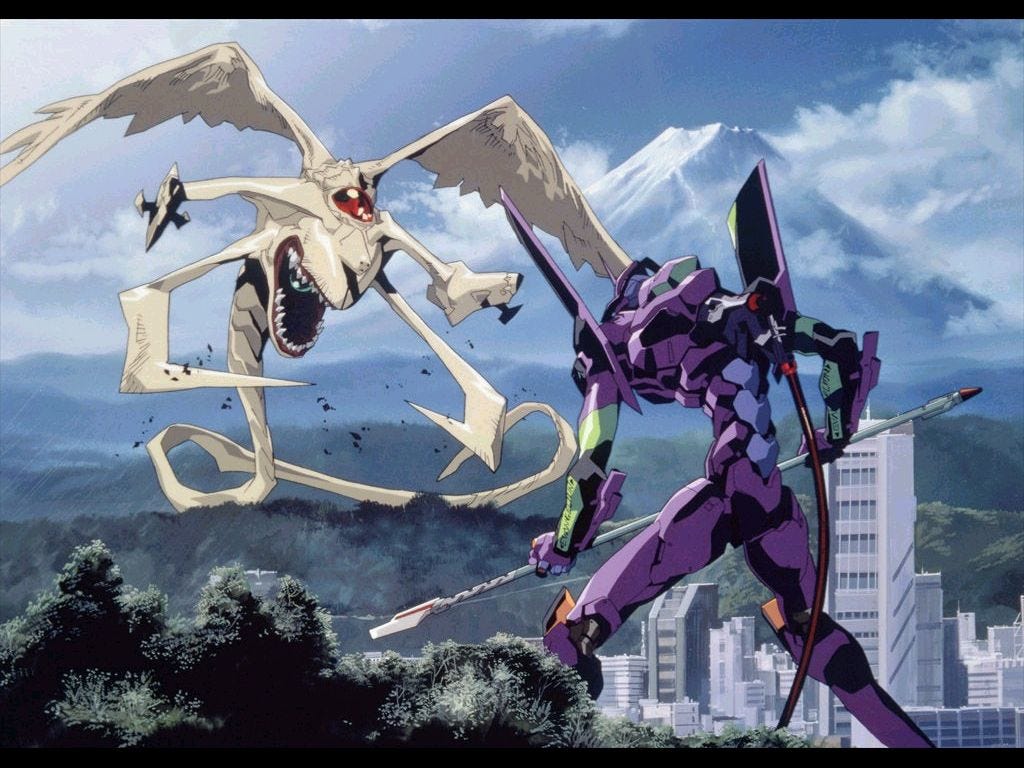
The series follows Shinji as he struggles with the emotional and physical strain of controlling this giant appendage. That strain is particularly acute because the Eva only works if it’s harmoniously synced with Shinji’s own nervous system. Any panic attacks he might have in the cockpit can send it reeling into a berserk frenzy, and any damage done to it by an Angel can wreak havoc on his own body.
![OC] [Fanart] EVA - Unit 1 Berserk : r/evangelion](https://substackcdn.com/image/fetch/$s_!osIU!,f_auto,q_auto:good,fl_progressive:steep/https%3A%2F%2Fsubstack-post-media.s3.amazonaws.com%2Fpublic%2Fimages%2Ffcfa5475-cd52-41b0-b665-896bfef57b58_1772x2362.png "OC] [Fanart] EVA - Unit 1 Berserk : r/evangelion")
Evangelion is a classic in the mecha genre, a branch of anime and manga that focuses on human pilots manning robot bodies. The genre extends beyond Japan - for example, the American series Power Rangers featured teens controlling mechas called Zords. Evangelion, however, is unparalleled in exploring just how dark and emotional this fusing of human and robot can be. The creation of a cyborg taxes both sides.
In sci-fi culture, the cyborg is a melding of human and machine. The combined entity has both greater reach and greater power than its human component. In this sense it represents extension and amplification of human capacity. As Shinji flexes his puny chest to thrust his arm forward 40cm in the cockpit, Eva Unit 1 delivers a 40 metre power-punch with the force of a freight train.
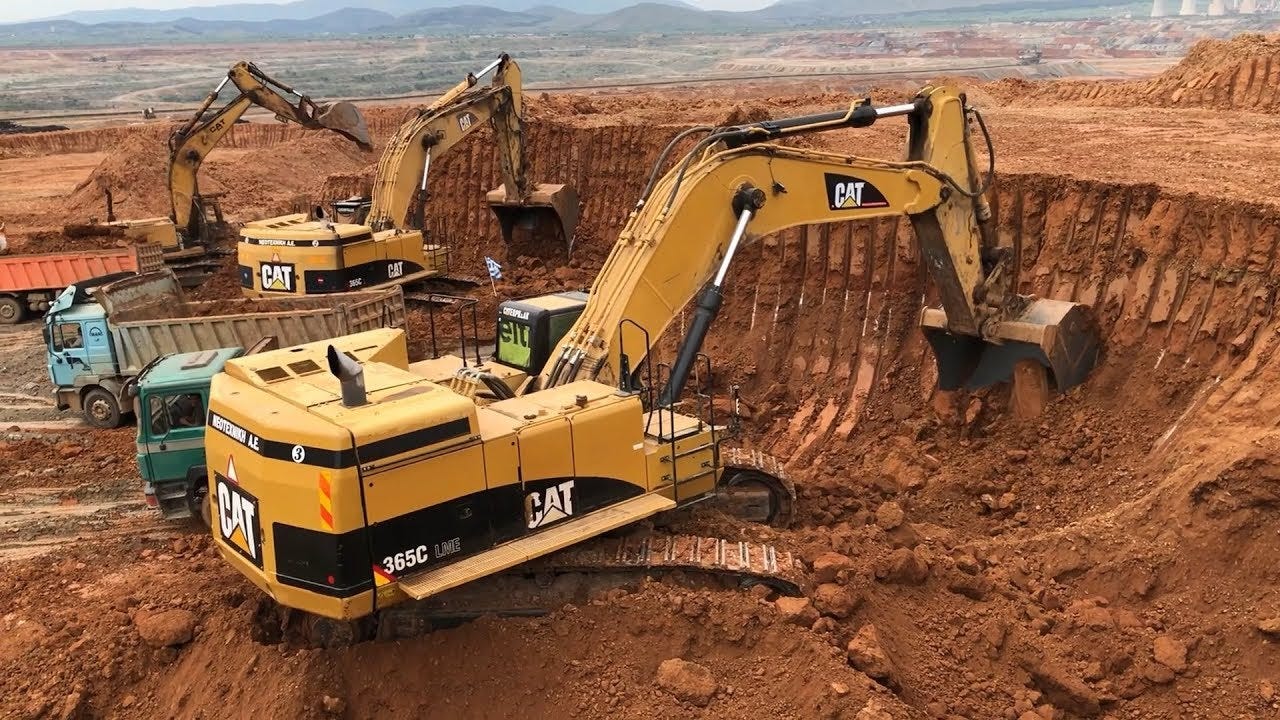
The mecha extends and amplifies the will of its pilot, and in many ways this a broader metaphor for technology more generally. The axe, for example, is an extension of the human arm. It amplifies and focuses a muscle’s energy to leave a gouge in a tree. Likewise, a Caterpillar excavator uses fossil fuels to turn the hand of its pilot into a powerful robot claw that can gouge whole chunks out of the earth. The excavator is, basically, a small mecha.
The figure of the cyborg in sci-fi culture doesn’t merely represent an extended and amplified human, but also a human that has become dependent upon external appendages, and therefore enmeshed with the machine. In the case of Evangelion, humanity’s survival is dependent upon the fusion of Shinji’s nervous system with the Eva, but this same phenomenon occurs in our lives. We cannot make it through a day without recourse to our technology, for we have lost the ability to survive without it. In many ways, we already are cyborgs.
A simple machine is an assemblage of components linked together under some common system of management, and powered by some energy source. We can, however, extend that concept to refer to larger and more complex assemblages, which may be held together under more sprawling management systems. For example, a corporation can be pictured as a globe-spanning assemblage of subsidiaries which collectively own an even vaster assemblage of assets, all tied together under some management structure.
Think, for example, about an agricultural corporation. It might own tens of thousands of combine harvesters - each a small mecha - tethered together through a common management system that’s presided over by a big boss somewhere. At some abstract level, we have here a mecha-of-mechas, a sprawling legal machine tethered to an army of smaller physical machines.

The CEO of a corporation - like the controller of an excavator - can try to make the corporation do things by sending out executive orders from a boardroom. The boss of an oil firm, for example, can instruct the entity to gouge out a thousand kilometre long trench in the earth to lay a pipeline.
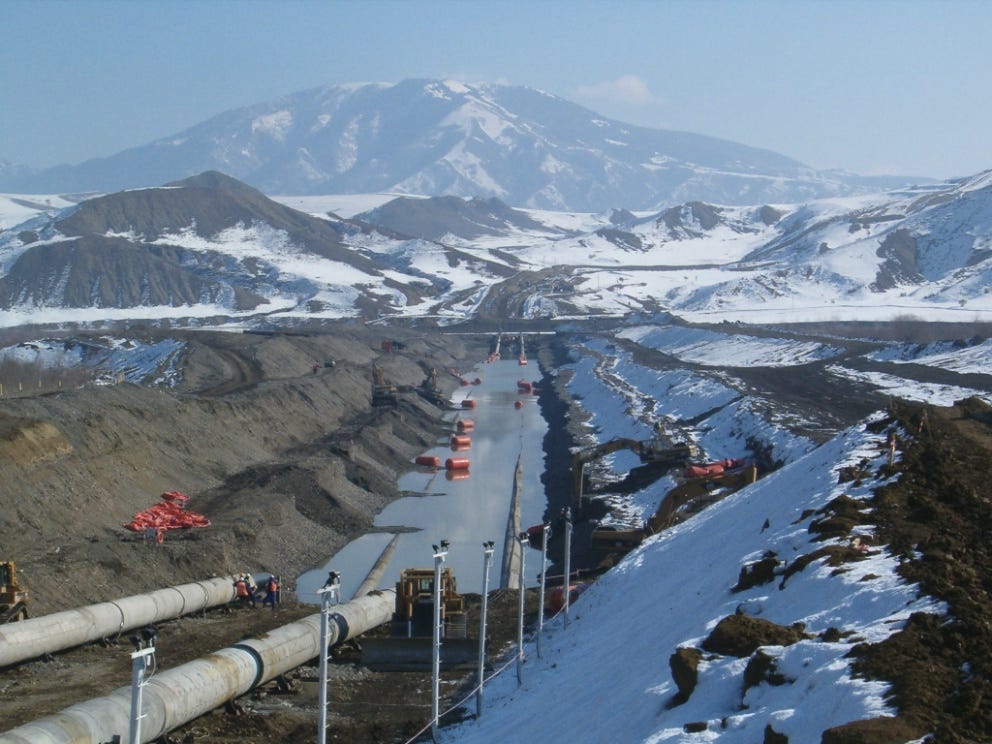
These orders, though, have to filter through many layers of sub-management. By the time the message reaches the frontlines of the entity it might be bogged down by all manner of glitches, short-circuitings, unresponsive parts and unintended feedbacks.
We see a contradiction here. While it’s true that the theoretical power of the controller goes up with the scale of the assemblage, it’s also true that greater scale brings greater unpredictability, with the orders holding less direct purchase over the actions of the entity. While I can be pretty confident in swinging an axe towards a precise target, a CEO of a multi-national corporation cannot guarantee that their instructions will translate into a precise outcome.
One of the main reasons for this is not only the complexity of interlinkages, but the fact that a corporation isn’t merely an assemblage of mechanical parts. Rather, it’s also an assemblage of human beings, who all have their own sense of agency. They do not like being treated as mere ‘cogs in the machine’. They wish for their humanity to be recognised.
Most modern corporations are explicitly hierarchical and often authoritarian, in the sense that they have supreme leaders who have the ability to simply cut loose anyone who disobeys their orders. Most CEOs, however, understand that they cannot simply treat their staff as appendages of a supreme controller, because it creates bad morale and rebellion, and stifles feedback from the frontlines which is needed for good management.
So, while it is possible for us to metaphorically attempt to imagine a corporation as a kind of ‘mecha’ that’s fused into the will of its supreme leader, most CEOs cannot afford to think of themselves as a mecha pilot. They cannot walk around the offices as if they were the only agent, as if their entire staff were simply there to extend and amplify the body and mind of the CEO.
In fact, by the time you’re at the helm of a large corporation, you’re supposed to see yourself as being a team leader in a human organisational structure that involves tens of thousands of others, and you’re supposed to be taking in their feedback and recognising their humanity.
This applies even more when we go up another level to the modern nation state. The person at the helm of a government does have a theoretical ‘mecha’ that they can manipulate via a whole range of mechanisms - policy, law, violence, soft power etc - but the average democratic leader isn’t supposed to think of themselves like that. They’re supposed to see the State as being an entity above-and-beyond themselves that they serve. They’re supposed to see themselves as a temporary caretaker granted power by a body-politic who is the true ‘agent’, and they are supposed to subordinate themselves to that body-politic.
That’s the theory at least, but of course it’s a helluva lot more complex than that in practice. Executive power always justifies itself as being enacted on behalf of a body-politic - all presidents claim to be acting as instruments of their voters - but this can never be separated from the private and personal interests of the person wielding the power. That’s why checks-and-balances are supposed to exist: they are designed to reign in any rogue pilot who is riding the state machinery too hard.
In the case of the US, however, the state machinery extends far beyond its own borders. The US is an empire, and its power is embedded in a gigantic assemblage of murky connections throughout the world. The US state acts not only through networks of proxies, and alliances, and foreign military bases, but also through its corporate sector, media and cultural influence. If you zoom out, the US ‘mecha’ extends across the globe, with the capacity to strike directly through missiles or indirectly through films and music.
The sheer scale of this assemblage means that most US presidents cannot picture themselves as a mecha pilot. It’s simply untenable to imagine that this complex is a mere extension of its leader. Indeed, for a president to imagine that the US state simply exists to reflect his personal desires and dreams would be the deepest form of narcissism. It would be to imagine that other consciousnesses are simply mechanical parts that have no purpose beyond enacting his own desires. It would be to imagine that voters are not primarily instructors granting a task, but rather loyal devotees recognising a supreme divine power.
I’m not going to come out and say that Trump overtly thinks of himself as a divine mecha pilot. I’m not going to claim that he is unable to process the fact that other people have wills and consciousnesses that do not reflect his own. I will, however, say that he does use a lot of rhetoric, and display a lot of behaviour, that suggests that he might view himself like this.
Certainly we can say that, compared to other US presidents, he’s coming a lot closer to seeing the state as an extension of his own body, as if he has only a hazy sense of a distinction between himself and its powers. A defining feature of his presidency has been to centralise power into a ‘unitary executive’. It often does seem that he sees the White House and Mar-a-Lago as cockpits of a planetary scale mecha fused with his own nervous system, a colossal exoskeleton that he controls through executive orders, which turn his small thoughts into giant globe-spanning punches.
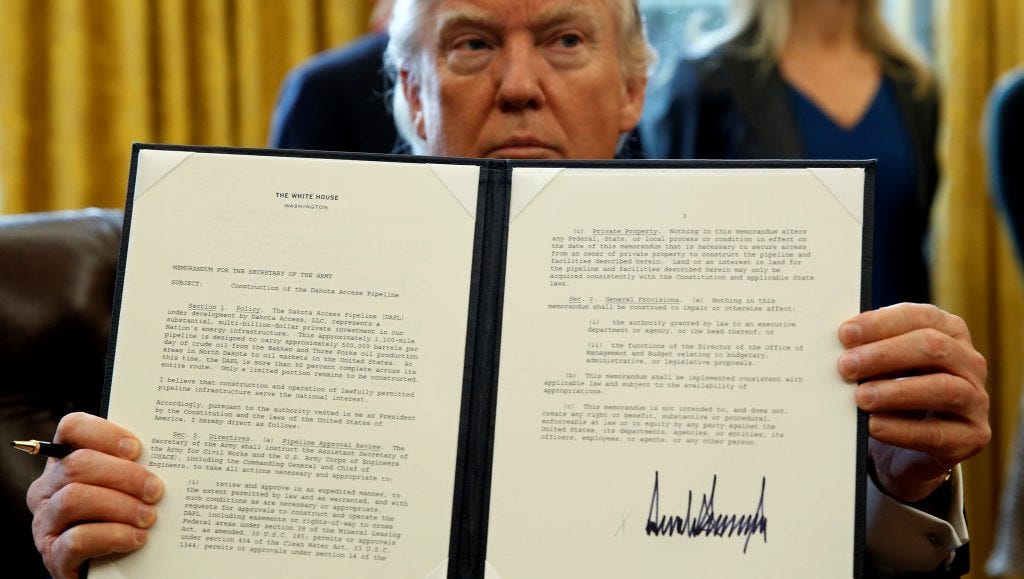
This attitude applies beyond immediate state institutions. For example, he sometimes seems to imagine that US corporations exist to enact his broader plan for the world, and that allies are subordinated appendages. This is reflected in the casual language of his speeches, in which complex, interdependent systems that have billions of connections - like the global economy, or the bond market - are spoken of as if they were easily manipulatable limbs, as if shifting the future of the world could be done through a phone call to a few mates.
He doesn’t seem to treat tariffs, military strikes, and sanctions as complex actions involving tens of millions of players that have wide-ranging and unpredictable consequences. Rather, it often appears as if he sees these and other mechanisms as fists that he can use to deliver precise blows across the globe from his desk.
If he does have this mentality though, he will also find himself with a problem, which is that this mecha wasn’t actually designed to fuse with him. He’ll often experience it as faulty, as it frequently fails to obey orders. It will seem to have components designed to frustrate his intentions. He might think the interface between his nervous system and the machinery of state has been infiltrated by a virus he calls the ‘deep state’, which is severing the connection between himself and the fists, weakening them. He might have tantrums, trying to shake pieces off the mecha that are not aligned with his being. Maybe he’ll feel an impulse to discard the soft power mechanisms because their connection to his body is just too diffuse. Maybe that’s why he will jettison USAID and try to shut down Hollywood and so on.
But, even if he was able to shake off those components that don’t sync up with him, he still finds himself at the helm of an extended imperial body that has - de facto - many decentralised centres of power. Regardless of what he imagines, he’s not in control of the stock market. He cannot push a button and make the Chinese - or the Iranians - do what he wants. He cannot simply subsume the interests of Big Tech, Big Oil and Big Finance under himself. He cannot simply ignore the fact that the mecha itself has a nervous system in the form of the US dollar - and petrodollar - and that such a system is constantly being affected by outside ‘pilots’. He doesn’t have nearly as much control of the machine than he imagines.
In fact, it may be the case that he himself is simply a reflection of the fact that the mecha has already gone berserk, unable to process the grief and angst of its own imperial decline.
Who are the Angels in this metaphor?
Generally I appreciate this level of hyper-geekiness, but I feel the metaphor falls short because of the sheer complexity of NGE.
And as you mention, there's a give and take between human and machine (especially because the machine is part organic), but Trump Is immune to feedback.
Perhaps just as worrying is the possibility that DT himself is a (largish) cog in a different machine.