

How to Visualize Capitalism (Part 1)
A 10-part modular model for seeing the circuitry of our economy

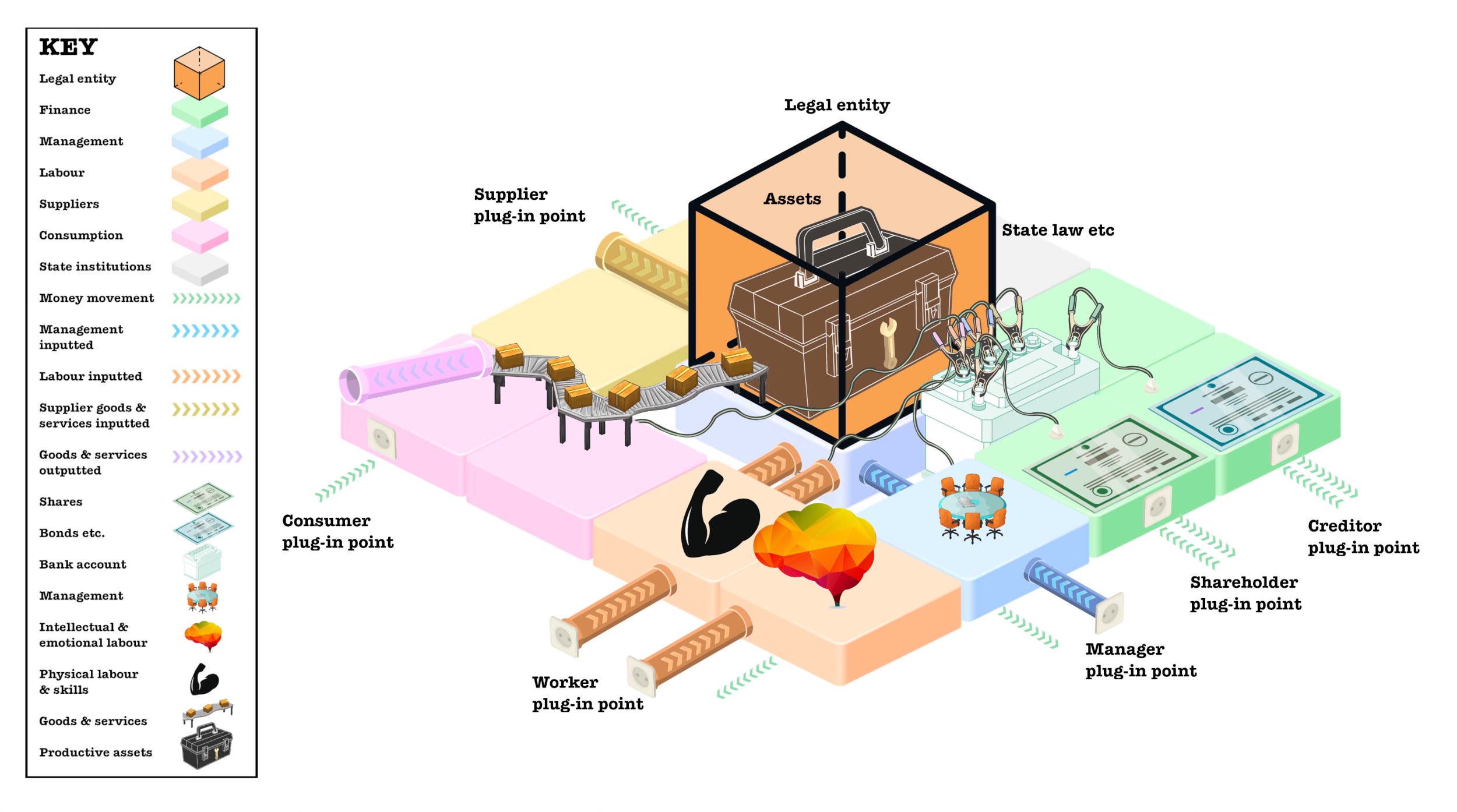
One of the core missions of ASOMOCO is to take complex, invisible systems and to make them visible. I’ve previously built pictures of corporations, corporate capitalism, the 10 layers of finance, and the monetary system. Over the last couple weeks, though, I’ve been updating this imagery to create a visual language composed of modular symbolic parts that can be arranged to describe the circuitry of capitalism.
The overall model has 10 sections to it, each designed to introduce new layers of complexity. Today I’m releasing the first seven sections to all readers, but on Friday I will release a Part 2 exclusively for paying subscribers, in which three additional sections are added. They will fuse the visualizations of Part 1 with the monetary and financial system to create a full picture of modern capitalism. If you’d like to receive Part 2, you can sign up below.
Finally, in the week after, I will then release a new tool for paying subscribers, in which I map the existing articles of ASOMOCO onto the images, so that readers can see how every essay I write fits into a bigger picture.
Enjoy!
0: The foundation
In the final analysis, everything in our world is built upon a foundation of ecological systems, within which interdependent human societies form. This has been the case for a couple hundred thousand years. To explore the foundations of all economies, you can take a look at my Econ Life 101 series.
1: The single corporation
To begin to visualise the capitalist economy in particular, though, I’m going to start in mid-air. It will come to make sense by the end.
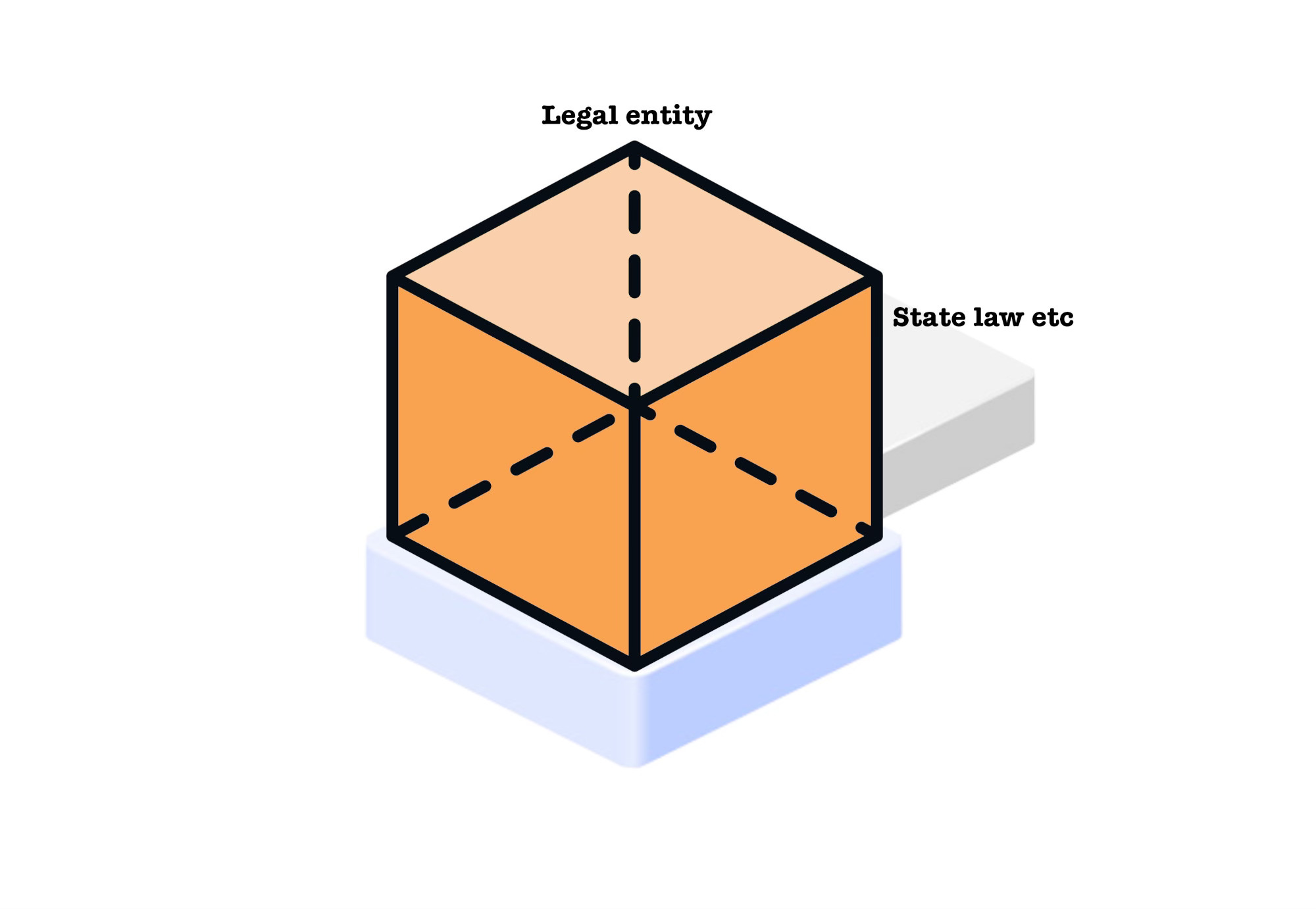
Let’s start with a new corporation. It’s an empty legal entity ‘incorporated’ upon a foundation of state law. This law grants it legal personhood, the right to act as if it were a person in the world. It is allowed to own things, enter into contracts and generally ‘do’ stuff that people can do. Of course, given that it has no mind, body or desire, this is a fiction, but the legal entity will become a focal point around which different groups of people will arrange themselves.
To act in the world, this entity will need a bank account. Let’s represent this account as a battery.
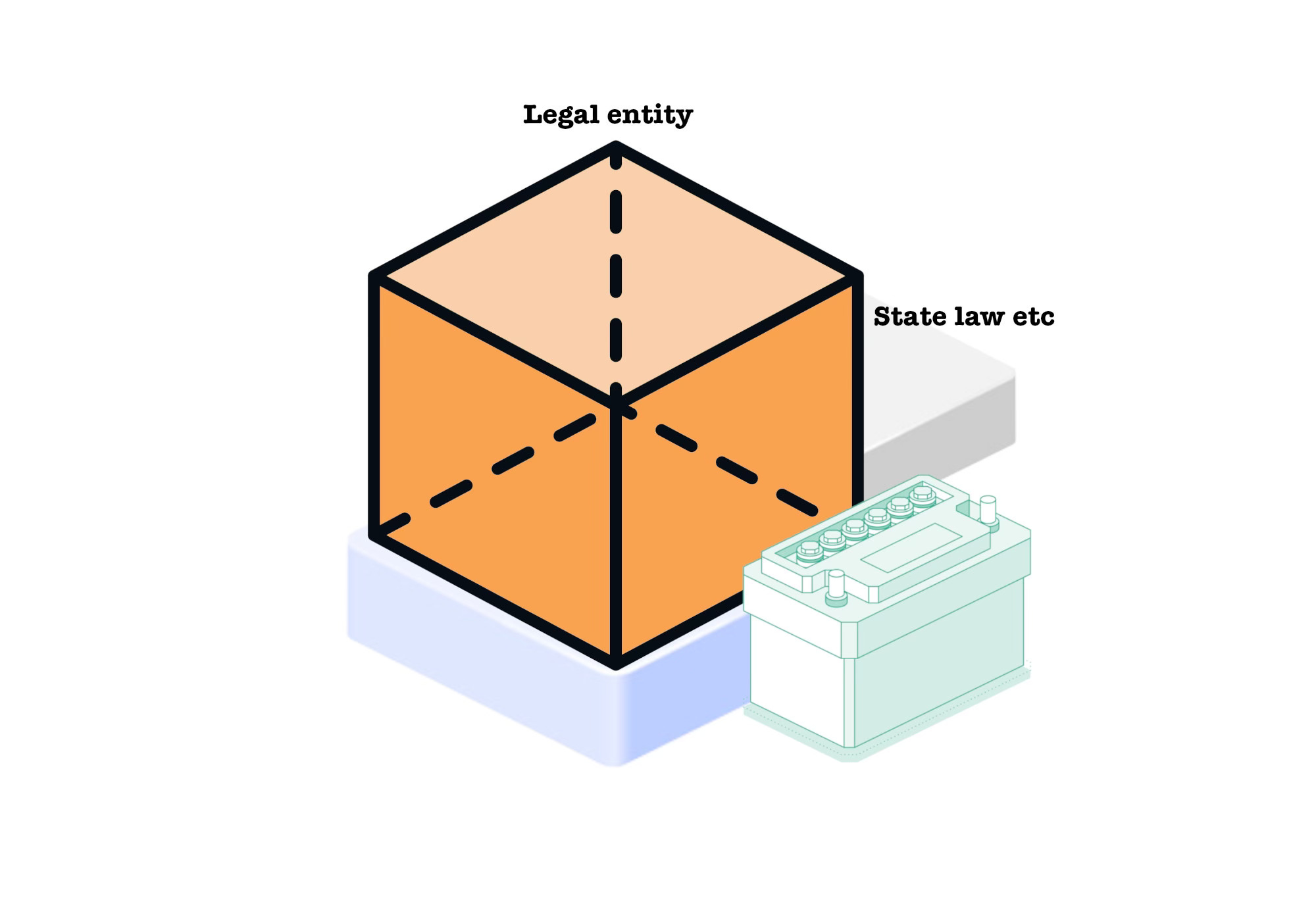
I’d like to make one thing clear here. By using the image of a battery, I don’t mean to imply that money ‘powers’ the economy. Economies are powered by humans and ecological systems (both of which are, in the final analysis, powered by the sun), but money does trigger people into action, much like a nerve impulse triggers a muscle to move.
So, when this bank account is ‘charged up’ with money, it can be used to trigger action, but this bank account is initially empty.
To charge it up, two types of financiers - shareholders and creditors - input money. There are many different styles and sizes of such financiers, but I’m initially going to just generically represent them as big financial institutions (like investment funds) plugging money (green arrows) into the system, and that money being transmitted into the battery via jump leads. In return for this, they get legal instruments - shares and bonds (represented below as certificates) - that grant them claims upon future money (for more on this, see The Ten Layers of Finance).
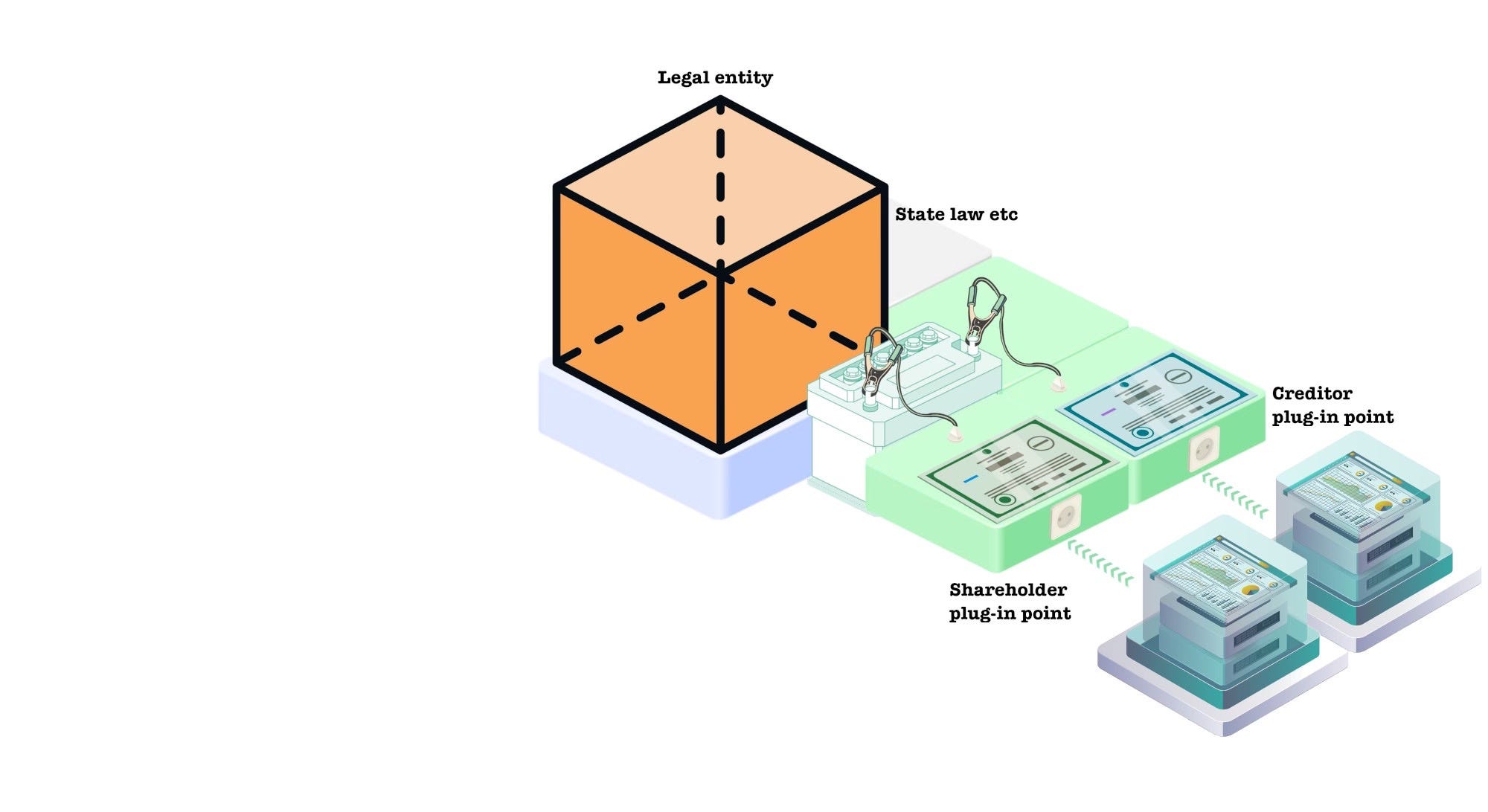
We now have a legal entity, with claims upon it owned by shareholders and creditors. The entity itself owns a charged-up bank account, but remains mindless and directionless, so money from the battery must now be outputted to hire managers to direct it.
I’m going to represent these managers as little stick figures who plug in managerial labour (blue arrows) into the system, in exchange for money. I’ve added in a new jump lead from the battery to represent that outgoing payment.
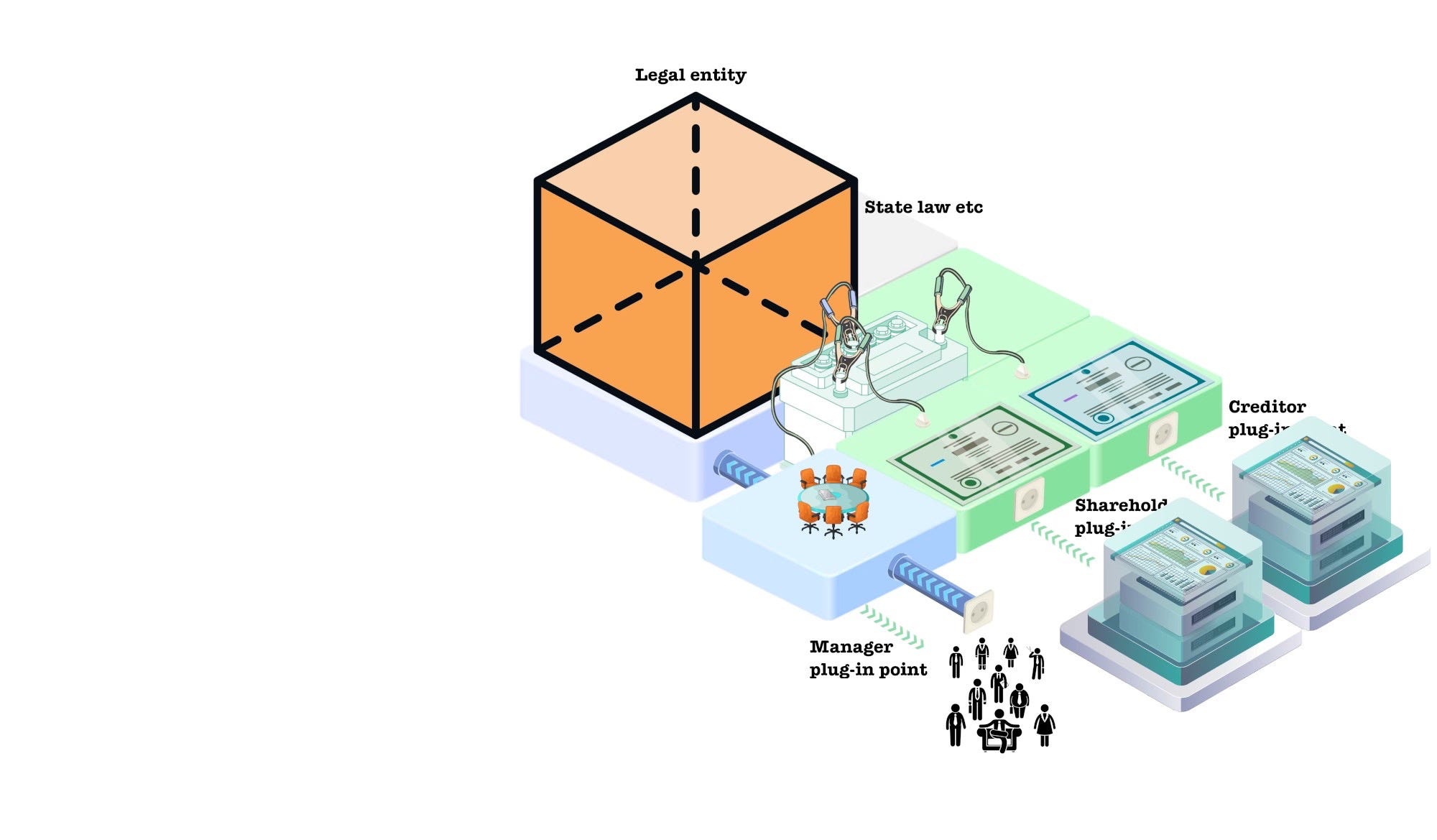
These managers in turn can begin to direct the legal entity to do things. One of their first acts is to direct it to pay suppliers to input tools and other productive assets into the legal entity. Productive assets are simply things that can be used to make other things, and I’m going to generically represent these as tools in a toolbox owned by the legal entity. I’m not going to represent the external suppliers yet - I will show them later.
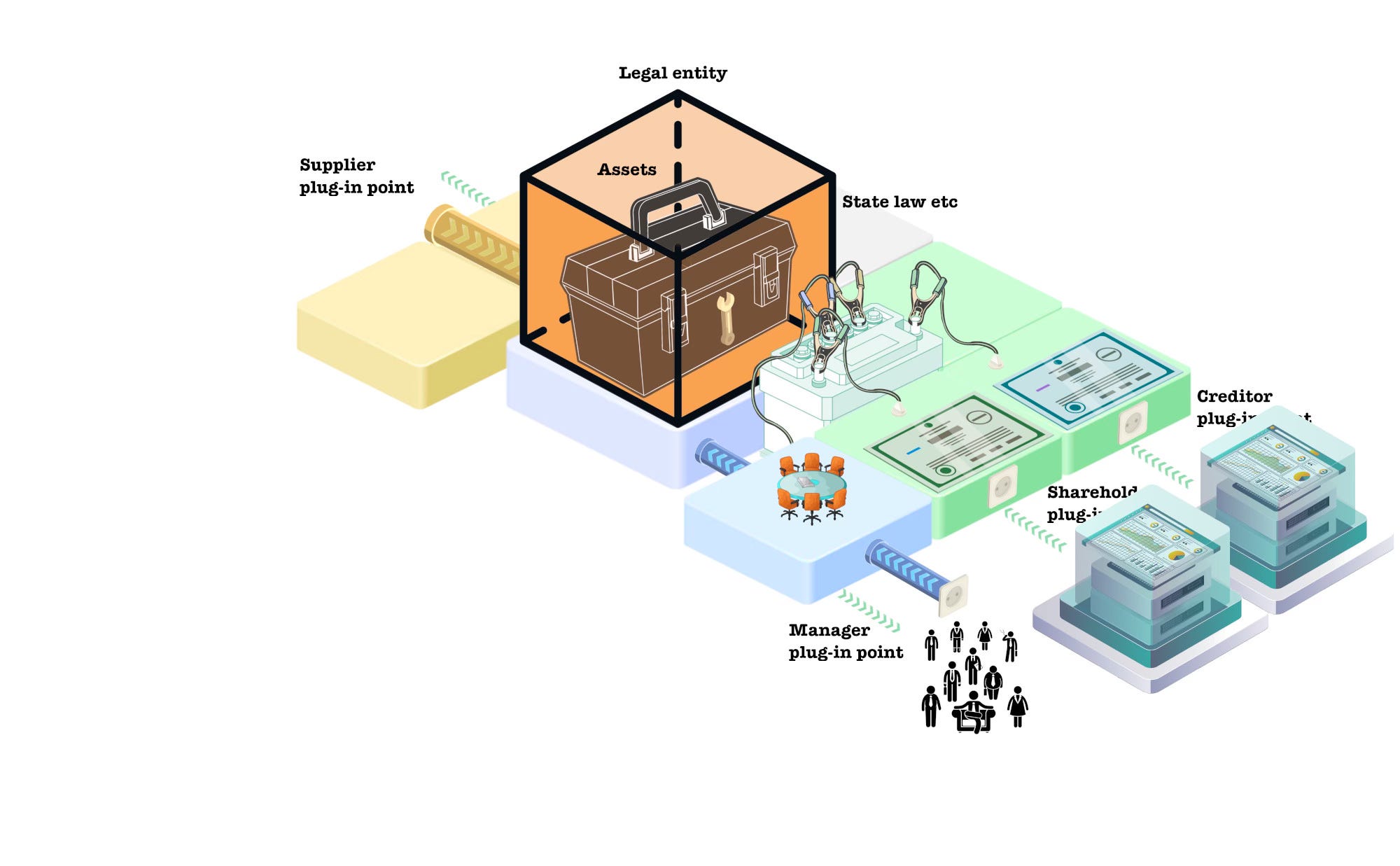
The ‘toolbox’ could include a very wide range of different things. For example, imagine a firm paying external suppliers for computers, desks, stationery and printers. In the 19th century, the ‘toolbox’ might have been a big building stocked full of coal-powered machines and materials - a factory - but in a modern economy it could also include, for example, ‘intangible’ assets like licenses and proprietary software.
Regardless of what form they take, assets by themselves cannot do anything. They will sit there idle, unless they are activated by workers who will plug in labour power into the system to operate the ‘toolbox’ in exchange for money outputted as wages. I’ve represented this labour power below with orange arrows, but labour takes many forms. It can be physical (represented by the muscle below), but also mental and emotional (represented by the multicoloured emotional mind).
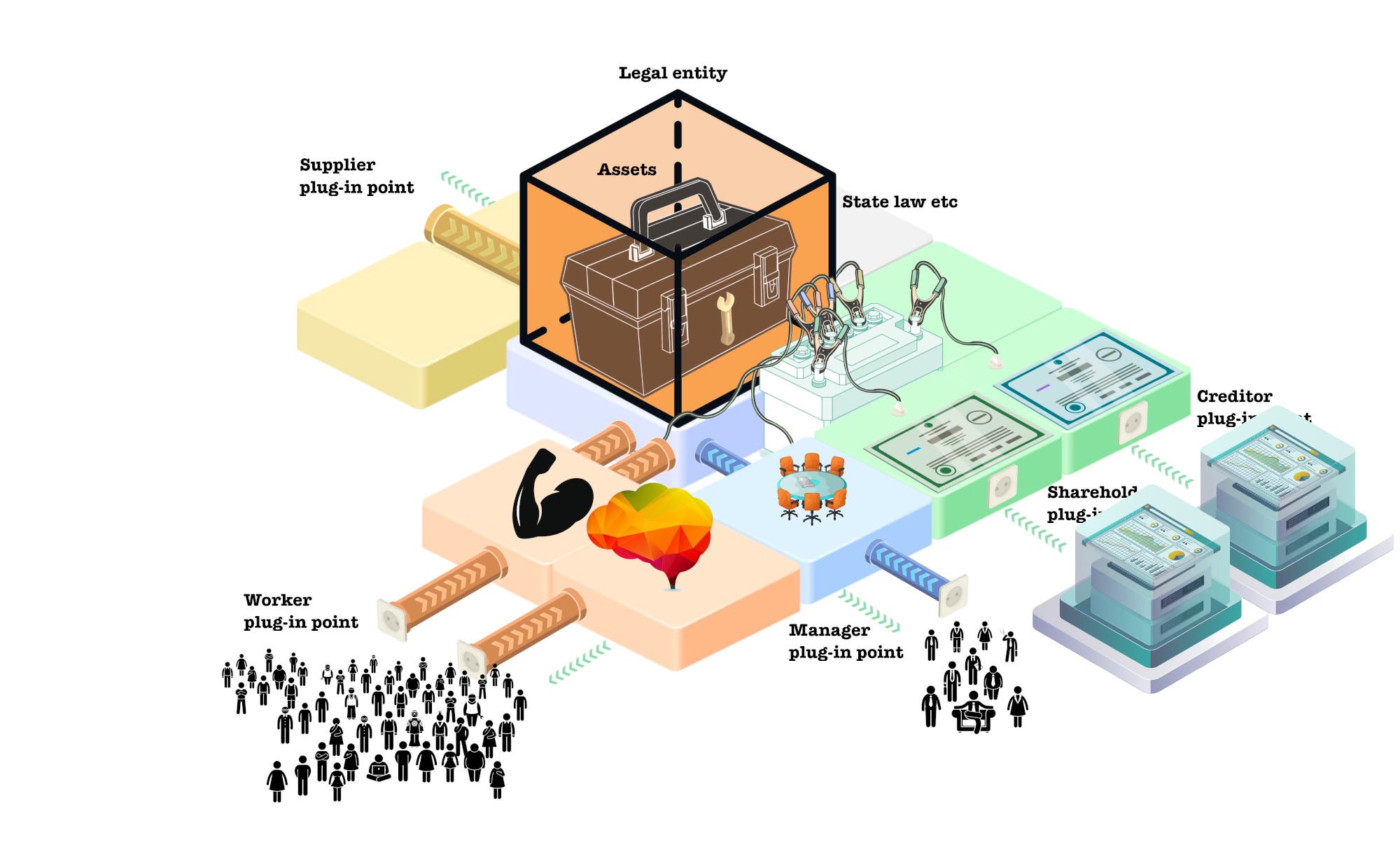
Nowadays there are complex debates as to whether the labour component of economies can be completely removed, leaving us with only financiers, managers and machines (tech companies fantasise about this), but the best way to think of the toolbox is as an amplifier of labour power, which needs labour to activate it.
So, labour power, under the direction of management, will combine with the productive assets to output goods and services. I’m symbolically representing those below as boxes on a conveyor belt, but those ‘boxes’ could contain anything from tractors to aromatherapy oils to consulting services. These goods and services are outputted to consumers, a process I’m representing with pinky-purple arrows below (for the record, I’ve never been a fan of the term ‘consumer’, but I’m going to use it because it is entrenched in common parlance).
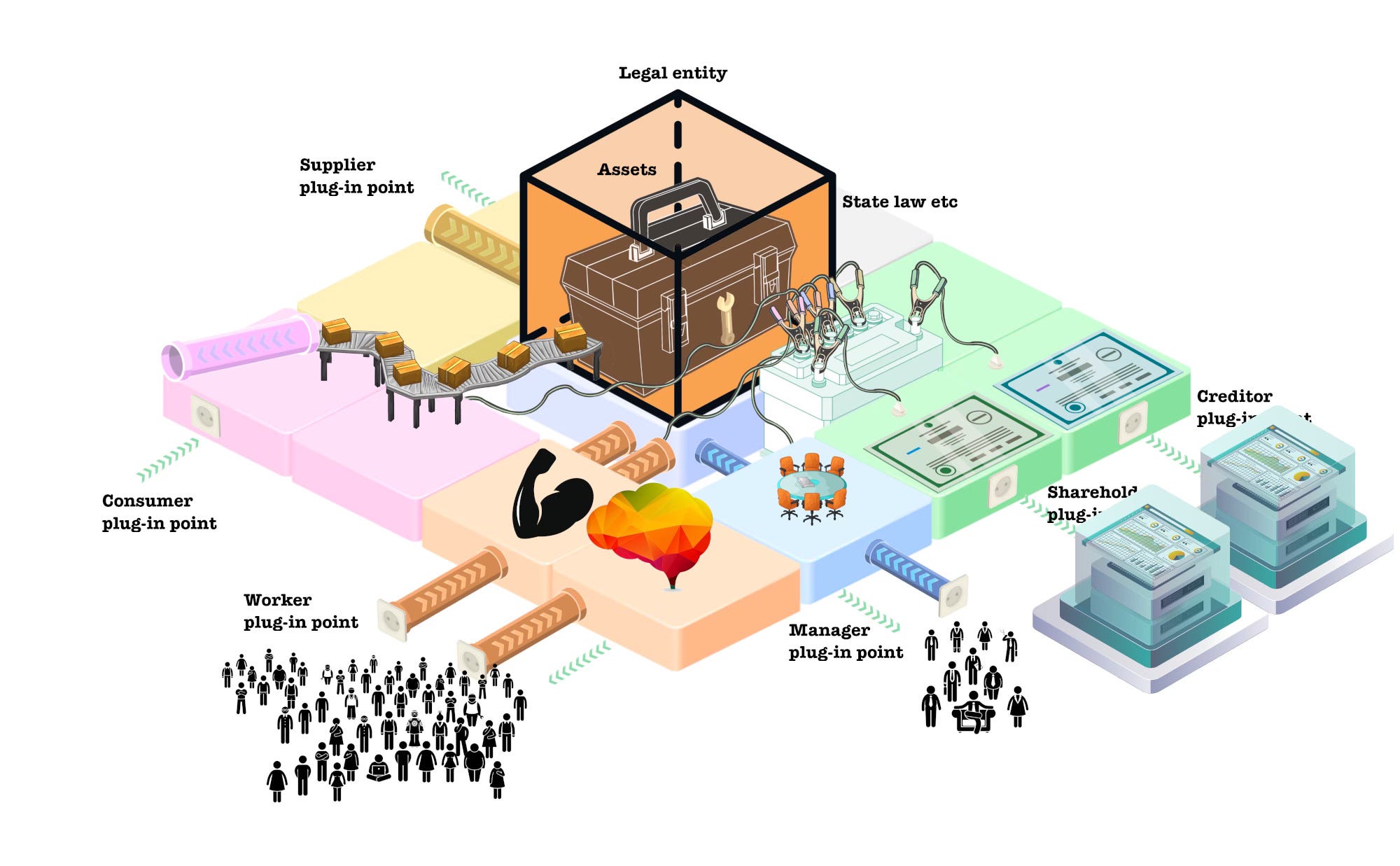
I’m not going to represent the consumers yet, but they input money into the system in exchange for those outputted goods and services, and that money in turn will be sent back into the battery. In due course, managers can then decide to pass that money back out to creditors in the form of interest and to shareholders in the form of dividends (and to governments in the form of tax, though I haven’t shown that here). I’ve represented those ‘returns’ in the image above as money exiting back out to the financiers. This is the money that they were promised earlier, encoded in the financial instruments they obtained when they originally charged up the battery.
An alternative path
Before moving on, I’ll add one complexity, which is that outputted goods and services can also be re-inputted into the company as a new asset. The firm can essentially act as a ‘supplier’ to itself. For example, imagine an employee using computers owned by the firm (but inputted by an external supplier) to programme a new factory management system that is then inputted back into the ‘toolbox’ as a new software asset. In essence the employee activated the assets to output something as a new input, a process I’ll represent as the conveyor belt doubling back on itself.
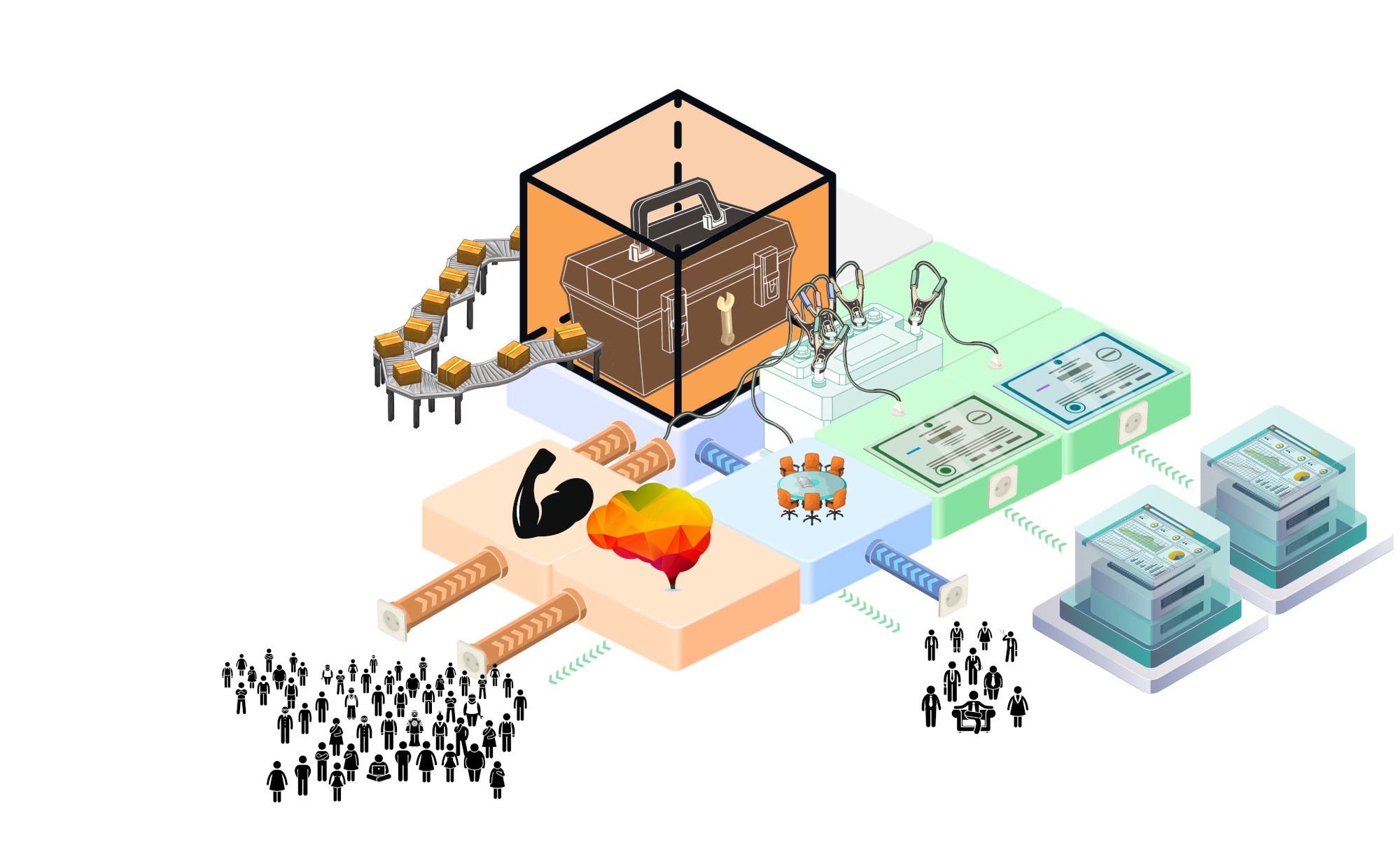
The important point to take away from this is that labour power can either be used to operate assets - outputting stuff to customers - or to build assets, bolstering the toolbox that will later be used to output more stuff. For the record, this is an important point to understand if you’d like to grapple with Marxist critiques of capitalism, in which labour power is assumed to both create assets and operate assets for an ownership class that takes rent.
2: Interlinked firms (‘supply chains’)
So far I haven’t shown who exactly an external supplier is, but a supplier is often just a second firm that outputs goods and services as inputs into our first firm. In the image below I show this, with the pink output section of one firm docking into the yellow supplier input section of another.
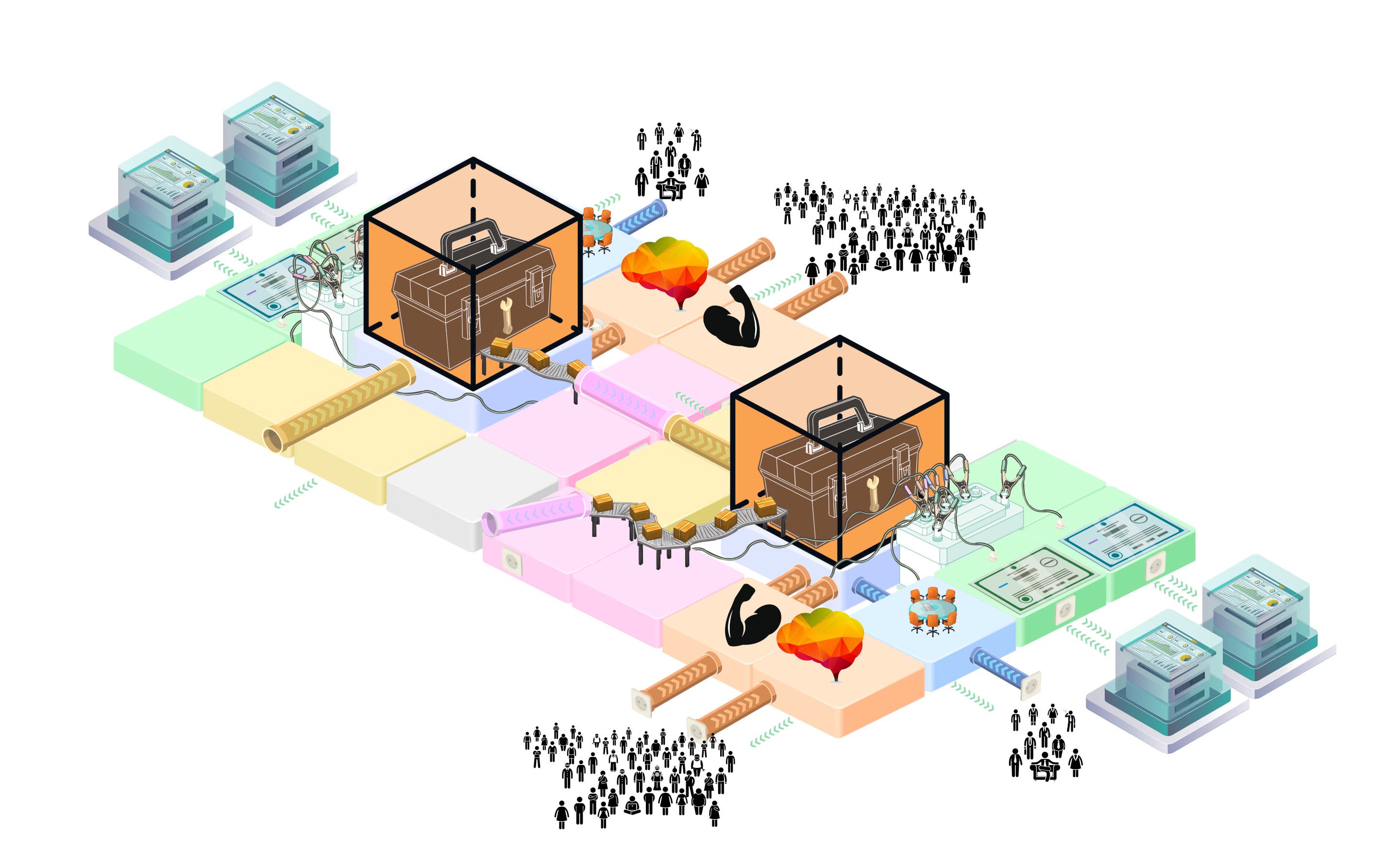
The firm on the left experiences the one on the right as a consumer of its goods and services, while the firm on the right experiences the firm on the left as a supplier that is inputting stuff into its asset ‘toolbox’, to be used for its own production processes. The two firms can be seen as chained together as part of the same overall production process, with the firm on the left forming part of the supply chain of the firm on the right.
3: Interlinked firms with bosses and workers doubling as consumers and financiers
Entanglement goes beyond chains of firms though. Let’s try to start picturing this by imagining a hyper-simplified economy in which there are only two companies with two sets of management teams and two sets of workers. Let’s now imagine the workers of one company using their wages to buy some of the goods outputted by the other company.
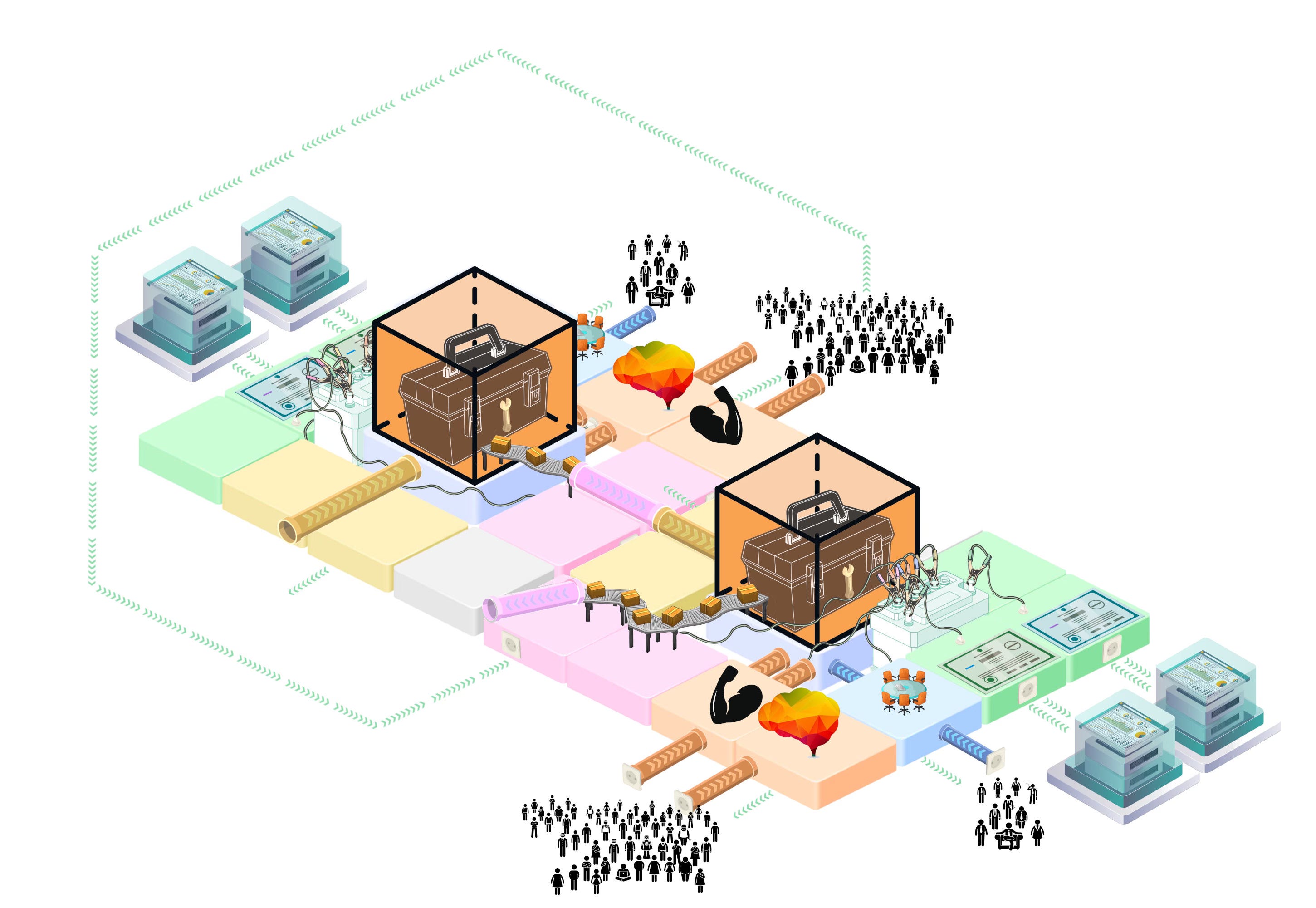
In our everyday life, we see this kind of thing all the time. For example, a person who works for an energy company might use some of their wage to buy cereal from an agribusiness company that uses electricity from the energy company.
Let’s now picture a second interlinkage, in which an executive at the energy company uses their salary to buy units in a fund that invests into the farming company.
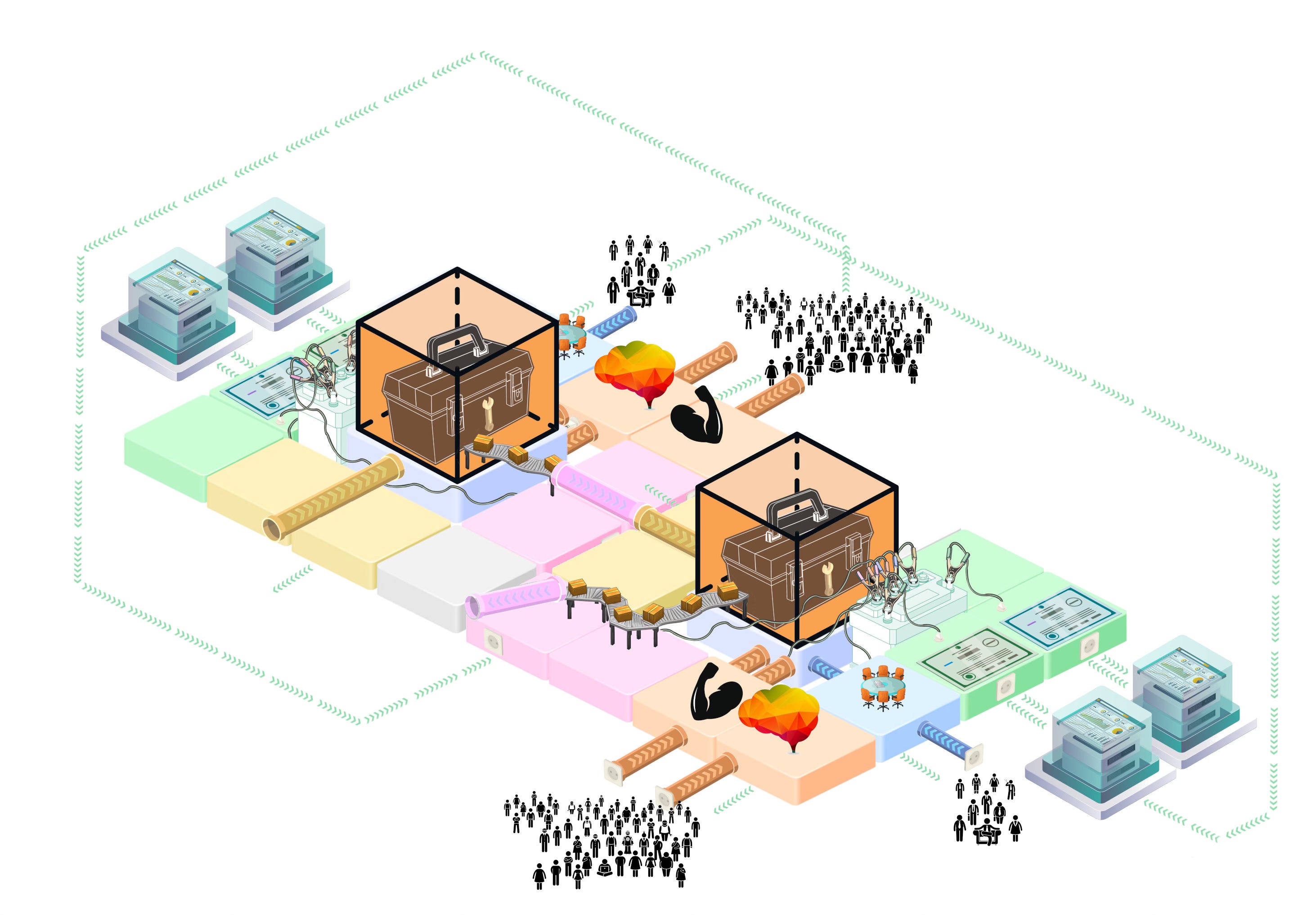
If you follow the green money arrows around, you can see that the energy company workers can input money as consumers into the agribusiness company, which in turn can be outputted as returns to financiers, of which the energy company manager is now one.
So, not only is the energy company manager also a financier of the agribusiness company, but they can transform into a consumer if they too decide to use their dividends, or salary, to buy cereal. Even with this simple picture, we can discern three sets of possible income - worker wages, manager salaries or financier returns - that can be re-inputted back into the system to claim goods as a consumer.
4: Smaller firms interlinking with larger ones
So far, I’ve been showing firms of equal power and size, but actual supply chains are often made up of players with vastly different levels of power and assets, with smaller firms acting as suppliers to larger ones, and vice versa.
Below is an image of a small firm. Let’s call it an SME (an acronym for ‘small and medium sized enterprise). It is ‘self-financed’, because the three partners that act as its managers, also put up money as shareholders to buy the assets that their firm needs in order to operate. The labour force that uses those assets is also smaller.
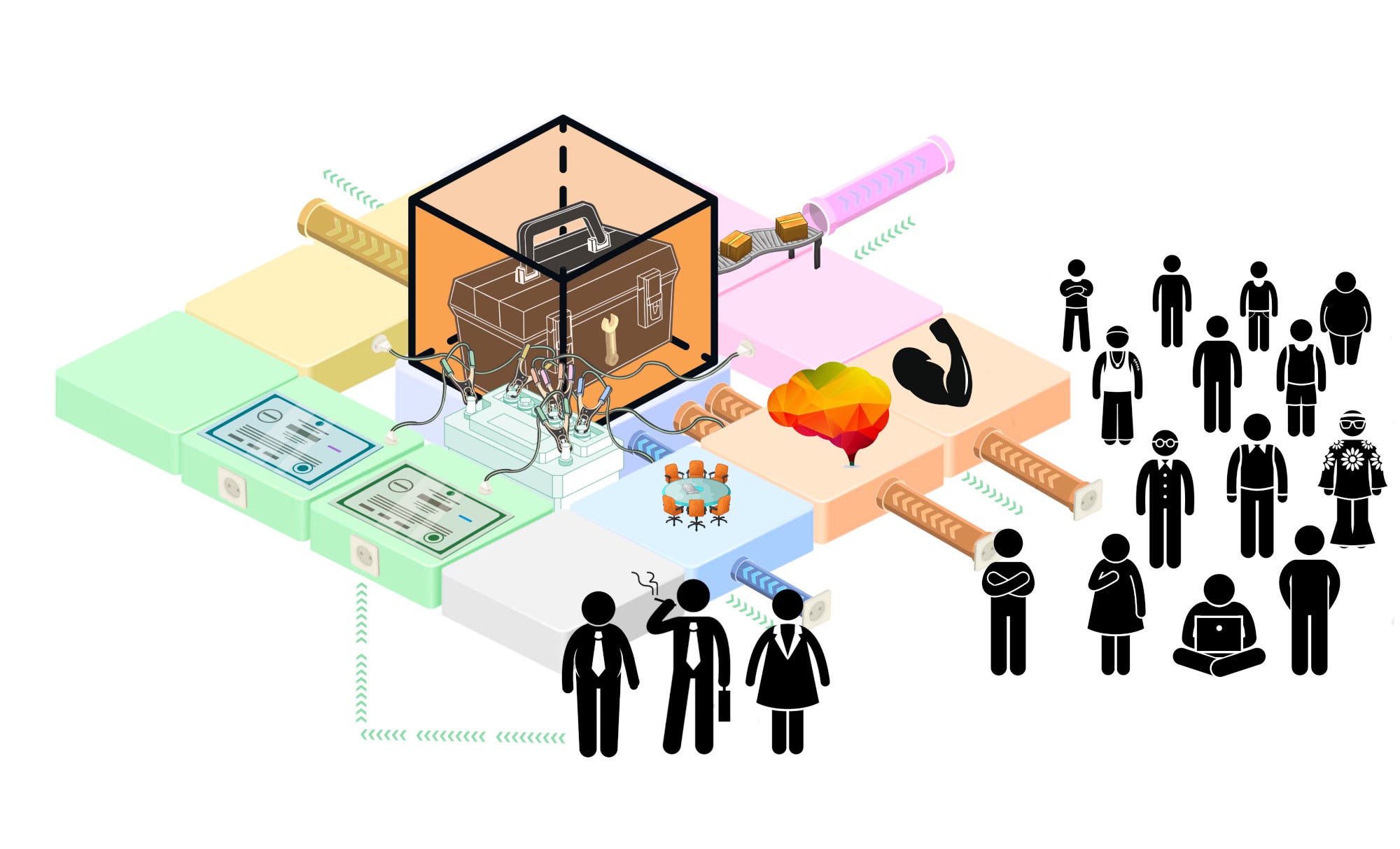
Let’s now imagine that one of their suppliers is an even smaller firm…
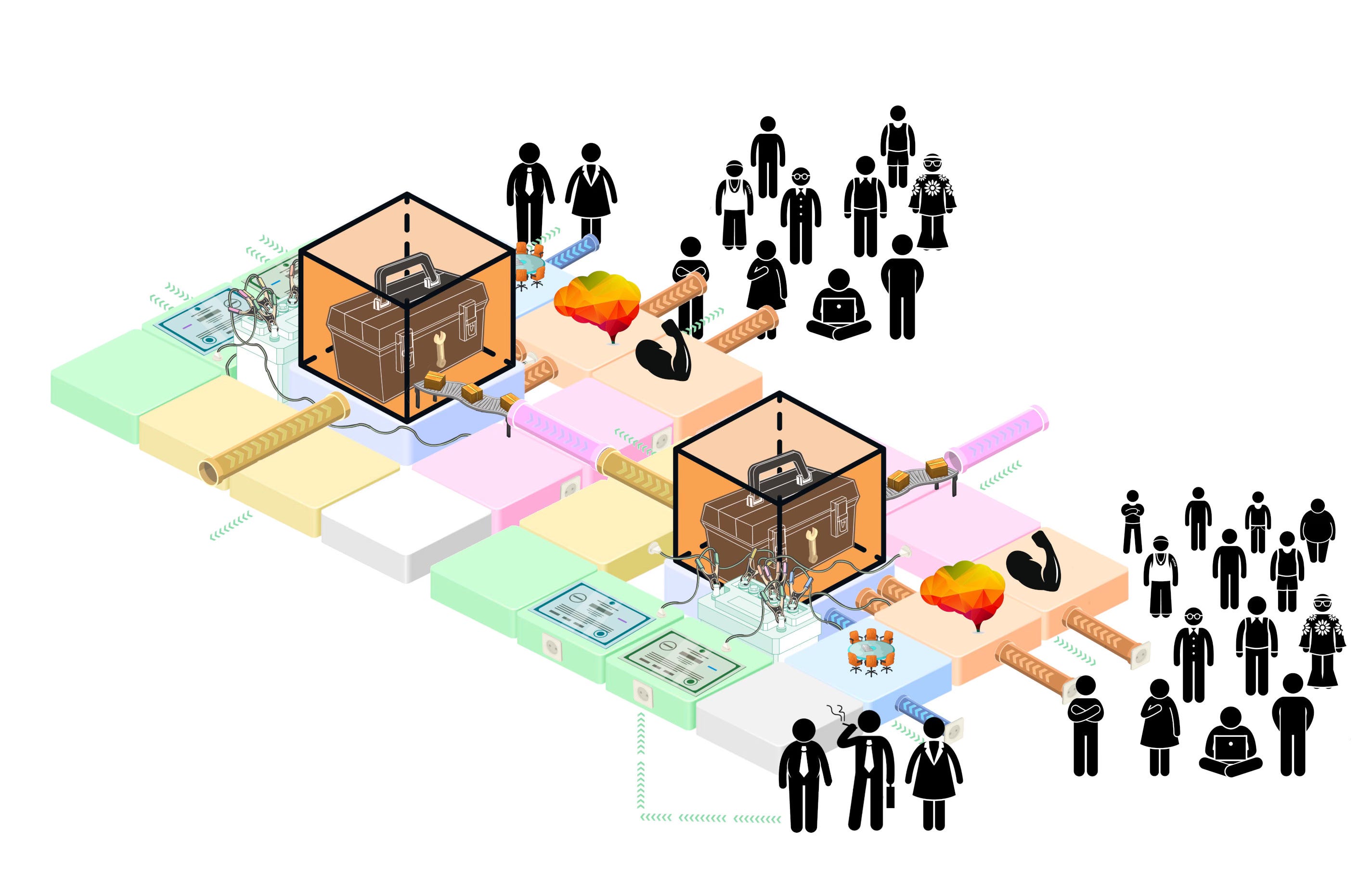
This little complex of two SMEs in turn can dock in as one of the many suppliers to a larger corporation, which itself is part of the supply chain of another large corporation.
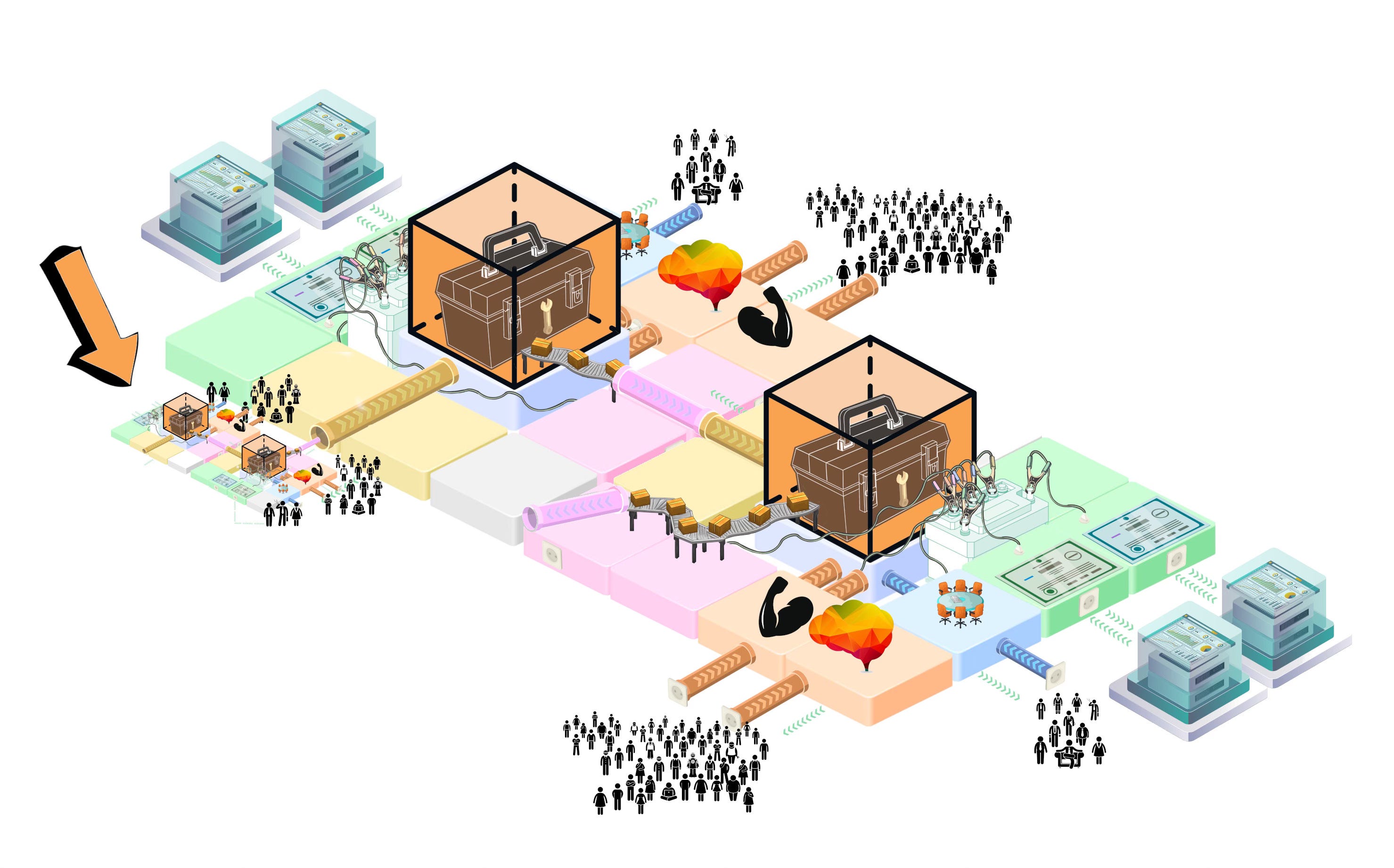
5: ‘Self-employment’
In the images above I’m using different colours to represent different conceptual segments of economic action (green for financing, blue for managing, yellow for inputting stuff, orange for labouring, and pink for outputting stuff) but at a smaller scale every individual person can also internalise such forms of action into themselves.
For example, a ‘self-employed’ person can take on multiple of those roles at the same time. They might self-finance a small number of assets - obtaining a little toolbox - and then ‘manage themselves’ while also ‘employing themselves’.
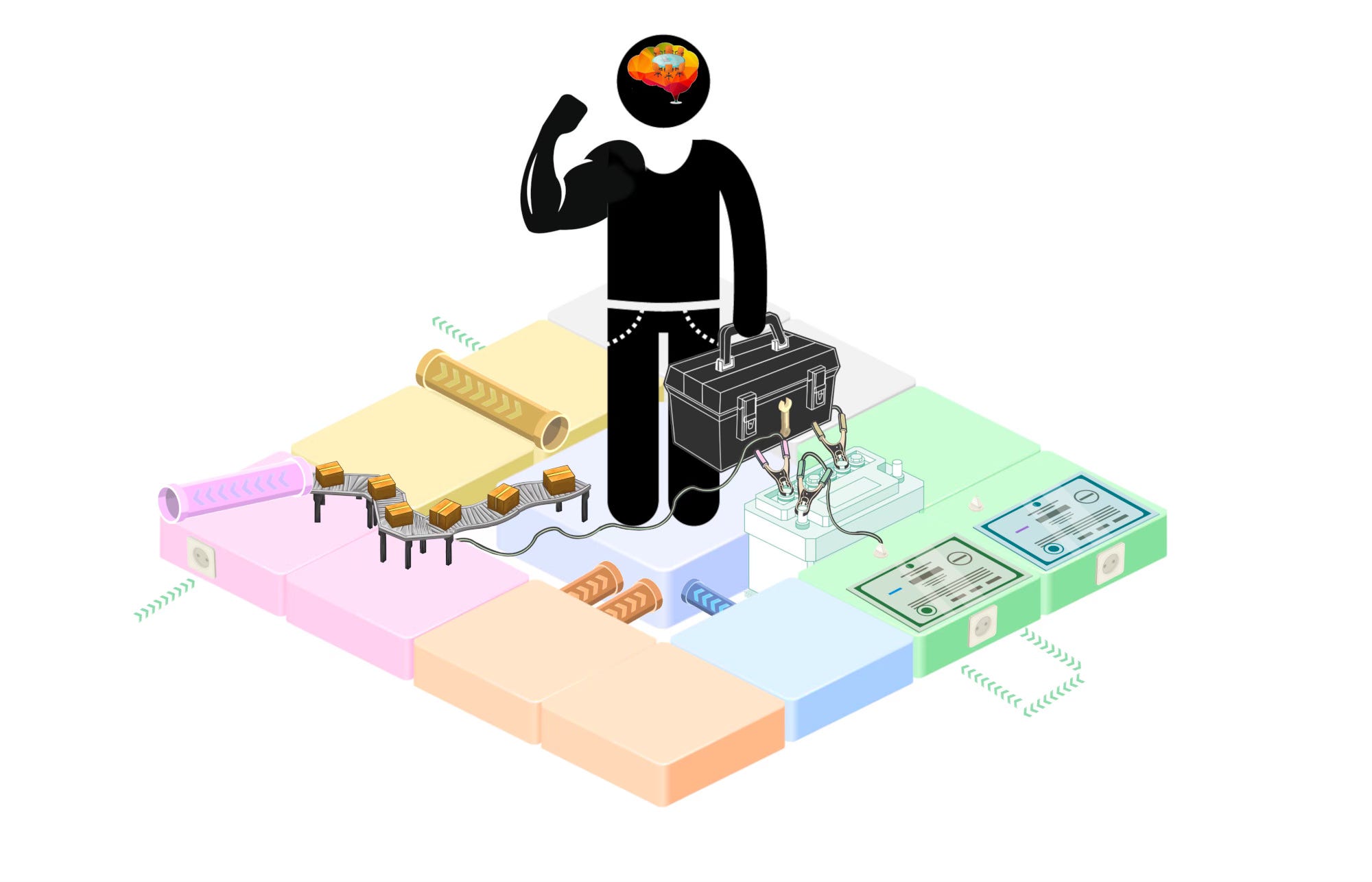
I, for example, am a self-employed writer who ‘finances’ my own productive assets (like my computer) by using money I’ve saved from previous income. In that position, I am a shareholder, obtaining ownership in assets. I then step into a different position in which I manage my time - a manager role - and ‘employ’ myself, directing my labour power to do different tasks. That latter ‘worker’ section of me will operate the computer to output goods and services (like this article), which I hope that some people will pay for.
Because all these roles are internalised within me, it’s highly ambiguous as to whether my subsequent income takes the form of wages, salaries or dividends, but in reality it’s all three at once.
Once I’ve received that income, I can choose whether to slip back into the ‘shareholder’ role and ‘reinvest’ it into new assets - upgrading my computer - or whether to buy food to continue surviving. At a macro-economic scale, me doing the latter will be considered an act of consumption - I am a consumer - but in my own little picture, it will be me inputting goods from a supplier, because, after all, I cannot continue to produce if I don’t eat, and so buying cereal for myself is actually part of maintaining my internal biological ‘toolbox’.
Self-employed people can do business with each other - creating a peer-to-peer economy in which they bypass big firms. Many small-scale informal economies are like this, but nowadays most self-employed people also rely upon docking into firms. Let’s imagine a self-employed maintenance man doing some work for one of the SMEs in our earlier picture, attaching himself as a tiny part of a much larger supply chain.
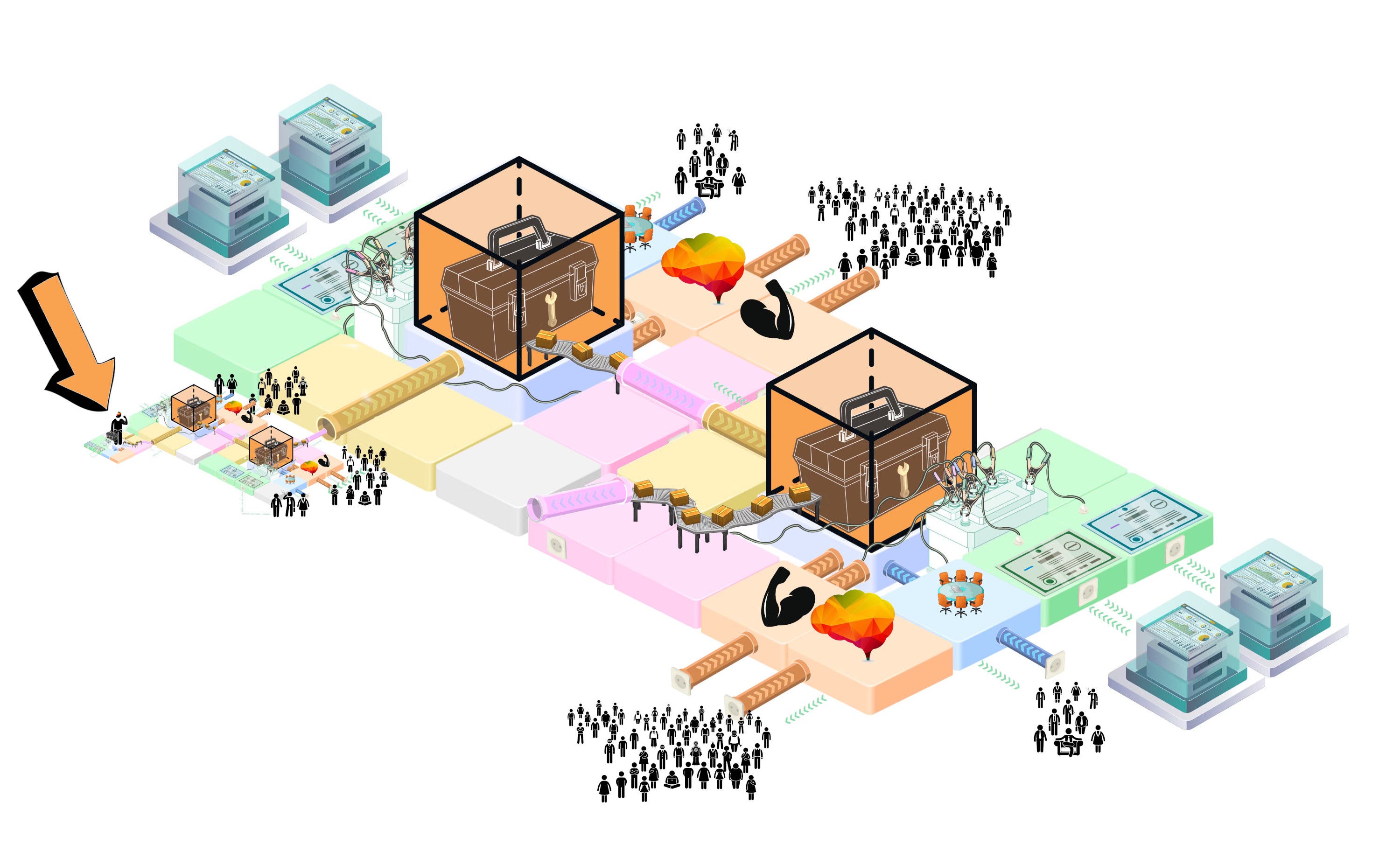
6: Entangled masses of corporations, SMEs and individuals
In the ‘economy’ above, there are two large firms, two small firms and one self-employed person, but we can use this as the basis for imagining far more complex arrangements.
Let’s move to a picture in which fifteen firms, along with their respective workers and managers, get entangled (I’m going to leave self-employed people out right now for simplicity). Both the workers and managers can use their wages and salaries to obtain goods and services from other companies, but also to invest into those companies as financiers (for example, perhaps a worker puts some of their income into a pension fund that invests in company shares). I’m only going to represent a small number of these possible interactions.
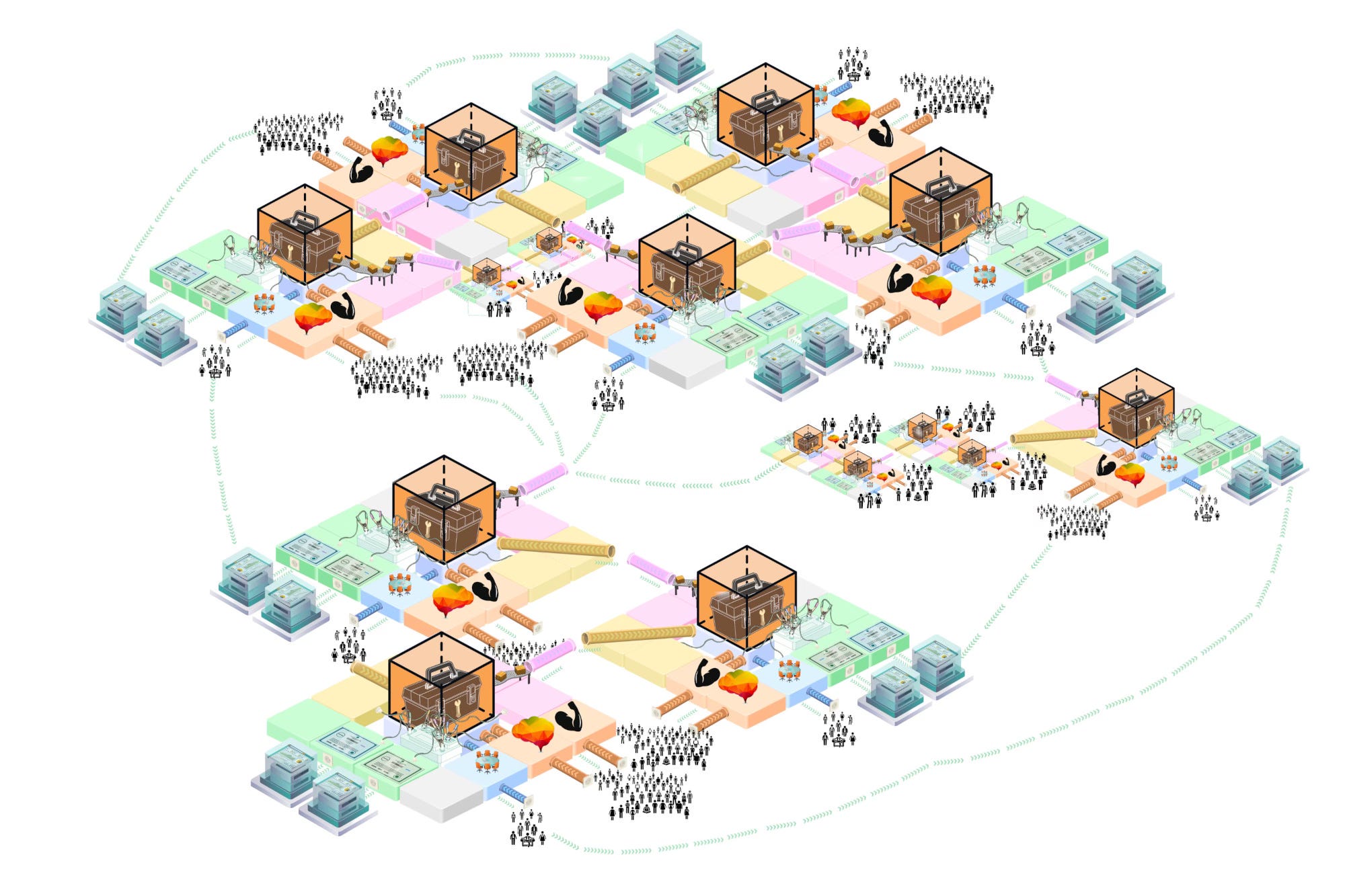
Even with only fifteen firms and a few hundred people, the possible number of different connections between the players is incredibly complex. In the image above, legal entities connect with other legal entities, but they also connect with people, while - in the more peer-to-peer economy - we can imagine those people forming connections with other people. For example, one of those company workers above might moonlight as a self-employed musician, playing as a busker for others on the weekend.
For the sake of simplicity, I’m going to stop at fifteen firms, but - if you want a more accurate picture of a modern economy - you can expand this interconnected web in your imagination to fifteen thousand firms and hundreds of millions of individuals. Imagine it extending into the horizon with countless more connections than I’m showing here. There is no beginning or end to the connections, because they double-back into each other.
7: Arranging the components into sectors and classes
I’m now going to show you how to go from this picture of entanglement into a ‘macro-economic’ picture of capitalism in which it is imagined as a series of interacting ‘sectors’ and ‘classes’.
Let’s start by pulling apart every company in the image above into their constituent components. The parts have always been modular from the beginning, so we can imagine doing this while they retain the ability to connect with each other.
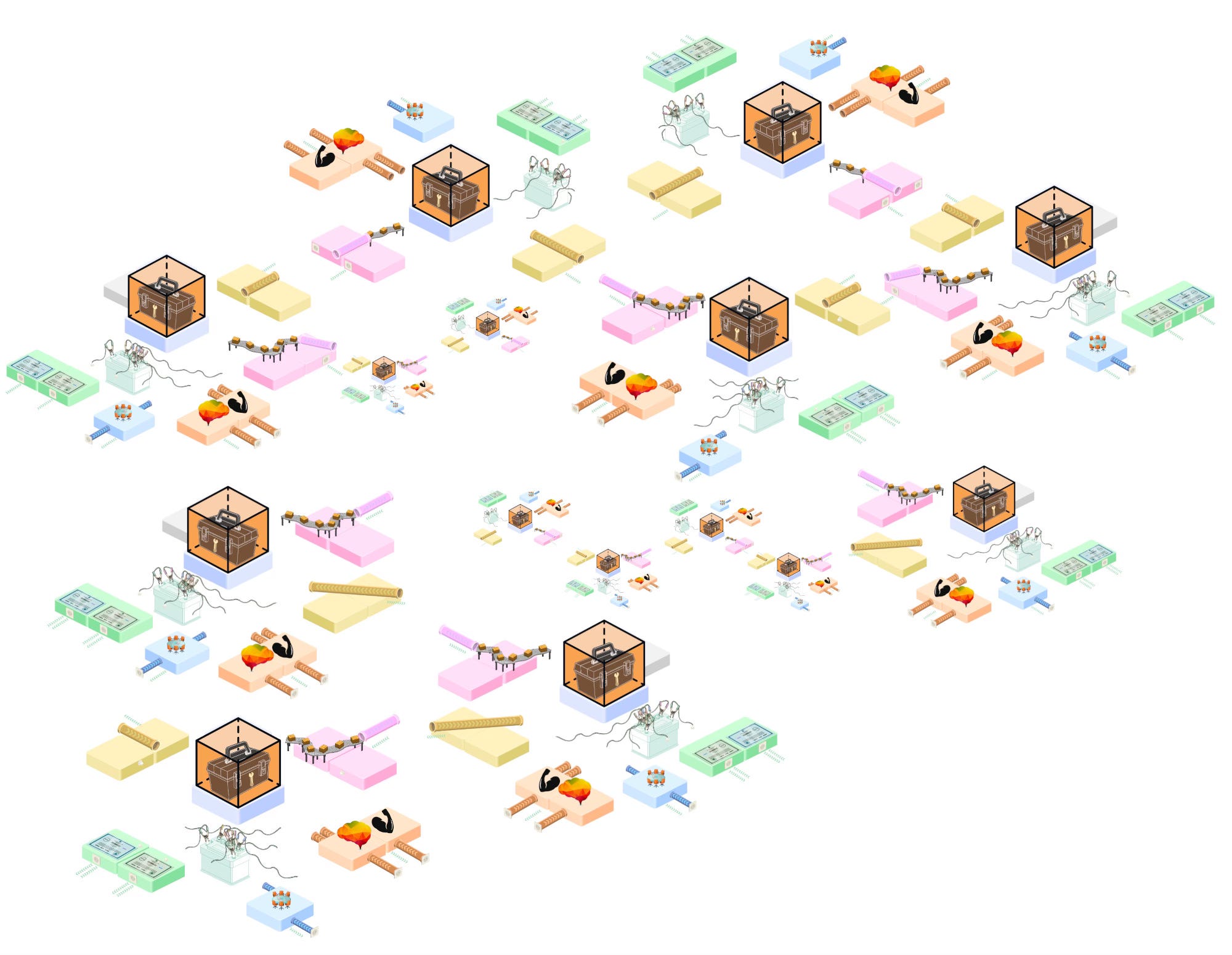
We can now stack the components into common piles.
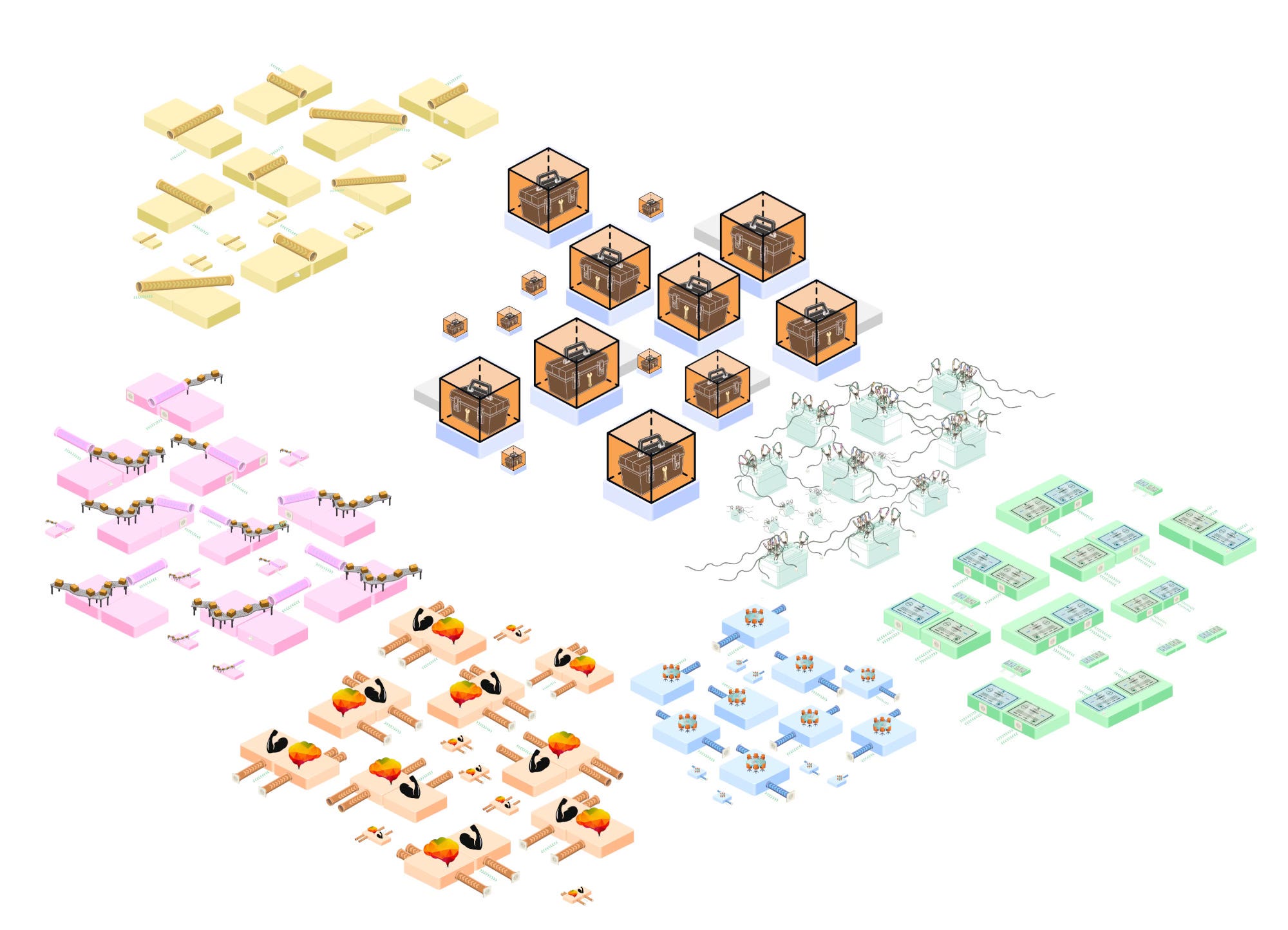
We can then neaten those piles up into a macro-economic picture of capitalism as a whole, showing the broad classes of action you can engage in, and the different positions you might occupy at different times. As with the picture of the corporation, I’m essentializing these positions, imagining them as discrete from each other, but of course there are gradients within them, and hybrids between them, and people can take on more than one position at once.
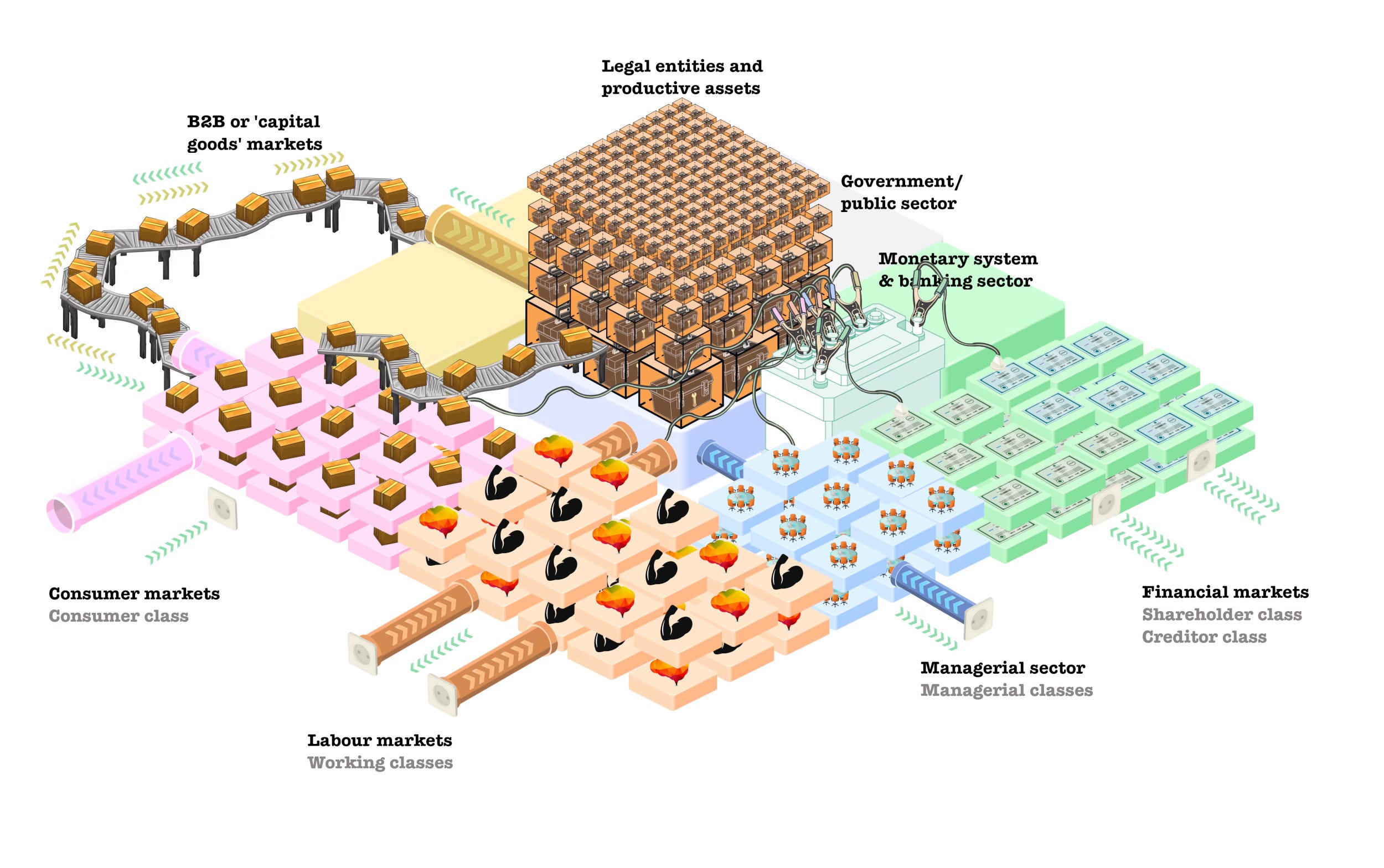
Let’s go through it.
In the middle there is a pile of societal assets. This is everything in society used to make stuff. They are owned - in different concentrations - by shareholders, while creditors have a residual claim upon them as co-financiers of this pile (for more on this relationship between the two forms of financier, see here).
Then we have the battery. In this macro context, the battery no longer represents a single bank account. Rather, it now represents the entire banking sector and monetary system. In Part 2 I will expand upon that and also bring in central banks, thereby connecting the monetary system to the government sector.
Around the asset pile and monetary system, we then have managerial classes managing working classes who are operating the collective asset pile. To the left we have a giant pile of societal goods that are being outputted by the societal assets.
Those goods have two paths they can travel. They can either be outputted to consumer classes, or they can be re-inputted back into the asset pile to build it up. Note that in this macro-economic image, there is no ‘supplier class’, because suppliers are just interlocking firms, so all their components are already incorporated into the financial, managerial and labour piles. So, at this macroeconomic scale, all we have is the societal asset pile being used to output either consumer goods, or ‘capital goods’ - stuff that is ploughed back into the asset pile to augment, upgrade or build it up.
Let’s focus in on that last point, because it’s crucial for understanding the nature of capitalism. Every asset in the societal asset pile is the outcome of previous production, and previous production always entails labour as its most essential component.
For example, in the 19th century, all factories would have been part of the overall societal asset pile, but every component in those factories had to be previously manufactured by other firms with an earlier generation of workers using an earlier societal asset pile.
There is, in other words, no ‘immaculate conception’ of assets (unless we’re talking about the underlying ecological systems we use, such as soil tended to by earthworms and plants that grow without our input). From a primal perspective, then, financiers and managers are secondary to labour, even if they, as classes, have higher power in the overall economy. In other words, without the labour there would be no assets to own or manage.
Classes are positions in an economy, and a person can shift from one to another, while the power structure between those classes remains intact. It’s true that in our old 19th century example, you might have found relatively discrete boundaries between people who were factory owners and factory workers, but in modern economies these lines can blur (see the Inner Civil War). Learning to see that is very important if, for example, you wish to be able to deconstruct the mythologies surrounding billionaires.
For example, in the very early phases of Amazon in 1994, Jeff Bezos appeared more like a ‘self-employed’ person. He owned the company, but he then employed himself as a worker, using his physical, mental and emotional labour to contribute to an early version of the assets the company came to own. At that time, a substantial part of this income could be attributed to actual work, but as time went on, he left that role and slipped ever more into the position of shareholder. Nowadays, almost all his wealth comes not from work, but from ownership of assets that other people build and operate. He, and all other billionaires, rely entirely upon the labour of tens of thousands of engineers and frontline workers, without whom no returns would accumulate to the asset owners. Every day those workers both build and operate the much vaster versions of the assets, which now bear almost no resemblance to the originals versions hacked together by the worker version of Jeff in 1994.
This process, in which a class of people grow extremely powerful and wealthy through ownership of assets is at the core of what we call capitalism. It is not called workism or tradeism, because it is a process in which a person capitalises upon wealth to secure ownership of societal assets, shifting ever more into the position of a shareholder who will claim returns from the work of others. This is always a secondary position - because without the labour input, the process ceases to operate - but it is a self-reinforcing position, because the accumulation of money allows capitalists to steer labour power to their advantage within a system tied together by money.
At the level of an individual firm, this either takes the form of bosses buying the outputs of labour via suppliers and inputting it into their toolbox, or it can take the form of them directing their own labour force to bolster that toolbox. At a macro scale, though, we can simplify this by saying that the capitalist class as a whole directs the different layers of the working classes as a whole to build assets and then operate them, and to then claim the residual returns from that. At a macro-scale, an ownership class is essentially renting out an asset pile to the very classes that both built and operate it.
This ownership class ends up not only with much higher ability to claim goods outputted by the asset pile - to consume - but also with power to decide if goods should be re-inputted back into it to shift the direction and shape of our subsequent economy. For example, if Elon decides he wishes to steer societal labour power to build datacentres in space in order to power AI systems that other managers will buy in order to shed their own labour forces, he has the power to do that. He could also direct it to build vast useless statues in the desert, or whatever. While doing that, he will make constant appeals to his personal hard work to justify why he has ended up with this power, rather than highlighting his self-reinforcing structural position (to learn how to deconstruct this, see The Stone Soup Theory of Billionaires).
So, that’s capitalism. There are classes of people who own the asset pile, classes of people who manage it, and classes of people who do the building and operating of it, and each is obtaining different slices of the income that comes from outputting the resultant goods from the asset pile to consumers, who are just people who are earning income from either being a worker, a manager or a financier.
I wish to reiterate at this point that many people in society can occupy multiple class positions at the same time in this setup, so there is not always a clear boundary between those who are working and those who are extracting rent, but at a conceptual level we can split income into returns to labour, returns to management, and returns to capital (rent), and then we can split spending into spending on consumption and spending on capital goods, and then split those into different tiers, such as rich financiers spending on luxury goods, or poor workers buying stuff outputted by the dollar store.
Coming up in Part 2: The monetary and financial system
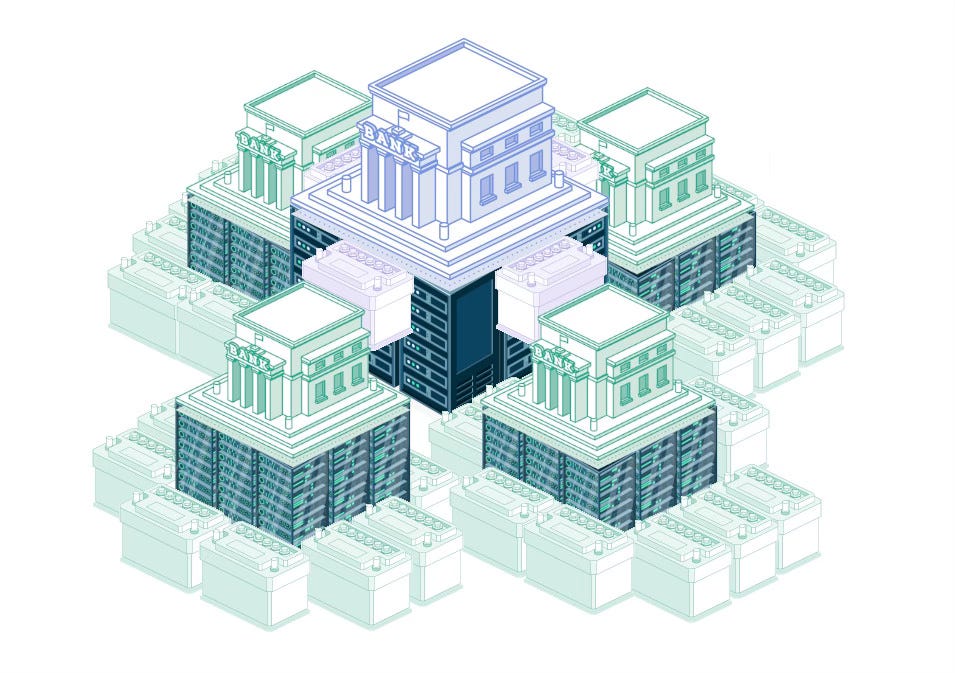
The primary purpose of the visualisations in sections 1-7 above has been to show the relations of production in a capitalist system, the way the different parts and classes interact. But, I’ve heavily glossed over the monetary system, which has its own unique classes of player. After all, both rich and poor alike use the same monetary system, and neither a billionaire nor an impoverished beggar are money issuers like central banks or commercial banks are.
So, in Part 2 - to be released in a few days - I will introduce three final sections for paying subscribers, in which I’ll introduce visualisations of the banking sector, financial system and monetary system, and then fuse those with the images of capitalism to create a hybrid picture of capitalism in the context of modern money and finance.
If you’re a free subscriber, I really hope you’ll consider upgrading to get access to that. If not, I really hope you found this article useful. Please do consider sharing it or giving it a like! It really helps me. I’d also love to hear your comments and questions.
Very clever. Now animate it please.
I wonder if there's a second visualization that complements this one. These layers explain how claims on value become increasingly abstract. But they don't show how value actually reaches people. Distribution isn't another layer of capitalism, it's the infrastructure that allows every layer to function. Roads, merchants, agent networks, logistics, and trusted local intermediaries are what reconnect financial abstractions to the physical economy.
That's why in many emerging markets, the bottleneck isn't capital or payments; it's distribution. We spend a lot of time mapping capital, but not enough mapping how it moves 👣